
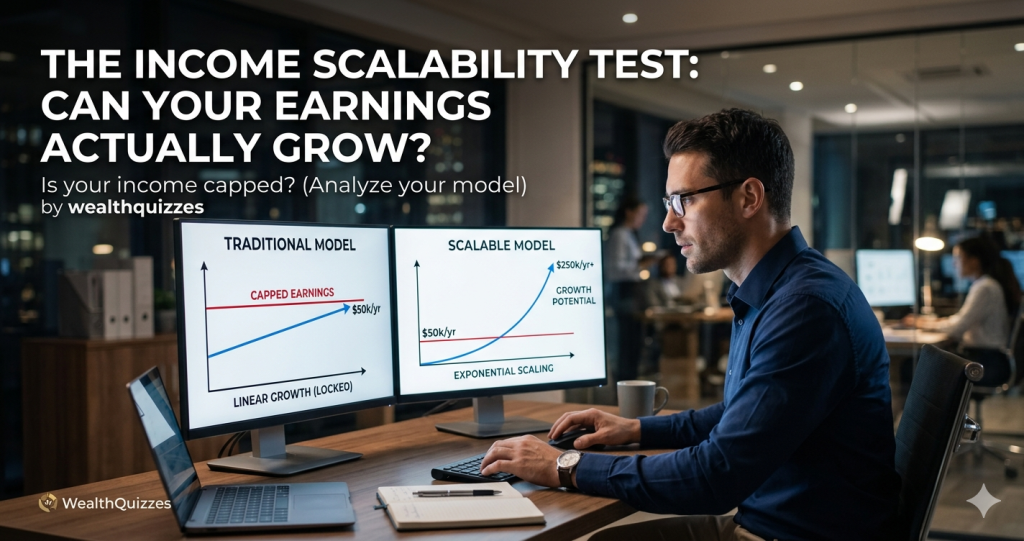
The Income Scalability Test: Can Your Earnings Actually Grow?
Why Some Income Models Keep People Busy—but Financially Stuck
Introduction: The Hidden Ceiling Most People Never Notice
Many people work harder every year yet experience only limited financial progress.
They:
- Take on more work
- Extend working hours
- Increase effort
- Chase additional clients
- Add side hustles
Yet despite all this activity, income growth eventually slows down—or completely stalls.
Why?
Because not all income models are designed to:
Scale.
This is one of the most important but least understood concepts in wealth creation.
Some earning systems naturally allow:
- Expansion
- Multiplication
- Exponential growth
Others remain permanently tied to:
- Time
- Physical labor
- Limited capacity
This creates what can be called:
The Income Scalability Problem.
Many people are not financially stagnant because:
- They lack skill
Or: - They lack ambition
They are stagnant because:
Their income model has structural limitations.
This is why understanding:
The Income Scalability Test
is essential for long-term financial growth.
The Core Truth
Core Idea: Some income models cannot scale
Angle: Scalability analysis
Not every income stream has the ability to:
- Grow significantly over time.
What Is Income Scalability?
Income scalability refers to:
The ability of an earning system to increase revenue without requiring equivalent increases in time, labor, or operational strain.
A scalable income model allows:
- Revenue growth
Without: - Proportional exhaustion.
Example:
If doubling income requires:
- Doubling working hours
The model has:
- Low scalability.
Conversely:
If income can grow through:
- Systems
- Technology
- Delegation
- Automation
- Replication
Then scalability becomes much stronger.
Why Scalability Matters
Without scalability:
- Financial growth eventually hits a ceiling.
Human beings have:
- Limited hours
- Limited energy
- Limited productive capacity
Therefore:
Income models entirely dependent on:
- Personal labor
Usually face natural limitations.
Insight from Authority
As Naval Ravikant famously explained:
“You’re never going to get rich renting out your time.”
This statement highlights a critical financial reality:
Time-based income has scaling limitations.
The Difference Between Linear and Scalable Income
Linear Income
Linear income grows proportionally with:
- Time
- Effort
- Labor input
Examples include:
- Salaries
- Hourly wages
- Freelance hourly work
- Manual labor
In linear systems:
Income increases usually require:
- More working time.
Scalable Income
Scalable income grows through:
- Systems
- Assets
- Replication
- Technology
- Distribution leverage
Examples include:
- Businesses
- Digital products
- Royalties
- Investments
- Subscription platforms
- Intellectual property systems
In scalable systems:
Income can increase without:
- Equivalent increases in labor.
The Scalability Ceiling
Every income model has:
- A scalability ceiling.
The key question is:
How high is that ceiling?
Example:
A professional charging hourly fees eventually encounters:
- Time limitations.
Even if rates increase:
- Hours remain finite.
Meanwhile:
A scalable digital system may serve:
- Thousands of customers simultaneously.
This dramatically changes:
- Income potential.
Insight from Authority
As Robert Kiyosaki emphasized:
The wealthy build systems that work for them instead of depending entirely on personal labor.
The Four Major Income Models
1. Labor-Based Income
This includes:
- Salaries
- Consulting
- Freelancing
- Skilled services
Strengths:
- Stability
- Fast income generation
Weaknesses:
- Time dependency
- Burnout risk
- Limited scaling capacity
2. Business-Based Income
Businesses scale through:
- Teams
- Systems
- Customers
- Processes
Strong businesses can expand revenue without:
- Founder dependence increasing proportionally.
3. Asset-Based Income
Assets generate:
- Cash flow
- Appreciation
- Compounding returns
Examples include:
- Investments
- Real estate
- Royalties
- Equity ownership
Asset systems often provide:
- Higher scalability potential.

4. Digital and Intellectual Property Income
Technology allows:
- Massive distribution with low replication cost.
Examples include:
- Online courses
- Software
- Content monetization
- E-books
- Membership platforms
Digital leverage significantly increases:
- Scalability potential.
The Nigerian Context: Why Scalability Matters
Nigeria’s economic realities include:
- Inflation
- Income instability
- Employment uncertainty
- Rising living costs
In such environments:
Purely labor-based income may become increasingly vulnerable.
Many Nigerians are now exploring:
- Digital businesses
- Remote work
- Content creation
- Technology-enabled income systems
- Entrepreneurship
Why?
Because scalable systems create:
- Greater financial flexibility.
However:
Many people still operate entirely within:
- Time-for-money structures.
The Burnout Trap
One major sign of poor scalability is:
- Exhaustion without proportional financial growth.
Many people constantly:
- Add more work
- Extend working hours
- Take multiple side hustles
Yet remain financially overwhelmed.
Why?
Because:
More effort alone does not guarantee scalable growth.
Insight from Authority
As Tim Ferriss explains:
Focus should shift from working more to designing systems that produce more.
The Scalability Test
To evaluate whether your income can scale, ask:
1. Is income directly tied to my time?
If:
- Work stops
And: - Income stops immediately
Scalability may be weak.
2. Can revenue increase without equal increases in labor?
Strong scalability allows:
- Multiplication without exhaustion.
3. Can the system operate beyond me personally?
If everything depends entirely on:
- Your constant presence
Scaling becomes difficult.
4. Is technology or automation involved?
Technology often increases:
- Distribution
- Efficiency
- Reach
5. Can the system serve multiple people simultaneously?
Scalable systems often:
- Expand customer reach efficiently.
The Leverage Principle
Scalability depends heavily on:
Leverage.
Leverage may include:
- Technology
- Media
- Teams
- Capital
- Systems
- Automation
Wealthy individuals often prioritize:
- Leverage creation.
Why?
Because leverage allows:
- Greater output from the same effort.
Insight from Authority
Investor Charlie Munger repeatedly emphasized the importance of scalable systems and compounding structures in wealth creation.
The Productivity Illusion
Many people mistakenly believe:
- Being busy equals financial progress.
However:
Busyness and scalability are not the same thing.
A person may remain:
- Extremely busy
Yet: - Financially capped.
Scalability requires:
- Structural efficiency.
The Psychological Shift
Many individuals struggle to scale income because they are deeply conditioned to:
- Trade time for money.
This mindset creates:
- Income dependency on constant labor.
Wealth builders gradually shift toward:
- System creation
- Asset ownership
- Leverage utilization
The Identity Shift
To scale income effectively, you must move from:
- “How can I work more?”
To:
“How can I build systems that grow beyond my direct labor?”
The Real Transformation
Scalable income systems create:
- Greater financial flexibility
- Reduced labor dependency
- Higher long-term growth potential
- Better wealth-building capacity
Eventually:
Financial growth becomes:
- More efficient
Rather than: - Purely effort-driven.
The Hard Truth
Many people are not financially limited because:
- They lack income.
They are limited because:
Their income model is structurally capped.
Conclusion: Wealth Requires Scalable Structures
Hard work matters.
Skill matters.
Discipline matters.
But long-term financial expansion often depends on:
Scalability.
Because there comes a point where:
- Human effort alone cannot produce significant wealth expansion.
The financially successful increasingly focus on:
- Systems
- Assets
- Leverage
- Replication
- Automation
Because in wealth creation:
Structure determines growth capacity.
Final Thought
Ask yourself honestly:
“Is my income capable of growing—or is it permanently tied to my time?”
Because true financial expansion begins when:
Your earnings stop depending entirely on how many hours you can work.
👉 Is your income capped? Find out on WealthQuizzes