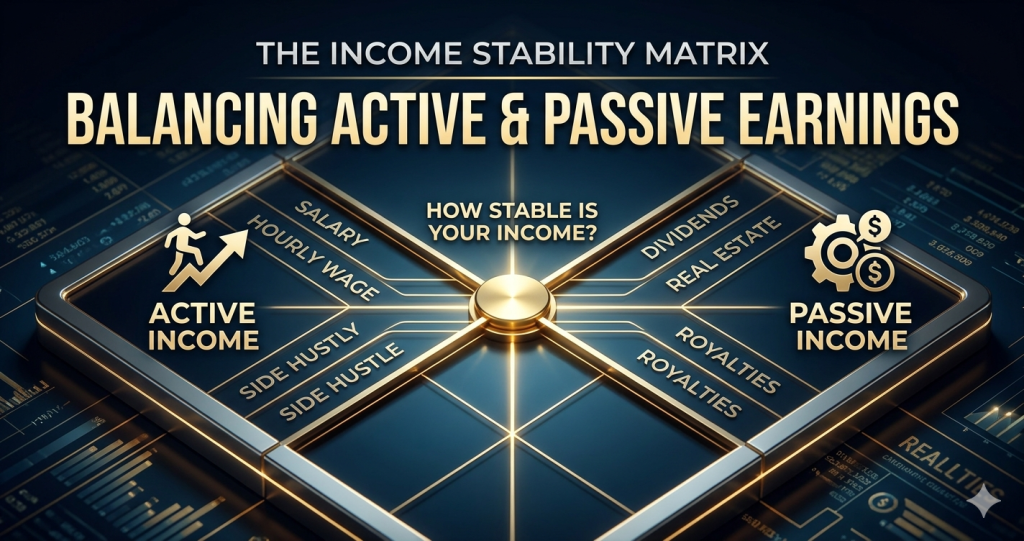
The Income Stability Matrix: Balancing Active and Passive Earnings
Why Financial Stability Depends on Structure—Not Just How Much You Earn
Introduction: The Fragility of Single-Source Income
Many people believe financial stability comes from:
- A high salary
- A successful business
- A steady monthly income
But history repeatedly shows that:
Income alone does not guarantee stability.
Jobs can disappear.
Businesses can slow down.
Economic conditions can change suddenly.
One of the biggest financial risks in modern life is:
Dependence on a single source of income.
This is why financially resilient individuals and families rarely rely on only one stream of earnings.
Instead, they build:
A structured balance between active and passive income.
The Core Truth
Core Idea: Stability comes from balance
Mindset Shift: One source → Structured mix
True financial security is not built on income size alone.
It is built on:
- Income structure
- Diversification
- Risk management
What Is the Income Stability Matrix?
The Income Stability Matrix is:
A framework for balancing different income sources to reduce financial vulnerability and increase long-term stability.
The goal is not simply:
- To earn more
But:
To create a stable and resilient income ecosystem.
Understanding the Two Major Income Categories
1. Active Income
Active income requires:
- Direct time
- Labor
- Continuous effort
Examples:
- Salaries
- Freelancing
- Consulting
- Hourly work
- Physical business operations
Key Characteristic:
Income stops if work stops.
2. Passive Income
Passive income is generated through:
- Assets
- Systems
- Investments
That continue producing earnings with reduced ongoing effort.
Examples:
- Dividends
- Rental income
- Royalties
- Digital products
- Automated businesses
- Investment returns
Key Characteristic:
Earnings continue beyond immediate labor.
The Problem With Depending Solely on Active Income
Active income creates:
- Stability in the short term
But:
- Vulnerability in the long term
Why?
Because:
- Human energy has limits
- Time is finite
- Economic disruptions happen
Example:
If:
- A job is lost
Or: - Business activity slows
Then:
- Income may collapse instantly.
Insight from Authority
As Robert Kiyosaki argues:
Wealthy individuals focus on building assets that generate income independent of their daily labor.
The Danger of Passive-Income Misunderstanding
However, passive income is often misunderstood.
Many people believe:
- Passive income means “easy money.”
This is inaccurate.
The Reality:
Most passive income streams require:
- Initial effort
- Capital
- Systems
- Patience
Passive income is usually:
Delayed reward from structured effort.
Why Balance Matters
The strongest financial structure combines:
- Reliable active income
With: - Growing passive income systems
This creates:
- Stability
- Flexibility
- Long-term wealth potential
The Income Stability Matrix
The matrix can be understood through four stages.
Stage 1: Single Active Income Dependence
Characteristics:
- One salary or business source
- No backup income
- High vulnerability
Risk Level:
Very high.
Stage 2: Multiple Active Incomes
Characteristics:
- Side hustles
- Freelancing
- Additional labor-based earnings
Advantage:
More income sources.
Problem:
Still dependent on time and energy.
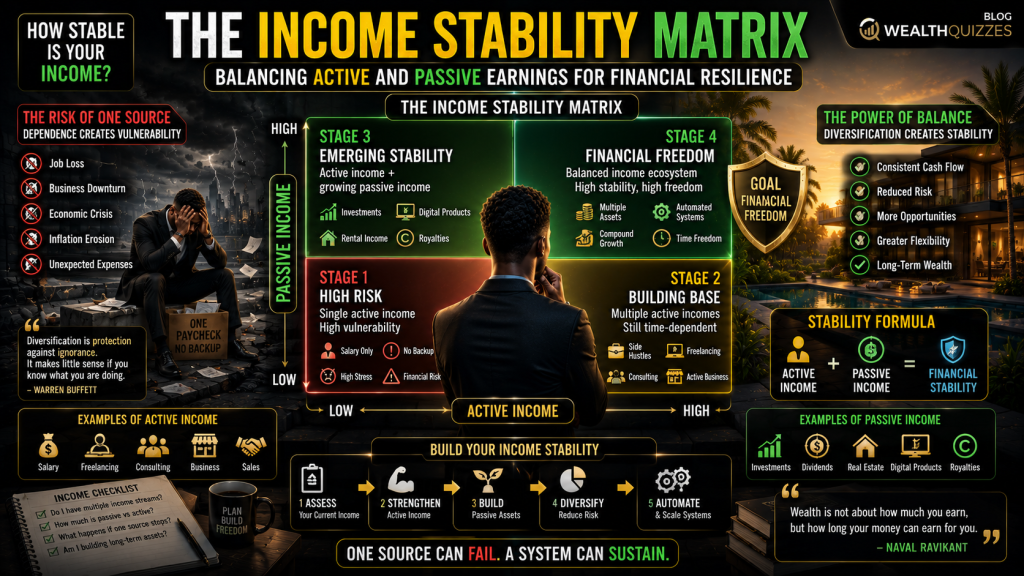
Stage 3: Active + Emerging Passive Income
Characteristics:
- Investments begin
- Small assets produce returns
- Systems start forming
Result:
- Improved stability
- Reduced dependence on labor
Stage 4: Structured Income Ecosystem
Characteristics:
- Balanced active and passive earnings
- Diversified income structure
- Asset-driven stability
Result:
Financial resilience and scalability.
The Nigerian Context: Why Income Stability Matters More Than Ever
Nigeria’s economic environment includes:
- Inflation
- Currency instability
- Employment uncertainty
- Market fluctuations
This makes income diversification essential.
Relying entirely on:
- Salary income
Or: - One business stream
Can become dangerous during economic shocks.
Those with diversified income structures are better positioned to:
- Absorb disruptions
- Maintain cash flow
- Continue investing during difficult periods
Insight from Authority
As Nassim Nicholas Taleb emphasizes:
Systems become stronger when they reduce dependence on single points of failure.
The Psychology of Income Stability
Income stability is not only financial.
It is psychological.
Why?
Because unstable income creates:
- Anxiety
- Reactive decision-making
- Financial stress
Stable income structures create:
- Confidence
- Strategic thinking
- Better financial decisions
The Balance Mistake
Some people:
- Chase passive income obsessively
- While neglecting active income growth
Others:
- Focus only on active income
- While ignoring long-term asset building
Both extremes are risky.
The goal is:
Balance.
Active Income Funds Passive Systems
In most cases:
- Active income is the engine that builds passive income assets.
Example:
Salary or business profits may fund:
- Investments
- Real estate
- Digital assets
- Equity positions
Over time:
Passive systems gradually reduce:
- Dependence on labor
The Role of Risk Management
The Income Stability Matrix is fundamentally about:
Risk reduction.
Diversification protects against:
- Economic downturns
- Industry disruptions
- Job loss
- Market instability
Insight from Authority
As Warren Buffett famously noted:
“Never depend on a single income. Make investment to create a second source.”
Building Your Income Stability Matrix
Step 1: Audit Your Current Income Sources
Ask:
- How many income streams do I truly have?
- Are they all labor-dependent?
Step 2: Strengthen Active Income
Improve:
- Skills
- Productivity
- Market value
Step 3: Build Passive Assets Gradually
Start with:
- Investments
- Digital products
- Dividend assets
- Scalable systems
Step 4: Reduce Single-Point Dependence
Avoid:
- Financial overreliance on one source
Step 5: Reinvest Strategically
Use active income to:
- Build long-term income-producing assets
The Identity Shift
To build lasting income stability, you must move from:
- “I earn money from work”
To:
“I build structured systems that generate income from multiple channels.”
The Real Transformation
Financial growth changes when:
- Income becomes diversified
- Systems replace fragility
- Assets support stability
You move from:
- Survival-based earning
To:
Resilient financial architecture
The Hard Truth
Many people are one disruption away from financial instability not because:
- They lack income
But because:
Their income structure lacks balance.
Conclusion: Stability Is Strategic
The strongest financial position is not necessarily:
- The highest income
It is:
The most stable and diversified structure.
Wealth is not built merely by earning more.
It is built by:
- Balancing income types
- Reducing dependency
- Creating resilient systems
Final Thought
Ask yourself honestly:
“If one income source disappeared today, how financially stable would I remain?”
Because true financial confidence does not come from one paycheck—
It comes from:
A structured income system designed for resilience.
👉 How stable is your income? Find out on WealthQuizzes