The Invisible Wealth Killers: Inflation, Taxes, and Lifestyle Drift
How Silent Financial Forces Slowly Destroy Wealth Without Most People Realizing It
Introduction: The Financial Threats Most People Never Notice
When people think about losing money, they often imagine:
- Business failure
- Job loss
- Bad investments
- Economic crises
But in reality, some of the greatest threats to wealth are not dramatic at all.
They are:
- Slow
- Quiet
- Invisible
These forces gradually erode purchasing power, destroy savings, and weaken long-term financial growth without creating immediate alarm.
Most people do not lose wealth overnight.
They lose it silently through:
- Inflation
- Taxes
- Lifestyle drift
The danger is not merely that these forces exist.
The real danger is that:
Most people underestimate their long-term impact.
Over time, these invisible wealth killers can quietly consume years of financial progress.
The Core Truth
Core Idea: Silent forces destroy wealth slowly
Angle: Hidden financial erosion
Financial decline is often not caused by one catastrophic mistake.
It is usually caused by:
Small, repeated forms of financial erosion over long periods of time.
The Nature of Invisible Wealth Killers
Invisible wealth killers are dangerous because they:
- Operate gradually
- Feel normal
- Often go unnoticed
Unlike sudden financial disasters, these forces:
- Do not trigger panic immediately
- Rarely receive enough attention
- Accumulate quietly over decades
The Three Major Invisible Wealth Killers
The most common and destructive are:
- Inflation
- Taxes
- Lifestyle drift
Together, they create a powerful system of wealth erosion.
1. Inflation: The Silent Destroyer of Purchasing Power
Inflation is one of the most misunderstood financial forces.
At its core:
Inflation reduces the purchasing power of money over time.
In simple terms:
The same amount of money buys:
- Less in the future than it buys today.
Example:
A product costing:
- ₦10,000 today
May cost:
- ₦15,000 or more in the future
Even if your money remains numerically the same.
The Hidden Danger
Many people believe they are financially stable because:
- Their account balance remains unchanged
But if inflation rises faster than:
- Their income
Or: - Their investment growth
Then:
They are effectively becoming poorer.
Insight from Authority
Economist Milton Friedman described inflation as:
“Taxation without legislation.”
This is because inflation silently reduces real value without direct visibility.
Why Inflation Hurts Savers
Money sitting idle loses value gradually.
Example:
If inflation averages:
- 10% annually
Then money earning:
- 2% interest
Is actually losing purchasing power.
This is why:
Wealth builders focus not merely on saving money—
But on:
Growing money faster than inflation.
The Nigerian Context
Inflation has especially significant effects in Nigeria due to:
- Currency volatility
- Rising living costs
- Economic instability
This means:
People who fail to invest strategically may experience:
- Long-term wealth erosion even while earning income consistently.
2. Taxes: The Wealth Reduction System Most People Ignore
Taxes are necessary components of modern economies.
However:
- Poor tax awareness can severely reduce wealth accumulation.
Taxes affect:
- Salaries
- Businesses
- Investments
- Property
- Consumption
The problem is not taxation itself.
The problem is:
Lack of strategic financial planning around taxes.
Insight from Authority
As Warren Buffett has repeatedly emphasized:
It’s not what you earn. It’s what you keep.
Wealth builders understand:
Net returns matter more than gross income.
Example:
Two individuals may earn identical income.
But the person with:
- Better financial structure
- Better investment efficiency
- Better tax planning
May retain significantly more wealth over time.
The Compounding Impact of Taxes
Taxes become especially powerful because:
They compound over time.
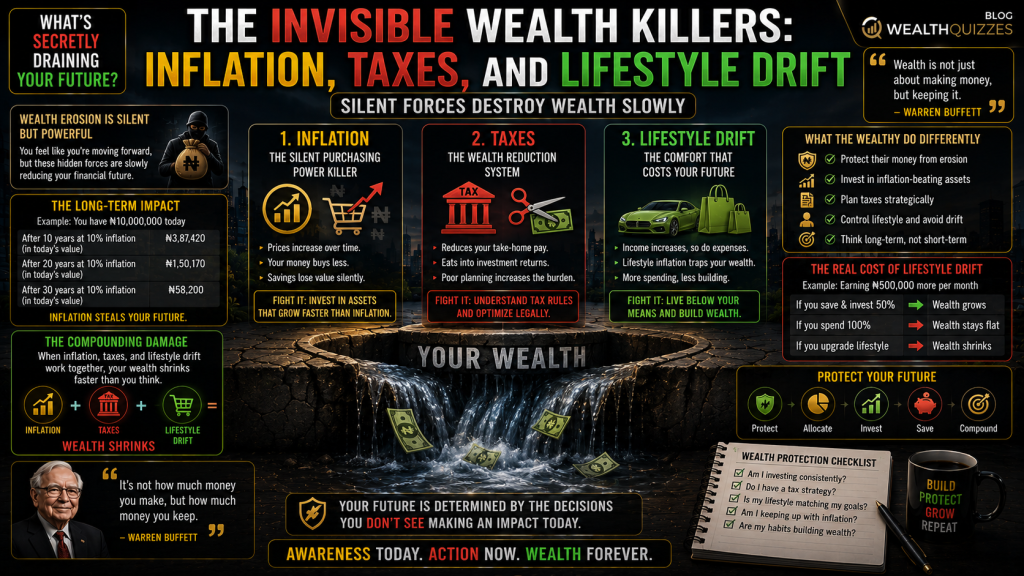
Small yearly reductions may appear insignificant initially.
But across:
- 10 years
- 20 years
- 30 years
The effect becomes substantial.
Wealthy individuals often focus heavily on:
- Efficiency
- Preservation
- Long-term optimization
Not merely:
- Income generation.
3. Lifestyle Drift: The Wealth Killer That Feels Like Success
Lifestyle drift—also known as lifestyle inflation—is one of the most psychologically dangerous financial patterns.
It occurs when:
Increased income automatically leads to:
- Increased spending
Example:
- Bigger salary
→ Bigger apartment
→ More expensive car
→ More luxury spending
→ Higher social expectations
The result:
Despite earning more:
- Financial freedom never improves.
Why Lifestyle Drift Is Dangerous
Lifestyle drift creates:
- Permanent expense expansion
This means:
Future income becomes increasingly committed to:
- Maintenance of lifestyle rather than wealth creation.
Insight from Authority
As Morgan Housel explains:
Spending money to show people how much money you have is the fastest way to have less money.
The Illusion of Progress
Many people confuse:
- Higher consumption
With:
- Financial growth
But wealth is not measured primarily by:
- Visible lifestyle
True wealth is often:
- Invisible assets
- Investments
- Ownership
- Financial flexibility
Lifestyle Drift and Social Pressure
Social media intensifies lifestyle drift by encouraging:
- Constant comparison
- Status signaling
- Consumption culture
People begin spending not based on:
- Need
But based on:
- Perception
- Validation
- Social pressure
Result:
Financial growth slows dramatically.
The Combined Effect of the Three Wealth Killers
These forces become extremely dangerous when combined.
Example:
A person may:
- Earn more money
But simultaneously experience:
- Inflation reducing purchasing power
- Taxes reducing retained income
- Lifestyle drift increasing expenses
Outcome:
Despite higher earnings:
- Wealth accumulation remains weak.
The Psychology Behind Invisible Wealth Loss
Invisible wealth killers succeed because:
- Humans respond more strongly to immediate gratification than long-term consequences.
Behavioral economists call this:
Present bias.
People prioritize:
- Immediate comfort
Over: - Future financial positioning.
Insight from Authority
As Daniel Kahneman demonstrated through behavioral economics research:
Human decision-making is often irrational, especially regarding long-term outcomes.
Protecting Yourself Against Wealth Erosion
Step 1: Build Inflation-Resistant Assets
Focus on:
- Investments
- Businesses
- Productive assets
- Scalable income systems
Step 2: Improve Financial Efficiency
Understand:
- Tax structures
- Financial planning
- Capital allocation
Step 3: Control Lifestyle Expansion
Avoid increasing expenses automatically every time income rises.
Step 4: Prioritize Wealth Building Over Status Spending
Focus on:
- Ownership
Rather than: - Appearance
Step 5: Think Long-Term
Every financial decision should be evaluated based on:
- Long-term consequences
Not merely: - Short-term comfort
The Identity Shift
To escape invisible wealth destruction, you must move from:
- “I earn and spend”
To:
“I protect, preserve, and compound capital strategically.”
The Real Transformation
Financial intelligence is not merely about:
- Making money
It is about:
- Preventing silent financial erosion
Wealth grows not only through:
- Income creation
But through:
- Preservation and strategic allocation.
The Hard Truth
Many people are working harder every year yet building very little real wealth because:
Invisible financial forces are quietly draining their progress.
Conclusion: Wealth Loss Is Often Silent
The greatest threats to wealth are not always obvious.
They are often:
- Gradual
- Normalized
- Hidden inside everyday financial behavior
Inflation slowly reduces purchasing power.
Taxes reduce retained growth.
Lifestyle drift converts increased income into increased obligations.
Together, they create:
A silent system of financial erosion.
The people who build lasting wealth are usually not merely the highest earners.
They are:
The people who learn to recognize and neutralize invisible wealth killers before they compound.
Final Thought
Ask yourself honestly:
“What invisible forces are quietly draining my financial future?”
Because wealth is not lost only through major mistakes—
It is often lost through:
Small financial leaks repeated consistently over time.
👉 What’s secretly draining your future? Find out on WealthQuizzes