

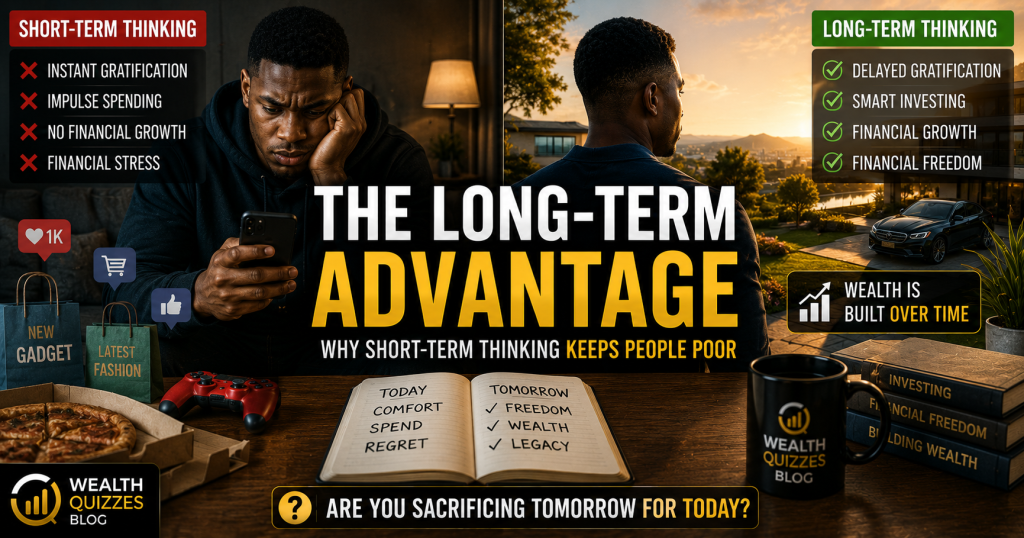
The Long-Term Advantage: Why Short-Term Thinking Keeps People Poor
How Delayed Rewards Create Extraordinary Financial Outcomes
Introduction: The Battle Between Today and Tomorrow
Every financial decision ultimately involves a choice between:
- Immediate gratification
or - Future benefit
This conflict shapes nearly every aspect of personal finance.
Should you:
- Spend or invest?
- Consume or build?
- Upgrade your lifestyle or increase your assets?
- Focus on short-term comfort or long-term freedom?
The answers to these questions often determine whether a person remains trapped in financial survival mode or gradually builds lasting wealth.
One of the most important truths in wealth creation is this:
Wealth rewards long-term thinking.
Unfortunately, modern society encourages the exact opposite.
Technology, advertising, social media, consumer culture, and even many financial products are designed to emphasize:
- Immediate satisfaction
- Instant results
- Fast rewards
As a result, many people unconsciously develop:
Short financial time horizons.
They make decisions based on:
- This week
- This month
- This year
Rather than:
- The next decade
This creates one of the greatest obstacles to wealth-building:
Short-term thinking.
Understanding the Long-Term Advantage may be one of the most valuable financial lessons anyone can learn.
The Core Truth
Core Idea: Wealth rewards long horizons
Angle: Delayed payoff systems
Long-term thinking allows compounding systems to work.
Short-term thinking often destroys them before they mature.
Why Wealth Is a Time-Based Process
Many people assume wealth is primarily about:
- Income
- Education
- Opportunity
While these factors matter, there is another factor that is often overlooked:
Time.
Time is the force that allows:
- Investments to compound
- Businesses to grow
- Skills to mature
- Networks to expand
- Assets to appreciate
Without time, wealth-building systems rarely reach their full potential.
Insight from Warren Buffett
Investor Warren Buffett is one of the clearest examples of the Long-Term Advantage.
Although Buffett became financially successful relatively early, the overwhelming majority of his net worth accumulated later in life because of decades of compounding.
Buffett has frequently emphasized that patience is a critical component of successful investing.
His career demonstrates a powerful lesson:
Time often matters more than brilliance.
The Problem With Short-Term Thinking
Short-term thinking focuses on:
- Immediate comfort
- Immediate rewards
- Immediate outcomes
Common examples include:
- Spending instead of investing
- Taking unnecessary debt
- Chasing quick-money schemes
- Abandoning investments too early
- Constantly changing business strategies
- Prioritizing appearances over assets
These decisions often feel good today.
However:
The long-term consequences can be severe.
Insight from Behavioral Economics
Psychologist and Nobel Prize-winning economist Daniel Kahneman spent decades studying decision-making.
His work demonstrated that human beings naturally place excessive value on:
- Immediate rewards
While often undervaluing:
- Future benefits
This tendency is known as:
Present Bias.
Present Bias is one of the biggest enemies of wealth creation.
The Delayed Payoff System
Most wealth-building activities operate through delayed rewards.
Examples include:
- Investing
- Business building
- Skill development
- Education
- Career advancement
- Relationship building
Initially:
Results may appear small.
Sometimes:
- Invisible
This is where many people quit.
Why?
Because humans naturally seek evidence of progress.
When rewards are delayed:
- Motivation declines.
Yet the greatest financial opportunities often emerge from systems that take years to mature.
The Bamboo Tree Lesson
A common illustration of delayed payoff is the Chinese bamboo tree.
For several years:
- Almost no visible growth occurs.
However:
- The root system develops underground.
Then eventually:
- Rapid growth follows.
Wealth-building often follows a similar pattern.
Many years of:
- Learning
- Saving
- Investing
- Building
May produce little visible evidence initially.
Then suddenly:
- Results accelerate.
What appears sudden is usually the outcome of long-term preparation.
The Nigerian Context
Many Nigerians operate under significant economic pressure.
Challenges may include:
- Inflation
- Rising living costs
- Unemployment concerns
- Family obligations
- Currency instability
These realities often encourage:
- Short-term financial survival decisions
While understandable, this can create a cycle where long-term planning is constantly postponed.
The danger is that:
A person can spend years reacting to immediate pressures while neglecting:
- Asset building
- Investment
- Skill acquisition
- Wealth creation
Eventually:
- Years pass
- Circumstances remain largely unchanged
Long-Term Thinkers Build Assets
One of the biggest differences between wealthy individuals and average earners is:
Time horizon.
Many wealthy individuals make decisions based on:
- 5 years
- 10 years
- 20 years
- Even multiple generations
Instead of asking:
“What will this do for me today?”
They ask:
“What will this become over time?”
Insight from Morgan Housel
In his bestselling book The Psychology of Money, Morgan Housel explains that successful financial behavior often depends less on intelligence and more on:
- Patience
- Discipline
- Long-term thinking
According to Housel:
The highest returns often belong to those willing to wait.
The Cost of Financial Impatience
Impatience creates expensive mistakes.
Examples include:
- Selling investments during temporary downturns
- Jumping from one opportunity to another
- Constantly restarting businesses
- Chasing trends instead of building systems
- Taking excessive risks for quick gains
Financial impatience destroys:
- Compounding
- Consistency
- Momentum
Why Long-Term Thinking Creates Wealth
Long-term thinking creates several powerful advantages:
1. Compounding
Compounding allows small actions to grow into large outcomes.
2. Better Decisions
Long-term thinkers are less emotional.
They focus on:
- Sustainability
- Risk management
- Strategic outcomes
3. Reduced Stress
When your focus extends beyond immediate results:
- Temporary setbacks become easier to manage.
4. Greater Opportunities
Long-term commitment often produces:
- Expertise
- Trust
- Reputation
- Influence
These factors increase financial opportunities.
The Wealth Gap Is Often a Time Gap
Many people believe wealth differences are primarily caused by:
- Income differences
In reality:
Many wealth differences result from:
- Time horizon differences
One person thinks:
“How much can I make this month?”
Another thinks:
“How much can I build over twenty years?”
The outcomes are often dramatically different.
Long-Term Thinking and Investing
The stock market provides one of the clearest examples of delayed payoff systems.
Historically, long-term investors have generally outperformed short-term traders.
Why?
Because markets fluctuate daily.
But over longer periods:
- Compounding becomes more powerful.
Insight from John Bogle
John Bogle, founder of Vanguard, repeatedly argued that long-term investing often beats attempts to:
- Predict short-term market movements
His philosophy emphasized:
- Patience
- Consistency
- Low-cost investing
The Long-Term Advantage Framework
To develop long-term financial thinking:
1. Expand Your Time Horizon
Begin thinking in:
- Years
Not: - Weeks
2. Focus on Systems
Build repeatable processes rather than chasing quick wins.
3. Ignore Excessive Noise
Many short-term events become irrelevant over time.
4. Invest Consistently
Small investments repeated over years create significant outcomes.
5. Value Delayed Rewards
Train yourself to prioritize future benefits over immediate gratification.
The Identity Shift
To benefit from the Long-Term Advantage, you must move from:
“I want results now.”
To:
“I am building something that will matter later.”
This shift changes:
- Spending behavior
- Investment decisions
- Career choices
- Wealth-building strategy
The Hard Truth
Many people do not remain poor because:
- They lack potential
They remain poor because:
They consistently sacrifice tomorrow for today.
Every unnecessary consumption decision, every abandoned investment, every shortcut taken for immediate satisfaction comes with a hidden cost:
The loss of future wealth.
Conclusion: Wealth Belongs to the Patient
The modern world rewards:
- Speed
- Entertainment
- Immediate gratification
But wealth operates by different rules.
Wealth rewards:
- Patience
- Consistency
- Delayed gratification
- Long-term thinking
The financially successful often understand something that many people overlook:
The future is built by decisions made long before the results become visible.
Because in finance, as in life:
The greatest rewards often belong to those willing to wait.
Final Thought
Ask yourself honestly:
“Am I building my future—or consuming it?”
Because wealth is rarely created overnight.
But it is often created by people who consistently choose tomorrow over today.
👉 Are you sacrificing tomorrow for today? Find out on WealthQuizzes.