
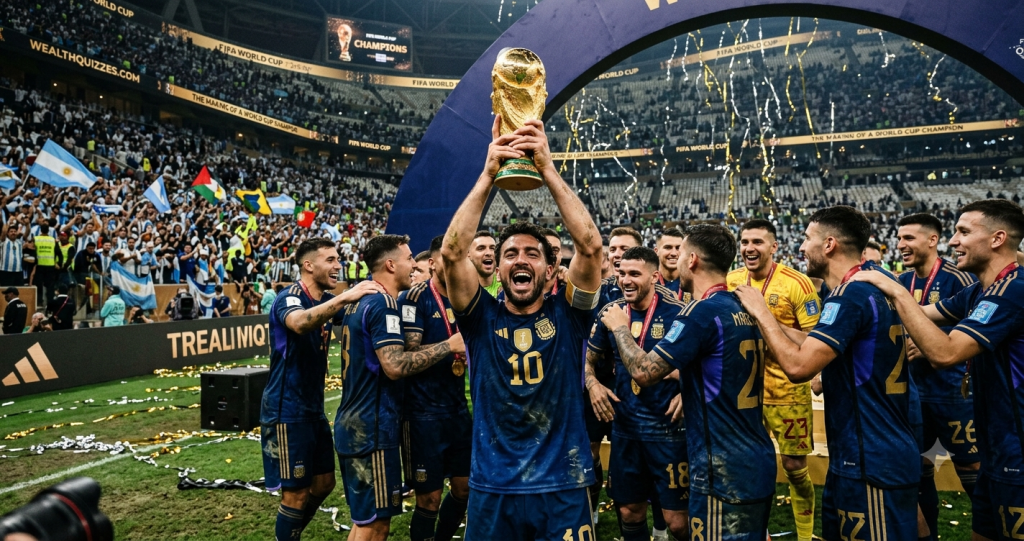
The Making of a World Cup Champion: What Every Winning Team Has in Common
Are There Common Traits Shared by All World Cup Winners?
Winning the FIFA World Cup is the ultimate achievement in international football. It is a feat so difficult that only eight nations—Uruguay, Italy, Germany, Brazil, England, Argentina, France and Spain—have ever lifted the famous FIFA World Cup Trophy since the inaugural tournament in 1930. Every champion emerged from different generations, tactical philosophies and football cultures, yet a closer examination reveals a remarkable truth: while styles evolve, the fundamental ingredients of success remain largely unchanged.
From Uruguay’s pioneering triumph in 1930, Brazil’s magical dynasty led by Pelé, Italy’s tactical resilience, Germany’s relentless efficiency, Spain’s possession revolution, France’s athletic excellence, Argentina’s championship mentality, to Spain’s victorious campaign at FIFA World Cup 2026, every champion has embodied a collection of enduring characteristics that separate winners from contenders.
Former FIFA President Sepp Blatter once observed that the World Cup is “the greatest examination of a nation’s football culture.” Likewise, legendary coach Sir Alex Ferguson famously remarked, “The hardest thing in football is not winning once—it is creating a team capable of winning consistently under pressure.” Those words perfectly capture the essence of World Cup success.
So, what exactly do World Cup champions have in common?
History provides compelling answers.
1. Exceptional Team Unity Always Comes Before Individual Brilliance
One of the greatest misconceptions in football is that World Cups are won by the most talented individuals.
History repeatedly proves otherwise.
Although every champion has featured outstanding footballers—Pelé, Franz Beckenbauer, Diego Maradona, Zinedine Zidane, Andrés Iniesta, Lionel Messi and Rodri—their success depended primarily upon collective unity.
Brazil’s legendary 1970 side remains one of the greatest teams ever assembled, yet coach Mário Zagallo consistently emphasised teamwork over individual stardom.
Similarly, Spain’s 2010 World Cup victory was built not merely upon technical excellence but upon extraordinary tactical cohesion.
The same philosophy underpinned Spain’s 2026 triumph.
Manager Luis de la Fuente transformed a squad filled with gifted individuals into a disciplined collective capable of defending, pressing and attacking as one.
Football remains the ultimate team sport.
Championships are rarely won by individuals alone.
2. Every Champion Possesses Elite Leadership
Leadership is football’s invisible advantage.
It cannot always be measured statistically, yet it consistently influences outcomes.
Every World Cup-winning nation has possessed influential leaders both on and off the pitch.
- Uruguay had José Nasazzi.
- Brazil had Pelé and Carlos Alberto.
- Germany had Franz Beckenbauer and Lothar Matthäus.
- France had Didier Deschamps and later Hugo Lloris.
- Spain relied upon Iker Casillas before Rodri assumed a similar leadership role in 2026.
- Argentina found inspiration in Lionel Messi.
Former Liverpool manager Bill Shankly famously stated:
“Football is not about life and death—it is much more important than that.”
While clearly humorous, his remark reflected football’s emotional intensity.
World Cup champions require leaders capable of remaining calm amid extraordinary pressure.
3. Tactical Flexibility Wins Championships
Football constantly evolves.
Rigid tactical systems rarely survive modern tournaments.
According to Arsène Wenger, FIFA’s Chief of Global Football Development, successful international teams increasingly distinguish themselves through adaptability rather than adherence to fixed formations.
Recent World Cups support that conclusion.
Spain alternated between possession-based control and rapid transitions.
Argentina adapted their pressing intensity according to opponents.
France shifted seamlessly between defensive solidity and devastating counter-attacks.
Germany’s 2014 triumph similarly reflected tactical versatility under Joachim Löw.
World Cup champions rarely possess only one method of winning.
They adapt.
4. Defensive Organisation Remains the Foundation
Popular imagination often remembers spectacular goals.
Championships, however, are usually secured by disciplined defending.
Legendary Italian coach Arrigo Sacchi once observed:
“Attack wins games. Defence wins championships.”
Statistics consistently reinforce his philosophy.
Spain conceded only one goal throughout their victorious 2026 campaign.
Italy’s famous 2006 triumph relied upon one of the tournament’s strongest defensive records.
France’s disciplined organisation proved decisive in 2018.
Even Brazil’s celebrated attacking teams maintained exceptional defensive balance.
Great attacks entertain.
Great defences win World Cups.
5. Midfield Control Determines Destiny
The world’s greatest football minds repeatedly emphasise midfield dominance.
Former Real Madrid manager Carlo Ancelotti frequently argues that football matches are controlled—not necessarily won—in midfield.
World Cup history repeatedly validates that assessment.
Brazil possessed Gérson in 1970.
Germany relied upon Kroos in 2014.
Spain controlled matches through Xavi, Iniesta and Busquets before Rodri assumed similar responsibilities in 2026.
Argentina’s success during recent tournaments similarly depended upon Enzo Fernández, Alexis Mac Allister and Rodrigo De Paul complementing Lionel Messi.
Modern football increasingly rewards teams capable of dictating tempo rather than merely chasing possession.
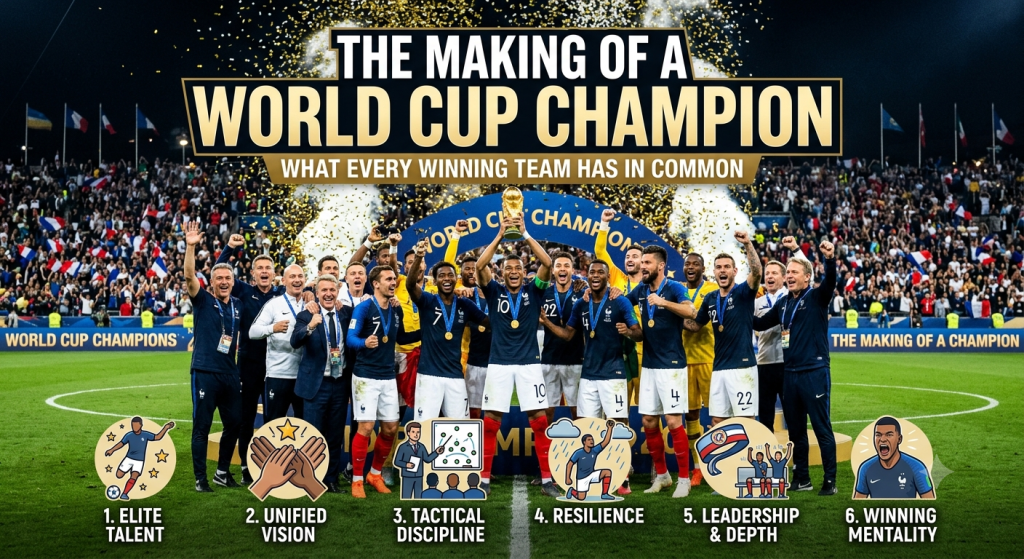
6. Mental Strength Separates Champions from Contenders
Perhaps the greatest common characteristic among World Cup winners is psychological resilience.
Every champion has encountered adversity.
Brazil recovered after difficult moments.
Italy survived penalty shoot-outs.
Germany repeatedly demonstrated extraordinary composure.
Argentina overcame setbacks throughout Qatar 2022 before again displaying remarkable resilience during FIFA World Cup 2026.
Sports psychologist Dr. Steve Peters, renowned for his work with elite athletes, argues that championship success depends upon controlling emotional responses under pressure.
World Cup football perfectly illustrates this principle.
The ability to remain composed often proves more valuable than technical superiority.
7. Outstanding Goalkeeping Is Non-Negotiable
No nation has ever won the FIFA World Cup without elite goalkeeping.
Consider history’s greatest champions:
- Gordon Banks (England).
- Dino Zoff (Italy).
- Iker Casillas (Spain).
- Manuel Neuer (Germany).
- Emiliano Martínez (Argentina).
- Unai Simón (Spain 2026).
Former German goalkeeper Oliver Kahn famously remarked:
“Goalkeepers become heroes because they rescue dreams.”
His words accurately summarise football’s greatest tournaments.
World Cups frequently turn upon one decisive save rather than one spectacular goal.
8. Young Talent Blended with Experience
Another recurring characteristic is balance between youthful energy and veteran wisdom.
Successful teams rarely consist entirely of young players or ageing stars.
Instead, they combine both.
Spain’s 2026 triumph perfectly illustrated this formula.
Young stars such as Lamine Yamal and Pau Cubarsí flourished alongside experienced leaders including Rodri, Unai Simón and Álvaro Morata.
Argentina similarly balanced youthful midfielders with Lionel Messi’s unparalleled experience.
Football history repeatedly confirms that successful squads require both fearlessness and maturity.
9. Preparation Extends Beyond the Pitch
Modern football increasingly relies upon science.
FIFA’s Technical Study Group has repeatedly highlighted the growing importance of sports science, nutrition, injury prevention, recovery strategies, performance analytics and psychological preparation.
Elite teams now employ specialists across multiple disciplines.
Former Arsenal manager Arsène Wenger has consistently advocated integrating technology into football development while preserving creativity.
World Cup champions prepare more intelligently than ever before.
Preparation begins months—not days—before tournaments.
10. Champions Embrace Pressure Instead of Fearing It
Pressure defines the FIFA World Cup.
Only players capable of thriving under immense expectation become champions.
Legendary basketball coach John Wooden, whose leadership philosophy extends beyond sport, once observed:
“Pressure is a privilege.”
Football’s greatest teams embody that mindset.
Rather than fearing decisive moments, champions welcome them.
Whether it was Pelé in 1970, Zidane in 1998, Iniesta in 2010, Messi in 2022 or Spain’s composed performances in 2026, greatness consistently emerges through embracing pressure rather than avoiding it.
Lessons from Spain’s FIFA World Cup 2026 Triumph
Spain’s championship campaign demonstrated nearly every characteristic shared by previous winners.
They possessed:
- Outstanding tactical discipline.
- Elite midfield control.
- Exceptional defensive organisation.
- Effective leadership.
- Fearless young talent.
- Remarkable squad unity.
- Intelligent coaching.
- Psychological resilience.
Manager Luis de la Fuente deserves enormous credit for creating a team that reflected football’s timeless principles while embracing modern innovation.
Spain did not simply win the World Cup.
They illustrated how champions are built.
What Future Champions Can Learn
The history of the FIFA World Cup offers invaluable lessons for future contenders.
Winning football’s greatest prize requires much more than assembling talented players.
It demands:
- Long-term player development.
- Strong domestic football structures.
- Excellent coaching.
- Tactical flexibility.
- Mental resilience.
- Organisational stability.
- Collective belief.
These qualities consistently distinguish champions from talented underachievers.
Conclusion
Every FIFA World Cup champion has travelled a unique journey.
Different generations have embraced different tactical philosophies.
Some teams dazzled with attacking brilliance.
Others triumphed through defensive resilience.
Yet beneath these stylistic differences lies an unmistakable pattern.
Champions are united by qualities far deeper than talent.
They trust one another.
They defend together.
They adapt under pressure.
They embrace responsibility.
They prepare meticulously.
They believe relentlessly.
From Uruguay in 1930 to Spain in 2026, football history has repeatedly demonstrated that while tactics evolve, greatness follows remarkably consistent principles.
The FIFA World Cup remains football’s greatest examination because it demands excellence in every department.
Ultimately, lifting the famous golden trophy is never the result of one magical moment.
It is the culmination of years of preparation, exceptional leadership, unwavering unity and extraordinary resilience.
That is the true making of a World Cup champion—and it is a lesson that will continue inspiring football nations for generations to come.