
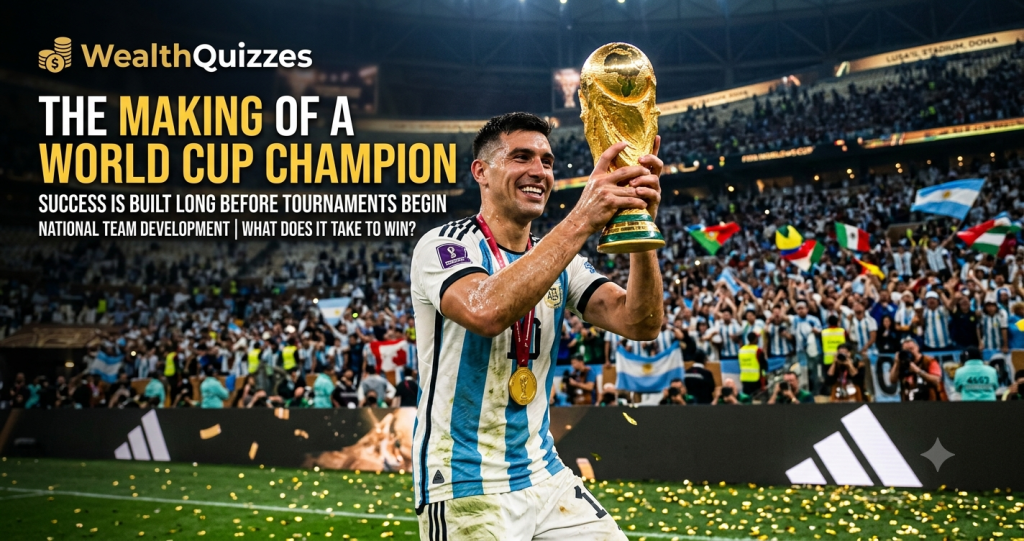
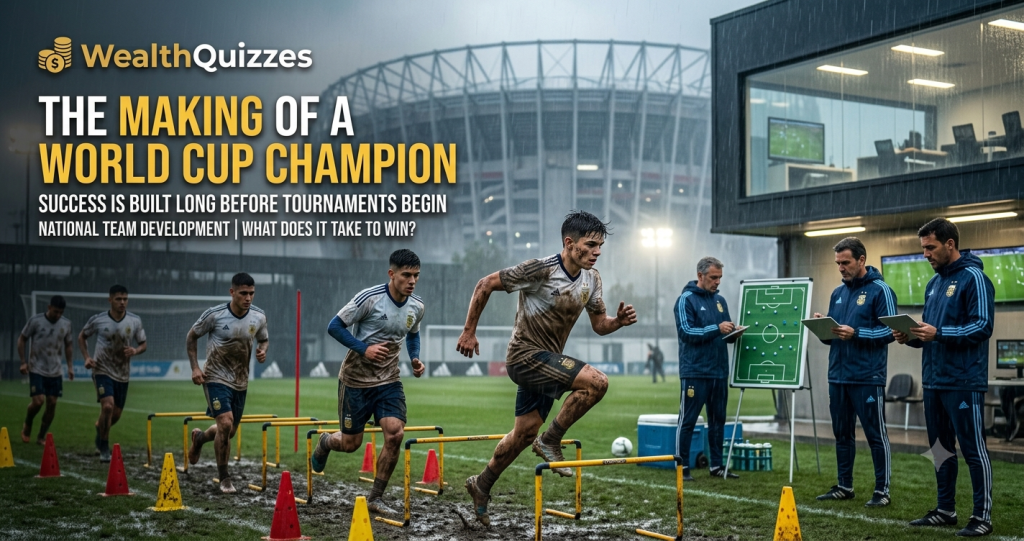
The Making of a World Cup Champion: What It Really Takes to Win Football’s Greatest Prize: Success Is Built Long Before Tournaments Begin: National Team Development
What Does It Take to Win the FIFA World Cup?
Every four years, billions of football fans around the world witness one nation lift the FIFA World Cup Trophy. The celebrations are unforgettable—players embracing in tears, coaches overwhelmed with emotion and supporters filling streets with songs, flags and fireworks. To many spectators, it appears that champions are created during the month-long tournament itself.
The truth is far different.
A FIFA World Cup champion is not made in 30 days.
It is built over decades.
Behind every victorious national team lies years of meticulous planning, youth development, coaching education, infrastructure investment, sports science, talent identification and cultural commitment to excellence. Every successful World Cup campaign represents the culmination of thousands of decisions made long before the opening match.
The recently concluded FIFA World Cup 2026, jointly hosted by the United States, Canada and Mexico, once again illustrated this reality. Spain’s triumph was not the product of fortune or a single outstanding tournament. It reflected years of investment in youth academies, technical education, tactical evolution and long-term national planning.
The World Cup is therefore not simply a competition.
It is the final examination of an entire football system.
As legendary football thinker Johan Cruyff famously observed:
“Quality without results is pointless. Results without quality are boring.”
The greatest World Cup champions achieve both because their foundations were laid years before they arrived on football’s biggest stage.
World Cup Success Begins at Grassroots Level
Every world champion starts with children.
No nation wins the FIFA World Cup without investing heavily in grassroots football.
Children must first learn:
- Technical ball control.
- Passing accuracy.
- Decision-making.
- Tactical awareness.
- Discipline.
- Teamwork.
- Creativity.
Countries consistently successful in international football—such as Spain, Germany, Argentina, France and Brazil—operate extensive youth development systems designed to identify talented players from an early age.
According to FIFA’s Talent Development Scheme (TDS), expanding access to quality youth coaching remains one of the organisation’s highest priorities because sustainable national success depends upon consistently producing technically gifted players.
Former Arsenal manager and FIFA Chief of Global Football Development Arsène Wenger has repeatedly argued that elite football begins with proper player education between the ages of six and twelve.
By the time future stars reach the senior national team, much of their technical foundation has already been established.
Coaching Matters as Much as Talent
Talent alone has never been enough to win a World Cup.
History consistently demonstrates that outstanding coaching transforms gifted players into championship teams.
Legendary managers such as:
- Vicente del Bosque (Spain)
- Didier Deschamps (France)
- Lionel Scaloni (Argentina)
- Joachim Löw (Germany)
- Carlos Alberto Parreira (Brazil)
all built successful national teams by establishing clear tactical identities while fostering unity within their squads.
The celebrated football coach Rinus Michels, architect of Dutch “Total Football,” once remarked:
“Football is war.”
Although modern football rightly rejects the militaristic tone of that statement, Michels’ broader point remains valid.
International football demands careful organisation, discipline and strategic planning.
Great coaches prepare their teams long before tournaments begin.
A National Football Philosophy Creates Identity
The world’s most successful football nations possess clearly defined football philosophies.
Spain emphasizes possession, technical precision and positional intelligence.
Germany traditionally values tactical discipline and structured organisation.
Brazil celebrates creativity, flair and attacking expression.
Argentina combines technical excellence with competitive intensity.
These identities do not emerge by accident.
They are deliberately cultivated across youth academies, coaching programmes and domestic football structures.
Professor Simon Chadwick, an internationally recognised authority on sport and geopolitics, argues that successful football nations develop coherent football ecosystems in which youth development, coaching education and elite performance complement one another.
Consistency builds champions.
Youth Development Is the Foundation of Success
Modern World Cup champions rely heavily on players developed through structured academy systems.
Spain’s famous La Masia academy at Barcelona produced players such as Xavi Hernández, Andrés Iniesta, Sergio Busquets and Lionel Messi during his formative years.
France’s national football academy at Clairefontaine has developed numerous international stars, including Thierry Henry, Nicolas Anelka, Kylian Mbappé and many others.
Germany completely restructured its youth development system following disappointing international performances in the early 2000s.
The result was remarkable.
A decade later, Germany lifted the FIFA World Cup in Brazil in 2014.
Investment in youth eventually produces senior success.
Domestic Leagues Strengthen National Teams
Strong domestic leagues provide competitive environments where players develop under high standards.
The English Premier League.
Spain’s La Liga.
Germany’s Bundesliga.
France’s Ligue 1.
Italy’s Serie A.
These competitions expose players to elite coaching, tactical diversity and intense competitive pressure.
Although many international players now compete abroad, robust domestic football remains essential for national development.
Former UEFA President Michel Platini frequently emphasised the importance of balancing club football with national team interests.
Healthy domestic competitions strengthen international football.
Sports Science Has Become Essential
Modern World Cup preparation extends far beyond tactical training.
Elite national teams now employ:
- Sports scientists.
- Nutritionists.
- Physiotherapists.
- Strength and conditioning specialists.
- Performance analysts.
- Psychologists.
- Medical experts.
According to FIFA’s Medical Centre of Excellence Programme, injury prevention and workload management significantly improve tournament performance.
Player recovery now includes:
- GPS workload monitoring.
- Sleep optimisation.
- Hydration management.
- Individual nutritional planning.
- Recovery technology.
- Biomechanical assessment.
Modern champions prepare scientifically.
Data Analytics Supports Better Decisions
The FIFA World Cup 2026 further demonstrated football’s analytical evolution.
National teams increasingly rely upon sophisticated data analysis to evaluate opponents, monitor player performance and identify tactical opportunities.
Performance analysts examine:
- Passing networks.
- Pressing efficiency.
- Defensive compactness.
- Set-piece effectiveness.
- Transition speed.
- Expected Goals (xG).
- Player positioning.
Former Liverpool manager Jürgen Klopp has consistently acknowledged that while football remains fundamentally human, intelligent use of analytics provides valuable competitive advantages.
Information enhances preparation.
Preparation improves performance.
Mental Strength Wins Championships
Physical ability alone rarely determines World Cup success.
Psychological resilience frequently separates champions from contenders.
Knockout football creates extraordinary pressure.
One mistake.
One missed penalty.
One moment of hesitation.
Entire tournaments can change instantly.
Sports psychologist Professor Richard H. Cox, author of Sport Psychology: Concepts and Applications, argues that confidence, emotional regulation and resilience consistently distinguish elite performers from equally talented competitors.
The greatest teams remain composed under immense pressure.
Argentina’s remarkable recovery after losing its opening match at the 2022 FIFA World Cup perfectly illustrated football’s psychological dimension.
Belief often proves decisive.
Leadership Creates Winning Cultures
Every World Cup champion possesses exceptional leadership.
Leadership extends beyond captains.
It includes coaches.
Senior players.
Support staff.
Football federation administrators.
Strong leaders establish:
- Accountability.
- Discipline.
- Shared purpose.
- Collective belief.
- Emotional stability.
Former Manchester United manager Sir Alex Ferguson repeatedly argued that successful teams require strong dressing-room leadership capable of maintaining standards regardless of circumstances.
Championship cultures rarely emerge spontaneously.
They are deliberately built.
Financial Investment Supports Excellence
Winning the World Cup requires significant investment.
National football associations allocate resources toward:
- Youth academies.
- Coaching education.
- Grassroots facilities.
- Sports medicine.
- Performance technology.
- International competitions.
- Talent identification.
FIFA itself contributes through programmes such as FIFA Forward, which supports football development across member associations.
However, financial resources alone cannot guarantee success.
Effective governance remains equally important.
Spain’s World Cup 2026 Triumph
Spain’s success at the FIFA World Cup 2026 perfectly illustrated long-term planning.
The squad combined experienced leaders with emerging stars such as Lamine Yamal, Pedri, Nico Williams and Pau Cubarsí.
Technically gifted.
Tactically disciplined.
Physically prepared.
Mentally resilient.
These qualities reflected years of investment rather than short-term preparation.
Manager Luis de la Fuente inherited players shaped by Spain’s enduring football philosophy.
The World Cup trophy represented the harvest of seeds planted many years earlier.
Lessons Beyond Football
The making of a World Cup champion offers valuable lessons applicable far beyond sport.
Businesses.
Governments.
Universities.
Law firms.
Entrepreneurs.
Successful organisations share remarkably similar characteristics.
They invest early.
They develop talent continuously.
They embrace innovation.
They prepare thoroughly.
They think long term.
Management scholar Peter Drucker famously stated:
“The best way to predict the future is to create it.”
World Cup champions embody this principle.
Their success is deliberately created rather than accidentally discovered.
The Future of International Football
Football continues evolving rapidly.
Artificial intelligence.
Advanced analytics.
Improved coaching methodologies.
Greater sports science.
Expanded youth development.
Technological innovation.
These developments will continue shaping future World Cup champions.
Yet despite these advances, one truth remains unchanged.
Champions are never built overnight.
Every World Cup winner represents years of patient investment, disciplined preparation and unwavering commitment to excellence.
Conclusion
Lifting the FIFA World Cup Trophy represents the highest achievement in international football, but the journey to that moment begins long before the opening ceremony.
World champions are forged through strong grassroots programmes, outstanding coaching, coherent football philosophies, elite youth academies, sports science, intelligent analytics, resilient leadership and sustainable long-term planning.
The FIFA World Cup 2026 reaffirmed that enduring success belongs to nations willing to invest consistently in every aspect of football development. Spain’s championship campaign was not merely the triumph of eleven players on the pitch—it was the success of an entire football system working together over many years.
As Johan Cruyff wisely understood, excellence is never accidental.
It is cultivated.
Ultimately, winning the World Cup requires far more than talented footballers.
It requires vision.
It requires patience.
It requires national commitment.
And above all, it requires understanding that the making of a World Cup champion begins years before the first whistle is ever blown.
That is the true secret behind football’s greatest triumphs.