
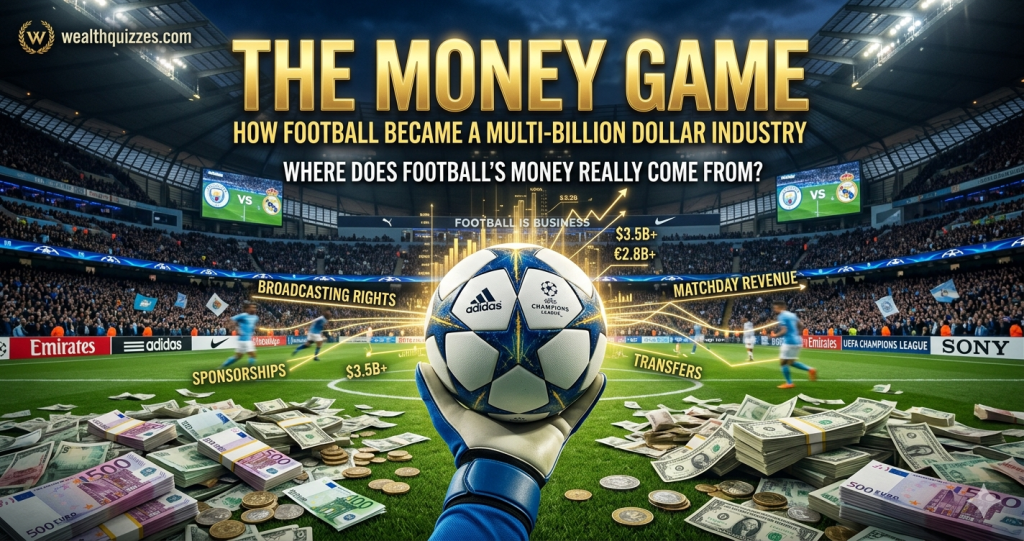
The Money Game: How Football Became a Multi-Billion Dollar Industry
Where Does Football’s Money Really Come From?
For millions of fans around the world, football is about passion, loyalty, competition, and unforgettable moments. It is the roar of the crowd, the tension of a penalty kick, and the joy of seeing a beloved team lift a trophy. Yet behind the spectacle lies an enormous financial ecosystem that has transformed football from a simple sporting contest into one of the world’s most lucrative industries.
Today, football generates hundreds of billions of dollars in economic activity globally. The sport fuels television networks, advertising agencies, sports apparel manufacturers, betting companies, tourism businesses, technology firms, and countless other sectors. Elite football clubs are no longer merely sports teams; they are global brands with revenues that rival major corporations.
This raises an important question: Where does football’s money really come from?
The answer lies in a sophisticated business model built around broadcasting rights, sponsorship agreements, commercial partnerships, ticket sales, merchandising, and player transfers.
Football’s Transformation into Big Business
Football was not always the financial giant it is today. For much of its history, clubs relied primarily on ticket sales and local support. Revenues were modest, and financial operations were relatively simple.
The commercialization of football accelerated dramatically during the late twentieth century, particularly with the emergence of satellite television and global broadcasting. According to FIFA, football is the most popular sport in the world, attracting billions of viewers across continents. As television audiences expanded, broadcasters recognized football’s enormous commercial value.
Sports economist Stefan Szymanski notes that football’s economic growth has largely been driven by its ability to attract mass audiences consistently. Unlike many forms of entertainment, football provides live content that viewers prefer to watch in real time, making it highly attractive to broadcasters and advertisers.
Today, football is not merely a sport; it is a global entertainment product.
Broadcasting Rights: The Financial Engine of Modern Football
If there is one revenue stream that transformed football into a multi-billion-dollar industry, it is broadcasting rights.
Television networks and streaming platforms pay enormous sums for the exclusive right to broadcast football matches. These deals generate billions of dollars for leagues, clubs, and governing bodies.
The Premier League provides one of the best examples. Its domestic and international broadcasting agreements have generated unprecedented revenues, helping English clubs become some of the wealthiest in world football.
According to sports business analyst Kieran Maguire, broadcasting income represents the largest revenue source for many top clubs. Media companies compete fiercely for football rights because live sports remain one of the few television products capable of consistently attracting massive audiences.
The value of broadcasting rights has also increased because football has become a global product. A match involving clubs such as Manchester United, Real Madrid, or FC Barcelona may attract viewers from Africa, Asia, Europe, North America, and South America simultaneously.
This global reach translates directly into revenue.
Sponsorships: Brands Pay for Attention
Another major source of football’s wealth is sponsorship.
Businesses seek visibility, and football provides access to one of the largest audiences in the world.
Companies spend millions—and sometimes billions—of dollars to associate their brands with football clubs, leagues, tournaments, and players. Sponsorship agreements can involve shirt branding, stadium naming rights, training kits, official partnerships, and digital marketing campaigns.
Marketing professor Philip Kotler has long emphasized that strong brands benefit from emotional connections with consumers. Football creates precisely this kind of emotional engagement. Fans develop deep attachments to clubs and players, making football an attractive platform for corporate advertising.
When fans watch matches, purchase jerseys, engage on social media, or attend games, sponsor brands gain exposure. As a result, companies view football sponsorship as a strategic marketing investment rather than merely an advertising expense.
The biggest clubs now negotiate sponsorship agreements worth hundreds of millions of dollars over multiple years.
Clubs as Global Brands
Modern football clubs increasingly resemble multinational corporations.
A club’s success is no longer measured solely by trophies but also by brand value, global reach, and commercial performance.
Business experts frequently point to clubs such as Manchester City, Liverpool FC, Bayern Munich, and Real Madrid as examples of organizations that have successfully expanded their brands beyond local markets.
These clubs operate sophisticated commercial departments focused on marketing, digital engagement, licensing, merchandising, sponsorship acquisition, and international expansion.
Football finance specialist Kieran Maguire often explains that elite clubs now compete not only on the pitch but also in global business markets. Their commercial strategies target fans worldwide rather than merely those living near the stadium.
This transformation has enabled clubs to generate revenues from audiences they may never physically meet.

Merchandise and Licensing
Every season, millions of football jerseys, scarves, caps, training kits, and collectibles are sold worldwide.
Merchandising has become a major revenue stream because football supporters are eager to demonstrate their loyalty through purchases.
Sports marketing researchers have consistently found that fans derive part of their identity from their association with clubs. This emotional attachment drives demand for official merchandise.
Major clubs partner with global apparel companies to manufacture and distribute products across international markets. These agreements generate revenue through licensing fees, royalties, and direct sales.
A star player’s arrival can significantly increase merchandise sales. The signing of a globally recognized footballer often leads to immediate spikes in jersey purchases, demonstrating the commercial value of elite talent beyond on-field performance.
Matchday Revenue Still Matters
Although broadcasting and sponsorships dominate modern football finances, matchday revenue remains important.
Ticket sales, hospitality packages, food and beverage purchases, stadium tours, and premium seating arrangements contribute significantly to club income.
Elite stadiums increasingly function as year-round business assets rather than venues used only on matchdays.
Sports venue management experts note that modern stadiums host concerts, conferences, exhibitions, corporate events, and tourism activities throughout the year. This diversification allows clubs to maximize returns on infrastructure investments.
For many clubs, stadium development is as much a business strategy as a sporting one.
The Billion-Dollar Transfer Market
One of football’s most visible financial dimensions is the transfer market.
Player transfers frequently generate headlines because of their extraordinary values. Transfer fees reaching tens or even hundreds of millions of dollars have become increasingly common.
Economist Stefan Szymanski argues that football’s transfer market reflects the economic principle of scarcity. Elite players capable of consistently performing at the highest level are rare. As demand for such talent grows, prices rise accordingly.
Beyond transfer fees, clubs must also consider salaries, performance bonuses, image rights, and contract incentives. As a result, acquiring top players often involves financial commitments worth hundreds of millions of dollars over several years.
These investments are justified because elite players can improve sporting performance, increase commercial revenues, attract sponsors, and expand global fan bases.
Digital Media and the New Revenue Frontier
The rise of social media has created new business opportunities for football.
Clubs now communicate directly with fans through digital platforms, generating engagement that can be monetized through advertising, sponsorships, subscriptions, and content partnerships.
Digital transformation expert David Meerman Scott has highlighted how organizations can build stronger customer relationships through direct online engagement. Football clubs have embraced this principle enthusiastically.
Some clubs now have social media followings that exceed the populations of many countries. These digital audiences represent valuable commercial assets that attract sponsors seeking global visibility.
The future of football business will likely depend increasingly on digital innovation, streaming services, and fan engagement technologies.
The Challenges of Football’s Financial Growth
Despite its enormous revenues, football faces significant financial challenges.
Many clubs spend aggressively in pursuit of success, sometimes accumulating substantial debts. Financial sustainability has therefore become a major concern.
Organizations such as FIFA and UEFA have introduced regulations designed to promote responsible financial management and competitive balance.
Critics argue that growing financial disparities between wealthy and less wealthy clubs may threaten competitive fairness. Others worry that excessive commercialization could weaken football’s traditional community roots.
Balancing business interests with sporting values remains one of football’s greatest challenges.
Conclusion: More Than Just a Game
Football’s journey from local competition to global industry is one of the most remarkable business stories in modern history.
The sport’s financial power comes from multiple interconnected sources: broadcasting rights, sponsorship agreements, commercial partnerships, merchandise sales, matchday revenues, player transfers, and digital engagement.
Yet football’s economic success ultimately rests on something that cannot be measured on a balance sheet: passion.
Fans create the audiences that broadcasters pay for. They buy the merchandise, fill the stadiums, follow clubs online, and support sponsors. Without that emotional connection, football’s vast financial ecosystem would not exist.
As football continues to evolve, one fact remains clear: the beautiful game is no longer just a sport. It is a global business empire worth billions, driven by the loyalty of billions more.
Understanding where football’s money comes from helps us appreciate that every match is not only a sporting contest but also part of one of the most powerful entertainment industries on earth.