
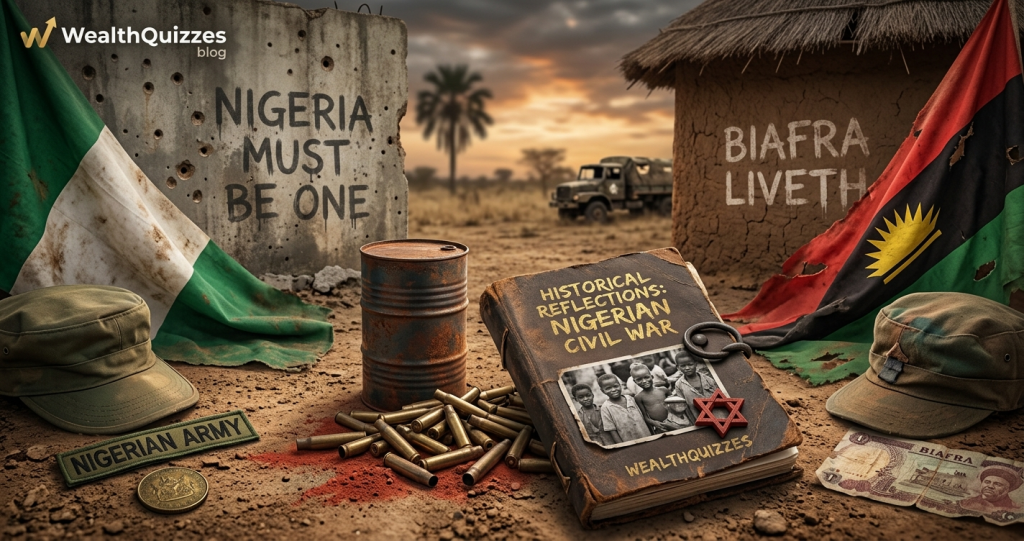
The Nigerian Civil War: Causes, Major Events and Historical Lessons
A Balanced Examination of the Political Crisis, Biafra, Military Campaigns, Humanitarian Consequences and the War’s Legacy
Few events have shaped modern Nigeria as profoundly as the Nigerian Civil War of 1967–1970. Known widely as the Nigeria–Biafra War, the conflict was not simply a military confrontation between the Federal Government and a secessionist region. It was the culmination of political instability, competing ideas of Nigerian nationhood, military intervention in politics, ethnic violence, constitutional disagreements, economic interests and a profound crisis of trust between political and military leaders.
The war lasted about thirty months. It ended with the surrender of Biafra in January 1970, but its consequences extended far beyond the battlefield. Between one and three million people are estimated to have died, with famine and disease accounting for a substantial proportion of the deaths. (OUP Academic)
Understanding the war therefore requires going beyond the question of who won and who lost. It requires asking why Nigeria descended into war, why Biafra emerged, what happened during the conflict, what civilians experienced, and what lessons the war left for the Nigerian state.
The Roots of the Crisis
The roots of the Civil War predated 1967 by several decades.
Nigeria entered independence in 1960 as a highly diverse federation containing numerous ethnic, linguistic, religious and political communities. Historians Toyin Falola and Matthew Heaton have described the underlying problem as part of Nigeria’s broader “national question”: what constituted Nigeria, and how could a meaningful national identity be built within a state whose territorial boundaries had been created largely through British colonial rule? (Cambridge University Press)
The political system inherited at independence was heavily regionalised. The three largest political forces were associated broadly with the Northern People’s Congress (NPC), the National Council of Nigeria and the Cameroons (NCNC), and the Action Group (AG). Political competition consequently operated simultaneously at federal, regional, ethnic and ideological levels.
The First Republic became increasingly unstable. Electoral controversies, the 1962–63 census dispute, the Western Region crisis and the troubled 1964 federal election deepened political distrust. The military eventually intervened.
The January 1966 Coup
On 15 January 1966, a group of military officers overthrew the civilian government. Prime Minister Tafawa Balewa and several senior political figures, including Ahmadu Bello and Samuel Ladoke Akintola, were killed.
Major-General Johnson Aguiyi-Ironsi, the senior surviving military officer, assumed power.
The coup was interpreted differently by different communities. In much of Northern Nigeria, it was increasingly viewed as an assault on northern political power, particularly because many of the principal political casualties were northern leaders while several of the coup plotters were Igbo officers. Scholars caution against reducing the episode to a simple ethnic conspiracy, but its ethnic interpretation had enormous political consequences. (Cambridge University Press)
Ironsi’s subsequent policies, including measures viewed as weakening the federal principle, intensified opposition.
The July Counter-Coup and the Pogroms
On 29 July 1966, northern and other military officers staged a counter-coup. Ironsi was killed, along with Lieutenant-Colonel Adekunle Fajuyi, the Western Region’s military governor. Lieutenant-Colonel Yakubu Gowon subsequently emerged as head of the Federal Military Government. (Cambridge University Press)
The political crisis was followed by devastating violence against Igbo and other Easterners living in Northern Nigeria.
Thousands were killed, while a mass movement of displaced people headed eastward. Some scholarly accounts estimate that approximately 250,000 people were displaced by the violence. (Cambridge University Press)
For many Easterners, especially Igbos, the events fundamentally altered their perception of whether their security could be guaranteed within Nigeria.
This was one of the most important developments leading toward secession.
Aburi and the Failure of Political Accommodation
In January 1967, Nigerian military leaders met at Aburi, Ghana, in an attempt to resolve the crisis. The discussions involving Gowon and Eastern Region military governor Colonel Chukwuemeka Odumegwu Ojukwu produced an agreement that envisaged a much more decentralised or confederal arrangement.
Among the reported understandings were regional autonomy and limitations on unilateral federal action. (Cambridge University Press)
However, the Aburi agreement was not implemented in the form expected by the Eastern leadership. The Federal Government subsequently reorganised the country into twelve states, a measure that had major political and economic implications. It weakened the territorial control of the Eastern Region over areas including the oil-producing Niger Delta. (Cambridge University Press)
The disagreement became increasingly irreconcilable.
On 30 May 1967, Ojukwu declared the independence of the Republic of Biafra.
The Federal Government rejected the secession and moved to preserve Nigeria’s territorial integrity. Diplomatic efforts failed, and open warfare began on 6 July 1967. (Cambridge University Press)
The Opening of the War
Biafra initially achieved important military successes.
Its forces moved westward into the Mid-Western Region in an attempt to break the Federal Government’s strategic position and potentially encourage wider political support. The advance, however, was reversed.
The Battle of Ore in 1967 became an important turning point in the Western theatre. Recent military scholarship argues that the battle deserves greater attention because it halted Biafran expansion westward and fundamentally altered the geography of the conflict. (SciELO)
The Federal forces subsequently captured important Biafran positions, including Enugu, the Biafran capital, in October 1967.
The war thereafter became increasingly concentrated in the East.
Biafra’s Resistance
Although materially weaker than the Federal Government, Biafra proved capable of sustaining resistance for much longer than many observers initially expected.
The Biafran military adapted to shortages of weapons, ammunition and equipment. Local production and improvisation became increasingly important.
One of the most famous episodes was the Abagana ambush of March 1968, in which Biafran forces inflicted heavy losses on a Federal Army convoy. The episode became an important symbol of Biafran military ingenuity and resistance.
Yet the broader strategic balance increasingly favoured the Federal Government. Nigeria had access to greater territory, manpower, international recognition and material resources.
External involvement also mattered. Both sides received varying forms of foreign assistance, while the Cold War shaped international calculations. Research by Cambridge historians has shown that the conflict cannot be understood entirely as an isolated domestic confrontation; foreign governments, arms suppliers and humanitarian organisations became deeply involved. (Cambridge University Press)
The Humanitarian Catastrophe
Perhaps the most tragic dimension of the war was its impact on civilians.
As Federal forces progressively encircled Biafra, the region became increasingly isolated. A blockade severely restricted the movement of food and other essential supplies.
By 1968, images of severely malnourished Biafran children had appeared prominently in international media. The humanitarian crisis transformed the international perception of the war. What had initially received limited attention became one of the most visible humanitarian crises of the late 1960s. (Cambridge University Press)
Miriam Bradley of the University of Oxford notes that the war may have cost up to two million lives, predominantly through starvation and disease. She also shows how the Nigerian blockade and the international humanitarian response became central features of the conflict. (OUP Academic)
Humanitarian organisations faced a difficult dilemma. The Federal Government regarded Biafra as Nigerian territory and was concerned that relief flights could also be used to transport weapons. Humanitarian agencies, meanwhile, confronted the immediate necessity of feeding civilians.
The resulting Biafran airlift became one of the most significant humanitarian operations of the period.
The crisis also contributed to the evolution of modern international humanitarianism. Caroline Abu Sa’ud and other scholars of the conflict have examined how Biafra became an important moment in the development of humanitarian consciousness, international relief operations and media-driven humanitarian mobilisation. (Cambridge University Press)
The Final Military Campaign
By late 1969, Biafran territory had been drastically reduced.
The Federal Government launched its final major offensive while Biafran forces struggled with diminishing territory, food shortages, military exhaustion and internal pressures.
Biafran President Ojukwu eventually left the territory in January 1970. His deputy, Philip Effiong, assumed leadership and announced the surrender.
On 15 January 1970, the war formally ended.
The Federal Government declared the principle of “No Victor, No Vanquished.” General Yakubu Gowon’s government sought reconciliation rather than a campaign of mass retribution, although historians continue to debate the extent to which postwar policies achieved genuine reconciliation. (OUP Academic)
The Human and Social Cost
The human cost of the Civil War cannot be captured adequately by military statistics.
Millions were displaced. Families were separated. Cities and villages were destroyed. Agricultural production collapsed in many areas. Children experienced starvation and disease on a massive scale.
The psychological consequences were also profound.
For many Nigerians, particularly in the former Eastern Region, memories of the war remained embedded in family histories. For others, the war became associated with the preservation of Nigeria’s territorial unity.
The competing memories help explain why the Civil War remains a sensitive subject decades later.
Historian Roy Doron has observed that Civil War scholarship contains highly polarised interpretations, including extreme claims and narratives that sometimes obscure rather than clarify the historical record. He argues for more serious engagement with the war’s complexities and legacies. (OUP Academic)
The Legacy of the Nigerian Civil War
The war fundamentally altered Nigeria.
First, it strengthened the role of the military in Nigerian political life. Nigeria remained under military rule for much of the period following the war.
Second, the conflict encouraged further state creation and administrative restructuring. The twelve-state structure introduced in 1967 eventually evolved into the much larger system of states and local governments that exists today.
Third, the war profoundly affected Nigeria’s understanding of national unity and federalism.
The Federal Government succeeded in preserving the territorial integrity of Nigeria, but the political and economic questions underlying the conflict did not disappear automatically.
Fourth, the war left a complicated legacy of memory and identity. The Biafran experience continues to influence political discussions in southeastern Nigeria, while the war remains an important part of Nigerian military, constitutional and political history. (OUP Academic)
Historical Lessons
The Nigerian Civil War offers several important lessons.
1. Political institutions must manage diversity
A diverse country requires institutions capable of accommodating legitimate regional, ethnic and political interests. Where political competition becomes a struggle for survival, constitutional disagreement can rapidly become a security crisis.
2. Military intervention does not automatically solve political problems
The coups of 1966 did not eliminate Nigeria’s political problems. Instead, military intervention transformed political disagreements into increasingly dangerous confrontations.
3. Minority and regional security matters
The violence against Easterners in Northern Nigeria profoundly affected the calculations that preceded Biafran secession. The security of citizens cannot depend merely on constitutional guarantees; institutions must be capable of enforcing those guarantees.
4. Negotiated settlements require trust
Aburi demonstrated that political agreements can fail when the parties interpret commitments differently or lack confidence in one another. Once trust disappears, even potentially workable constitutional arrangements become extremely difficult to implement.
5. Civilians bear the greatest cost of political failure
The starvation, displacement and disease associated with the war demonstrate the devastating consequences when political crises become armed conflicts.
6. Historical memory must be confronted honestly
Perhaps the most important lesson is that national reconciliation cannot depend on silence alone. A society may preserve territorial unity while still carrying unresolved memories of violence.
As Ogechi E. Anyanwu’s Cambridge study argues, the Nigeria–Biafra War emerged from a convergence of political mistrust, ethnic tensions, economic interests and institutional weaknesses rather than from a single cause. (Cambridge University Press)
Conclusion
The Nigerian Civil War was the defining catastrophe of Nigeria’s first decade of independence.
It emerged from a chain of political crises: the instability of the First Republic, the January 1966 coup, the July counter-coup, anti-Igbo violence and mass displacement, the failure of reconciliation, the breakdown of the Aburi understanding, the restructuring of Nigeria into twelve states and finally Biafran secession.
The war itself was fought through major military campaigns, but its most devastating battlefield was ultimately the civilian population. Starvation, disease, displacement and destruction made the conflict one of the major humanitarian tragedies of postcolonial Africa. (OUP Academic)
Yet the history of the war should not be reduced to a simple contest between heroes and villains, nor should it be understood solely through the lens of ethnicity. The scholarship shows a much more complicated picture involving constitutional weakness, political rivalry, military intervention, economic interests, security fears, foreign involvement and competing visions of Nigeria’s future.
The enduring lesson is therefore not simply that Nigeria survived the war.
It is that the preservation of a nation requires more than preserving its borders. It requires political institutions capable of managing difference, protecting citizens, resolving disputes peacefully and giving competing communities a genuine stake in the national project.
The Nigerian Civil War ended in 1970. Its historical questions, however, remain part of the continuing story of Nigeria.
Renowned authorities consulted include: Toyin Falola and Matthew M. Heaton, A History of Nigeria; Toyin Falola and Matthew M. Heaton’s Oxford Handbook of Nigerian History; Roy Doron, “The Nigerian Civil War and Its Legacies”; Ogechukwu E. Williams, “The Biafran War”; Ogechi E. Anyanwu’s research on the causes of the Nigeria–Biafra War; Miriam Bradley’s Oxford study of international humanitarianism; and Cambridge scholarship on Biafra, Aburi, military politics and humanitarian relief. (OUP Academic)