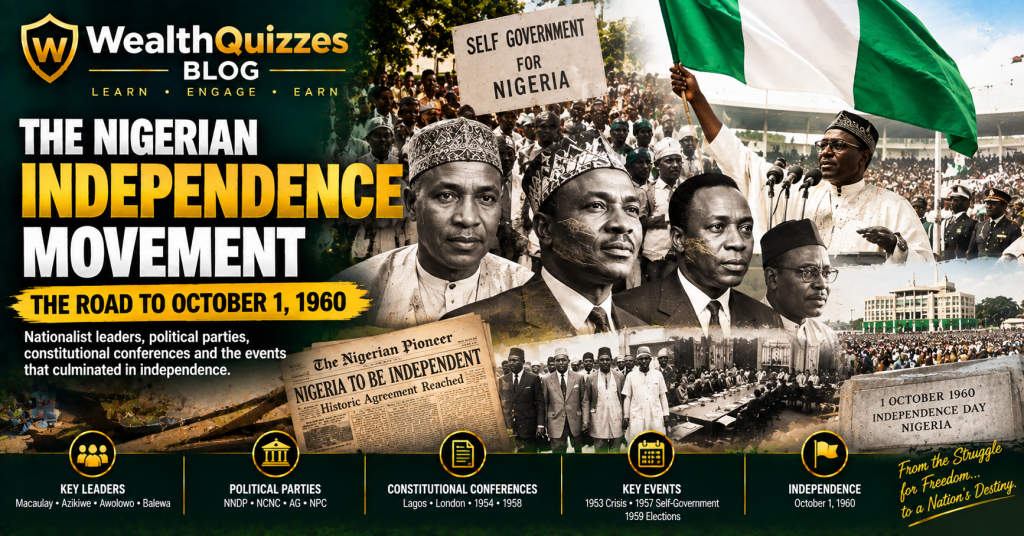
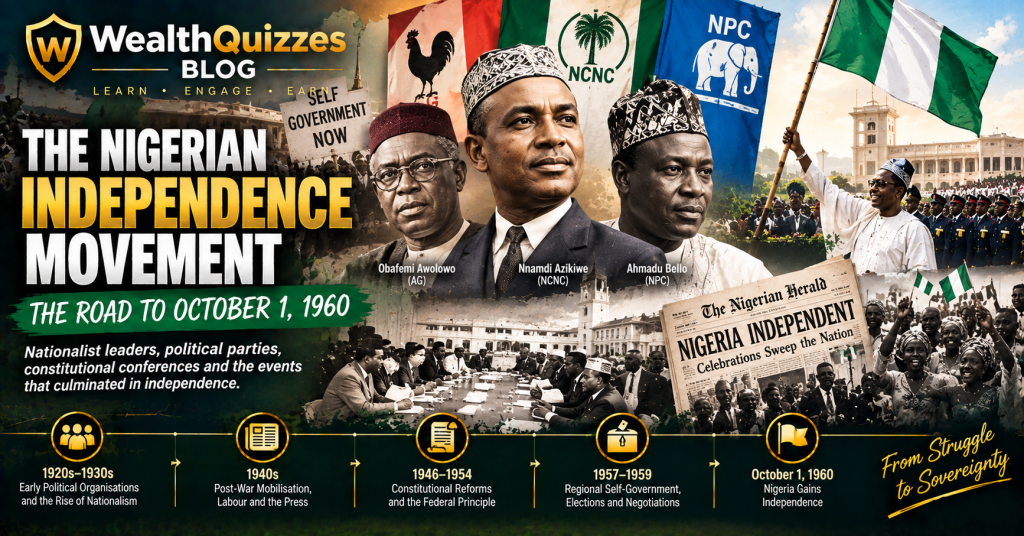
THE NIGERIAN INDEPENDENCE MOVEMENT: THE ROAD TO OCTOBER 1, 1960
Nationalist Leaders, Political Parties, Constitutional Conferences and the Events That Culminated in Independence
Nigeria’s independence on 1 October 1960 was the culmination of decades of political agitation, intellectual mobilisation, labour activism, constitutional reform and negotiation. The lowering of the British Union Jack and the raising of Nigeria’s green-white-green flag was therefore not the product of a single campaign or the achievement of one political leader. It represented the outcome of a long and complicated process in which Nigerian nationalists gradually transformed demands for greater African participation in government into a sustained demand for self-government and, ultimately, sovereignty.
As historians Toyin Falola and Matthew M. Heaton observe in A History of Nigeria, colonial rule generated resistance from its earliest decades, but the resistance increasingly developed into organised nationalist movements from the 1930s. After the Second World War, nationalist pressure accelerated constitutional reform and steadily expanded Nigerian participation in government. [1]
The Early Foundations of Nigerian Nationalism
The foundations of Nigerian nationalism predated the famous political struggles of the 1940s and 1950s.
The Clifford Constitution of 1922 introduced limited elective representation in the Legislative Council, particularly for Lagos and Calabar. Although the franchise was extremely restricted, the development created a small but important constitutional arena in which educated Nigerians could challenge colonial policies through formal politics.
In 1923, Herbert Macaulay founded the Nigerian National Democratic Party (NNDP). The party became an important force in Lagos politics and demonstrated that colonial political institutions could be used by Nigerians to demand greater representation.
The nationalist press was equally significant. Newspapers provided an intellectual and political platform through which Nigerians debated colonialism, racial discrimination, economic exploitation and political representation.
However, early nationalism was not yet uniformly pan-Nigerian. As Falola and Heaton explain, early anti-colonial resistance often reflected local circumstances, racial consciousness and particular community interests before developing into broader nationalist movements. [1]
The Rise of a New Generation of Nationalists
The 1930s and 1940s witnessed the emergence of a more assertive nationalist generation.
The Nigerian Youth Movement (NYM), founded in 1936, represented an important stage in the development of organised nationalism. Although initially concentrated around Lagos and the educated elite, it broadened political participation and challenged colonial political arrangements.
A particularly influential figure was Nnamdi Azikiwe, popularly known as “Zik.” A journalist and political organiser, Azikiwe used the press to popularise nationalist ideas and promote the idea of political emancipation. His newspapers, particularly the West African Pilot, became powerful instruments of political mobilisation.
Cambridge scholarship notes that Azikiwe’s influence extended beyond formal party organisation: his political ideas inspired a younger generation of activists who increasingly viewed independence as the ultimate objective of political struggle. [2]
In 1944, Azikiwe and his associates became associated with the National Council of Nigeria and the Cameroons (NCNC). The organisation would eventually become one of the principal political forces in the struggle for independence.
The nationalist movement was also strengthened by labour activism. The 1945 general strike, organised by Nigerian workers, demonstrated the growing ability of organised labour to challenge colonial economic policies. Industrial workers were no longer merely economic actors; they were becoming an important component of the broader political movement.
The Second World War and the Acceleration of Nationalism
The Second World War transformed the political environment.
Nigerian soldiers fought in Britain’s armed forces while Nigerian workers and farmers contributed to the colonial war economy. At the same time, the global language of freedom and self-determination became increasingly difficult for European colonial powers to reconcile with continued colonial domination.
The war also intensified economic difficulties, inflation and social pressures.
For Nigerian nationalists, the post-war world created an opportunity. If Britain and the Allies had fought a war ostensibly defending freedom and democratic principles, nationalists increasingly asked why those principles should not apply to colonised peoples.
The colonial administration responded with constitutional reforms.
The Richards Constitution of 1946
The Richards Constitution of 1946 was an important step in Nigeria’s constitutional development.
It created a central Legislative Council while also recognising regional structures for the North, West and East. The intention was partly to encourage greater participation while accommodating Nigeria’s regional diversity.
However, the constitution was criticised because Nigerians had not been sufficiently involved in its preparation. The experience demonstrated an important lesson: constitutional development could no longer be imposed successfully from above without significant Nigerian participation.
This criticism helped produce the next major constitutional experiment.
The Macpherson Constitution of 1951
The Macpherson Constitution of 1951 represented a more substantial attempt to involve Nigerians in constitution-making.
The colonial administration undertook extensive consultations, beginning at local levels and progressing through divisional, provincial and regional discussions before reaching the central level. The Nigerian Senate’s constitutional history records that this extensive consultation contributed to the creation of the Macpherson Constitution. [3]
The constitution established a central House of Representatives and strengthened regional legislatures.
It also helped establish the political environment in which the major regional parties would emerge.
The Three Major Political Forces
By the early 1950s, Nigerian politics had become increasingly organised around three major political parties.
The National Council of Nigeria and the Cameroons (NCNC), associated with Nnamdi Azikiwe, was particularly influential in the East.
The Action Group (AG), founded in 1951 and led by Obafemi Awolowo, became the dominant political organisation in the Western Region.
The Northern People’s Congress (NPC) emerged as the principal political force in the North and was associated with leaders including Ahmadu Bello and Abubakar Tafawa Balewa.
Cambridge historian Wale Adebanwi notes that, during the decade preceding independence, Nigeria’s three major ethno-regional blocs organised largely around these three parties: the NCNC in the East, NPC in the North and Action Group in the West. [4]
This regionalisation of politics was both a strength and a complication.
The parties mobilised millions of Nigerians and expanded political participation, but they also reflected different regional interests and competing visions of Nigeria’s constitutional future.
The 1953 Independence Crisis
One of the decisive moments came on 31 March 1953.
Anthony Enahoro, an Action Group member of the federal legislature, introduced a motion calling for Nigeria to attain self-government in 1956.
The proposal generated intense controversy.
Northern political leaders, particularly within the NPC, considered the proposed timetable premature. Ahmadu Bello supported an amendment replacing the specific year 1956 with the less definite phrase “as soon as practicable.”
The dispute became extremely bitter. Southern politicians interpreted the northern position as opposition to independence, while northern politicians argued that the constitutional future of Nigeria could not be determined without adequate consultation and preparation.
Adebanwi’s study of the period shows how the dispute exposed one of the fundamental questions that would continue to shape Nigerian politics: not simply whether Nigeria should become independent, but how the country’s different regions and peoples could reach independence together. [4]
The crisis contributed to political violence and intensified regional distrust, making constitutional restructuring unavoidable.
The Lyttleton Constitution and the Federal Principle
The constitutional crisis eventually produced conferences in London in 1953 and Lagos in 1954.
These negotiations resulted in the Lyttleton Constitution of 1954.
The constitution established a much clearer federal structure, dividing responsibilities between the Federal Government and the Regions. Nigeria consisted principally of the Northern, Eastern and Western Regions, alongside Lagos and Southern Cameroons.
The federal principle became central to Nigeria’s constitutional settlement.
Historian Peter Ekeh later observed that Nigerian political leaders in the 1950s ultimately developed federalism as a mechanism for managing the country’s deep political and cultural diversity. [5]
This was one of the most consequential achievements of the independence negotiations.
Rather than attempting to eliminate regional differences, the constitutional settlement sought to accommodate them within a federal system.
Self-Government Comes Closer
The 1957 constitutional conference in London marked another major advance.
The Eastern and Western Regions became self-governing in 1957, while the Northern Region followed in 1959.
In 1957, Abubakar Tafawa Balewa became Nigeria’s first Federal Prime Minister, while regional governments increasingly exercised substantial authority over their internal affairs.
Meanwhile, constitutional discussions addressed the concerns of minority groups. The Willink Commission investigated fears and grievances of minorities, particularly in the regions where large political blocs could potentially dominate smaller communities.
These discussions demonstrated that independence was not merely a question of transferring power from British officials to Nigerian politicians. It required designing institutions capable of accommodating Nigeria’s extraordinary diversity.
The 1958 Constitutional Conference
The decisive constitutional negotiations resumed in London in September 1958.
A major breakthrough was reached.
The Northern Region was scheduled to become self-governing in March 1959. More importantly, the British Government agreed that if Nigeria’s new Federal Parliament passed a resolution requesting independence in 1960, Britain would introduce legislation enabling Nigeria to become fully independent on 1 October 1960. [6]
The conference also addressed fundamental rights and constitutional safeguards.
According to Nigerian constitutional records, the 1958 conference agreed that Nigeria should attain independence on 1 October 1960 and that fundamental rights should be incorporated into the constitutional framework. [7]
The date that would eventually become one of the most important dates in Nigerian history had therefore been politically agreed upon before independence itself.
The 1959 Federal Elections
The next essential step was electoral.
Federal elections were held in December 1959 under the emerging independence framework.
No single party obtained an outright majority sufficient to govern alone. This led to negotiations among the major political forces.
The eventual arrangement brought the NPC and NCNC into partnership at the federal level.
This settlement was significant because it demonstrated that Nigeria’s independence would emerge through political negotiation and coalition-building rather than through the victory of one nationalist organisation over all others.
At independence, Abubakar Tafawa Balewa became Prime Minister, while Nnamdi Azikiwe became Governor-General and ceremonial head of state. Obafemi Awolowo, whose Action Group was not part of the governing coalition, became Leader of the Opposition. [8]
The arrangement reflected the constitutional architecture negotiated during the preceding decade.
The Final Constitutional Settlement
A final constitutional conference was held in 1960 to consider the draft Independence Constitution.
The settlement provided for a federal parliamentary system based substantially on the Westminster model.
There would be a Federal Parliament, a Prime Minister as head of government, a Governor-General as head of state representing the British monarch, and regional governments with substantial powers.
The Federal Government retained authority over matters such as defence, foreign affairs, currency and customs, while the Regions retained extensive responsibility for internal affairs. [6]
Southern Cameroons also chose, through a referendum, to cease being part of Nigeria at independence and subsequently became part of Cameroon.
The constitutional process therefore dealt not only with Britain’s withdrawal but also with the precise territorial and institutional character of the new Nigerian state.
October 1, 1960: Independence
At midnight on 1 October 1960, Nigeria became an independent country.
The British Union Jack was lowered and the Nigerian flag raised.
The transfer was constitutional rather than revolutionary. There was no violent overthrow of colonial government. Instead, decades of nationalist agitation, political organisation, labour activism, elections, constitutional conferences and negotiations had gradually transferred governmental responsibility to Nigerians.
The Federal Ministry of Information records that Nigeria became independent on 1 October 1960 under a federal parliamentary system, with Tafawa Balewa as Prime Minister and Azikiwe as Governor-General. [9]
Nigeria entered independence as a member of the Commonwealth.
Yet independence did not mean that every question had been resolved.
The new country inherited regional inequalities, minority concerns, competing political loyalties, economic disparities and institutions developed under colonial rule. The three principal parties remained strongly associated with their regional bases.
Consequently, the independence settlement was both an achievement and a beginning.
The Meaning of the Independence Movement
The Nigerian independence movement cannot properly be reduced to the activities of a handful of famous politicians.
Herbert Macaulay helped establish early nationalist political organisation. Nnamdi Azikiwe used journalism and mass politics to popularise nationalist ideas. Obafemi Awolowo developed a powerful political organisation in the West. Ahmadu Bello represented northern political interests, while Tafawa Balewa emerged as a key federal statesman. Anthony Enahoro became one of the most prominent advocates of an accelerated independence timetable.
But alongside these leaders were journalists, teachers, lawyers, students, workers, market women, trade unionists, traditional rulers and ordinary Nigerians whose political activity progressively made colonial rule more difficult to sustain.
The struggle also evolved.
It began with demands for representation and protection of Nigerian interests. It developed into demands for responsible government, self-government and eventually complete independence.
As Falola and Heaton emphasise, nationalist pressure and constitutional reform worked together to progressively increase Nigerian self-government until independence was achieved in 1960. [1]
Conclusion
The road to 1 October 1960 was neither straight nor simple.
It passed through the limited constitutional reforms of the 1920s, the nationalist politics of the 1930s, the mobilisation of the 1940s, the constitutional experiments of Richards and Macpherson, the political crises of 1953, the federal settlement of 1954, regional self-government from 1957, the decisive constitutional negotiations of 1957 and 1958, and the federal elections of 1959.
Most importantly, independence required Nigerians to confront a difficult question: How could a country of many peoples, political traditions and regional interests become one sovereign state?
The answer was imperfect, but the constitutional settlement of the 1950s provided the framework.
On 1 October 1960, Nigeria crossed the final constitutional threshold from British colonial rule to sovereign statehood.
The flag changed. The government changed. Political authority passed into Nigerian hands.
But the larger project of building a cohesive Nigerian nation had only just begun.
October 1, 1960 was therefore not the end of Nigeria’s political history. It was the beginning of Nigeria’s responsibility for its own history.
Principal Authorities
- Toyin Falola & Matthew M. Heaton, A History of Nigeria, Cambridge University Press — particularly the chapter “Nationalist Movements and Independence, 1929–1960.”
- Peter P. Ekeh, scholarship on the foundations of modern Nigerian politics and federalism.
- Wale Adebanwi, Nation as Grand Narrative: The Nigerian Press and the Politics of Meaning.
- Julius O. Adekunle, scholarship on the Yoruba contribution to Nigerian nationalism and political development.
- Toyin Falola, Understanding Colonial Nigeria: British Rule and Its Impact.
- National Library of Nigeria, historical and constitutional records on Nigeria’s constitutional development.
- Federal Government of Nigeria, constitutional history and National Conference records.