
The Numbers Behind FIFA World Cup 2026: How the Biggest Tournament in Football History Is Breaking Every Record
From Packed Stadiums to Billions of Digital Views, FIFA World Cup 2026 Is Redefining the Global Game
There are sporting events, there are global spectacles, and then there is the FIFA World Cup. Every four years, football’s greatest tournament captures the imagination of billions, transcending borders, languages, politics and cultures. Yet the ongoing FIFA World Cup 2026 has accomplished something no previous edition has achieved—it has fundamentally redefined the scale of international football.
Long before the World Cup Final between Argentina and Spain, the tournament had already secured its place in football history.
The first-ever 48-team FIFA World Cup, jointly hosted by the United States, Canada and Mexico, has shattered records on and off the pitch. Stadiums have been filled to capacity, global television audiences have surged, digital engagement has reached unprecedented levels, and new football nations have demonstrated that the gap between traditional giants and emerging teams is steadily narrowing.
According to FIFA, this is not merely the biggest World Cup ever organised—it is the largest sporting event ever staged in terms of participating nations, host cities and total matches.
As the tournament reaches its climax, one truth has become increasingly clear:
Football has entered a new era.
The First 48-Team World Cup
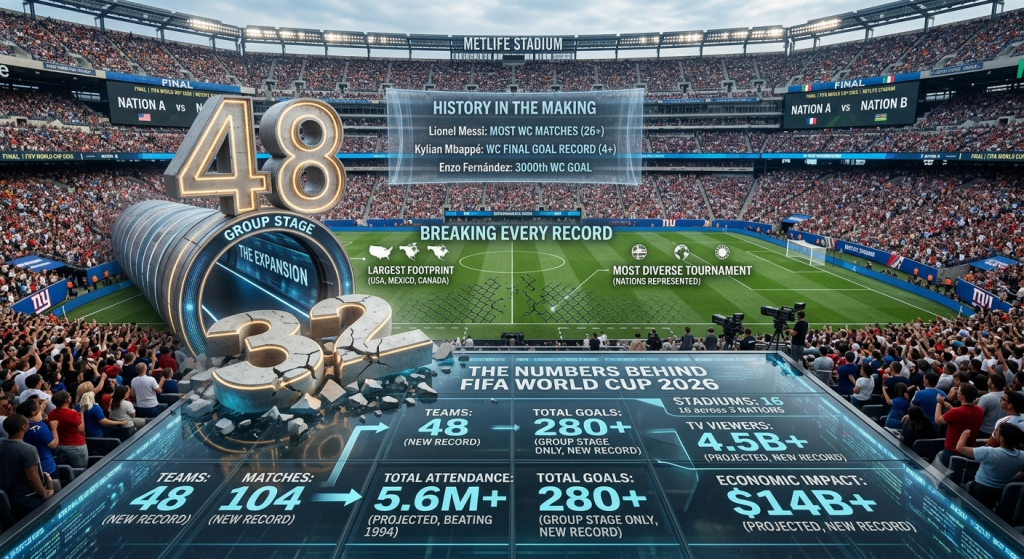
Perhaps the defining innovation of FIFA World Cup 2026 has been the expansion from 32 to 48 participating nations.
When FIFA announced the change several years ago, critics questioned whether increasing the number of teams would dilute quality and produce too many one-sided matches.
Instead, the opposite has happened.
The new format expanded representation across every continental confederation, creating opportunities for countries that had previously struggled to qualify for the world’s biggest football tournament.
With 104 matches instead of the previous 64, supporters have enjoyed significantly more football while emerging nations have gained invaluable experience competing against the sport’s elite. FIFA describes the new structure as the most inclusive in the tournament’s history.
Record Attendance Across North America
One of the tournament’s most remarkable achievements has been its extraordinary attendance figures.
Across the United States, Canada and Mexico, supporters have filled stadiums in numbers never previously witnessed at a FIFA World Cup.
FIFA reported that stadium occupancy reached approximately 99.7%, with more than 6.25 million spectators attending matches before the tournament concluded.
The success has silenced many early concerns about whether such a geographically vast tournament could generate a unified atmosphere.
Instead, fans from every continent transformed the host cities into celebrations of football, culture and international friendship.
Football’s Digital Revolution
If previous World Cups belonged primarily to television audiences, World Cup 2026 belongs equally to digital media.
FIFA announced that tournament-related content had generated approximately 20 billion video views across its digital platforms before the final. Viral celebrations, match highlights and behind-the-scenes content spread across social media within minutes of each game.
Platforms such as YouTube, Instagram, TikTok and X have transformed the supporter experience.
Fans no longer simply watch football.
They analyse it.
Debate it.
Share it.
Create content around it.
Football has become a continuous global conversation.
Tactical Football Has Reached Another Level
Beyond commercial success, World Cup 2026 has showcased some of the most sophisticated tactical football ever witnessed at international level.
Managers now rely upon advanced analytics, GPS tracking, artificial intelligence-assisted scouting and detailed performance data.
Former Arsenal manager Arsène Wenger, now FIFA’s Chief of Global Football Development, has repeatedly argued that modern coaching increasingly combines traditional football knowledge with scientific analysis.
Throughout the tournament, successful teams have demonstrated remarkable tactical flexibility.
Spain have controlled possession while attacking vertically.
Argentina have adapted seamlessly between pressing aggressively and defending compactly before launching devastating counterattacks.
England, France and Norway likewise displayed tactical evolution that reflects football’s continual development.

Young Stars Have Taken Centre Stage
Every World Cup introduces future legends.
FIFA World Cup 2026 has accelerated that process.
Spain’s Lamine Yamal has emerged as one of the tournament’s defining performers, playing with astonishing maturity despite his youth.
England’s Jude Bellingham continued establishing himself among the world’s finest midfielders.
Argentina’s younger generation—including Enzo Fernández, Julián Álvarez and Alexis Mac Allister—have provided vital support for Lionel Messi.
These performances reinforce an important reality.
Elite football increasingly belongs to players who combine technical excellence with exceptional tactical intelligence at remarkably young ages.
Lionel Messi’s Enduring Greatness
Although FIFA World Cup 2026 has celebrated emerging talent, one established superstar continues commanding worldwide attention.
Lionel Messi’s influence extends beyond statistics.
Against England in the semi-final, he provided assists for both Argentine goals despite not scoring.
Throughout the tournament he has demonstrated that football intelligence often becomes even more valuable than physical pace.
His performances have reminded supporters why many consider him the greatest footballer of all time.
Regardless of the final’s outcome, Messi has once again shaped the narrative of a World Cup.
Commercial Success Beyond Expectations
The FIFA World Cup has always represented one of sport’s most valuable commercial properties.
World Cup 2026 has elevated that success even further.
Broadcasting rights, sponsorship agreements, hospitality packages, merchandise and licensing continue generating enormous revenues for FIFA and its commercial partners.
Reuters recently highlighted that while financial investment alone cannot guarantee World Cup success, countries with greater football investment often possess stronger development structures and increased competitive depth. Yet the tournament has also shown that intelligent planning and coaching can allow lower-valued squads to defeat more expensive opponents.
The Global Reach Continues to Expand
One remarkable feature of this tournament has been its truly worldwide appeal.
Supporters from every continent have embraced the competition.
Countries eliminated early continued following the tournament through adopted “second teams.”
Host cities experienced multicultural celebrations rarely witnessed in international sport.
The Financial Times described the North American tournament as a major organisational success, noting strong attendance and a vibrant atmosphere despite pre-tournament concerns.
Football once again demonstrated its unique ability to unite people through a shared passion.
The Final Represents More Than a Trophy
The upcoming final between Spain and Argentina symbolises more than determining another world champion.
Argentina seek to become the first nation since Brazil in 1962 to successfully defend the FIFA World Cup.
Spain pursue only their second World Cup title after their historic triumph in 2010. FIFA has highlighted the final as the culmination of the largest tournament in the competition’s history.
Whatever the result, the final will conclude a tournament that has already transformed international football.
Conclusion
FIFA World Cup 2026 has exceeded expectations in almost every measurable category.
The expansion to 48 teams has broadened football’s global reach.
Record attendances have confirmed the tournament’s universal appeal.
Digital engagement has rewritten sporting benchmarks.
Young players have announced themselves as future global icons.
Established legends have continued inspiring millions.
Most importantly, the tournament has demonstrated that football’s greatest strength lies not merely in competition but in connection.
Across continents, cultures and generations, billions have experienced the same moments of joy, heartbreak and wonder.
When the trophy is finally lifted in New York New Jersey Stadium, the winning team will become world champions.
But regardless of whether Argentina or Spain prevails, FIFA World Cup 2026 has already secured a different kind of victory.
It has proven that the beautiful game continues to grow, innovate and inspire on a scale unmatched by any other sport on Earth.