The Ownership Economy: Why Equity Beats Income
Why True Wealth Is Built Through Ownership, Not Just Hard Work
Introduction: The Difference Between Working for Money and Owning Wealth
For decades, many people have been taught a simple financial formula:
- Go to school
- Get a good job
- Earn a stable income
- Work hard for decades
- Retire eventually
While employment and earned income remain important, modern wealth creation increasingly operates under a different system:
The Ownership Economy.
In today’s financial world, the largest fortunes are rarely built solely through salaries.
Instead, they are built through:
- Equity
- Ownership
- Assets
- Intellectual property
- Business stakes
- Royalties
- Investments
This creates one of the most important wealth distinctions of our time:
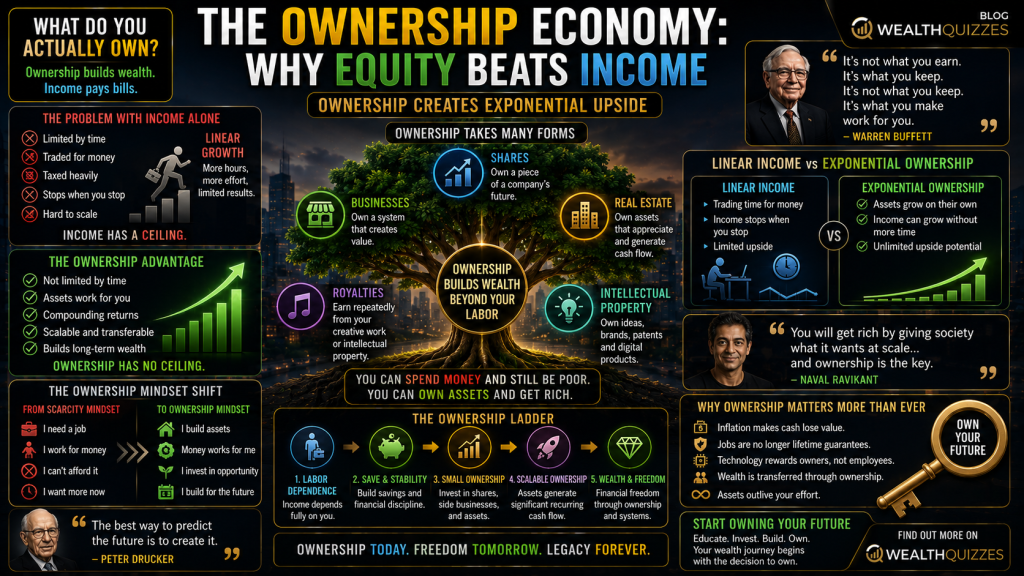
Income pays bills. Ownership builds wealth.
The highest earners are not always the wealthiest people.
Very often, the wealthiest individuals are those who own systems that continue producing value long after direct labor ends.
The Core Truth
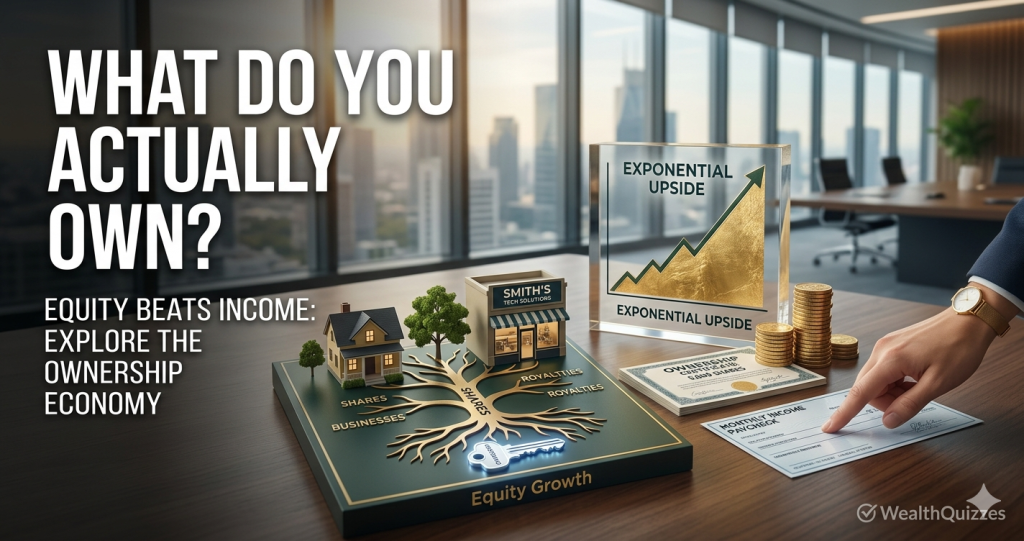
Core Idea: Ownership creates exponential upside
Angle: Shares, businesses, royalties
The financial world rewards ownership differently from labor.
Labor produces:
- Linear income
Ownership produces:
- Scalable and compounding returns.
Understanding the Ownership Economy
The ownership economy refers to:
A financial system where wealth increasingly flows toward people who own productive assets.
These assets may include:
- Businesses
- Company shares
- Real estate
- Digital products
- Royalties
- Intellectual property
- Investment portfolios
Why Ownership Matters
Ownership changes the relationship between:
- Effort
And: - Reward
In employment:
Income is usually tied directly to:
- Time
- Labor
- Hours worked
In ownership:
Income may continue growing even when:
- Direct effort decreases.
This creates:
Scalability.
Insight from Authority
As Robert Kiyosaki famously emphasized:
The rich acquire assets. The poor and middle class acquire liabilities they think are assets.
Whether one fully agrees with Kiyosaki or not, the principle remains influential:
Ownership is central to wealth accumulation.
The Problem With Income Alone
Income is important.
But income alone has limitations.
Salaries often face:
- Taxation
- Inflation pressure
- Time limitations
- Career ceilings
There are only so many:
- Hours in a day
- Promotions available
- Energy reserves available for labor
This means:
Pure labor-based income is often:
Structurally capped.
Ownership, however, operates differently.
The Power of Equity
Equity represents:
Ownership in a productive asset.
Examples include:
- Shares in companies
- Ownership in businesses
- Startup equity
- Partnership stakes
Why Equity Is Powerful
When a company grows:
- Equity holders benefit from growth beyond their labor contribution.
Example:
An employee may receive:
- Fixed salary increases
But an equity owner may benefit from:
- Exponential company growth.
Insight from Authority
As Naval Ravikant explains:
“You will get rich by giving society what it wants at scale… and ownership is the key.”
This highlights one of the central realities of modern wealth:
Scale rewards ownership disproportionately.
The Difference Between Linear and Exponential Income
Linear Income
Linear income grows through:
- More hours
- More effort
- More labor
Example:
- Salaries
- Freelance work
- Hourly services
Limitation:
Growth remains tied to personal capacity.
Exponential Income
Exponential income grows through:
- Systems
- Assets
- Ownership structures
Examples:
- Dividends
- Royalties
- Business equity
- Scalable digital assets
Result:
Income can grow without proportional increases in labor.
The Role of Shares and Investments
One of the simplest forms of ownership is:
- Equity investing.
When individuals own shares in productive companies:
- They participate in long-term value creation.
This is important because:
Many consumers spend money with companies they do not own.
Wealth builders often seek to:
Become partial owners of productive systems.
Insight from Authority
As Warren Buffett demonstrated throughout his career:
Long-term ownership of quality businesses can create extraordinary wealth through:
- Compounding
- Patience
- Strategic capital allocation
Royalties: The Ownership of Intellectual Property
Ownership is not limited to traditional businesses.
It also includes:
- Intellectual property
Examples include:
- Books
- Music
- Digital courses
- Software
- Creative licenses
Royalties are powerful because:
They allow creators to earn repeatedly from work completed once.
This is:
Scalable value creation.
The Nigerian Context: Why Ownership Matters More Than Ever
Nigeria’s economic realities include:
- Inflation
- Employment instability
- Currency challenges
- Limited wage growth
In this environment:
Relying solely on earned income may create vulnerability.
Ownership offers opportunities for:
- Financial resilience
- Wealth expansion
- Long-term security
Increasingly, young Nigerians are exploring:
- Entrepreneurship
- Digital ownership
- Investment participation
- Intellectual property monetization
However:
Ownership requires:
- Patience
- Discipline
- Financial literacy
The Psychological Shift From Consumption to Ownership
One major financial transformation occurs when people stop asking:
- “What can I buy?”
And begin asking:
“What can I own that produces value?”
This changes financial behavior dramatically.
Consumers focus on:
- Immediate gratification
Owners focus on:
- Long-term value generation
The Ownership Gap
One reason wealth inequality expands globally is because:
Asset owners benefit disproportionately from economic growth.
While many people depend solely on:
- Earned income
Others benefit from:
- Business growth
- Asset appreciation
- Market expansion
- Intellectual property systems
This creates widening financial differences over time.
Insight from Authority
Economist Thomas Piketty argued extensively that:
Returns on capital often outpace general wage growth.
This helps explain why ownership plays such a major role in wealth concentration.
The Risks of Ownership
Ownership is powerful, but not risk-free.
It may involve:
- Volatility
- Uncertainty
- Delayed returns
- Business failure risks
However:
The solution is not avoiding ownership entirely.
The solution is:
Strategic and informed participation.
Building Ownership Gradually
Ownership does not always require massive capital initially.
It can begin gradually through:
- Investing consistently
- Building small businesses
- Creating digital products
- Acquiring scalable skills
- Purchasing shares over time
The key is progression.
The Ownership Ladder
Most people move through stages:
Stage 1: Labor Dependence
Income depends fully on:
- Active work
Stage 2: Savings and Stability
Capital begins accumulating.
Stage 3: Small Ownership Participation
- Investments
- Small business stakes
- Side income systems
Stage 4: Scalable Ownership
Ownership systems begin generating:
- Significant recurring value
The goal is not necessarily abandoning employment immediately.
The goal is:
Gradually increasing ownership participation over time.
The Identity Shift
To thrive in the ownership economy, you must move from:
- “I work only for income”
To:
“I build and acquire systems that create value beyond my labor.”
The Real Transformation
Ownership changes:
- Financial leverage
- Wealth scalability
- Long-term opportunity
Eventually:
Money stops depending entirely on:
- Personal effort
And begins depending increasingly on:
Productive assets and scalable systems.
The Hard Truth
Many people spend years helping build:
- Other people’s assets
Without building:
- Any meaningful ownership for themselves.
Conclusion: Ownership Creates Financial Leverage
Income is necessary.
But ownership creates:
- Scalability
- Compounding
- Long-term wealth potential
The modern economy increasingly rewards:
- Equity
- Assets
- Intellectual property
- Value ownership
The people who build lasting wealth are often not merely the hardest workers.
They are:
The people who own systems capable of producing value repeatedly over time.
Final Thought
Ask yourself honestly:
“What do I actually own that can grow without my constant labor?”
Because financial freedom rarely comes only from earning more—
It often comes from:
Owning more productive assets over time.
👉 What do you actually own? Find out on WealthQuizzes