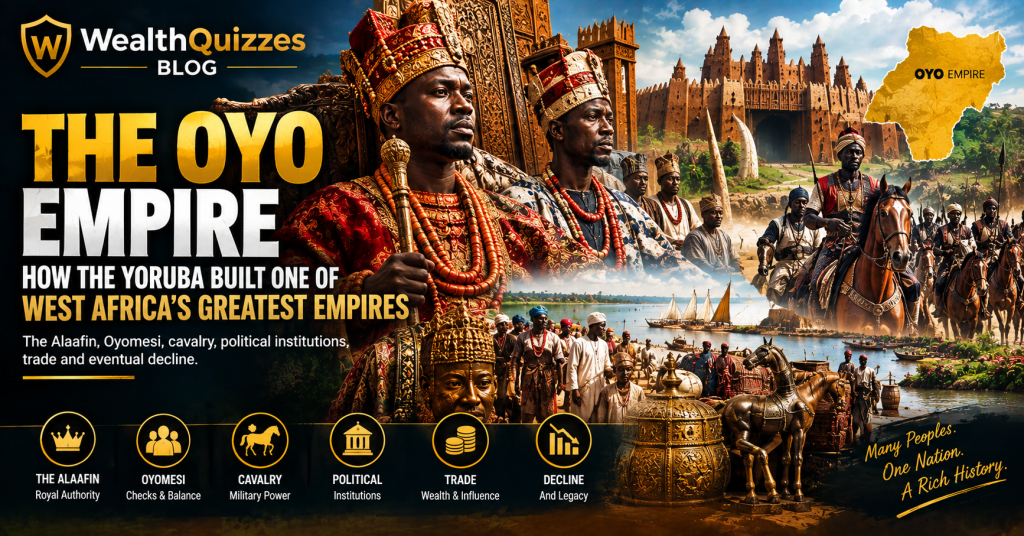
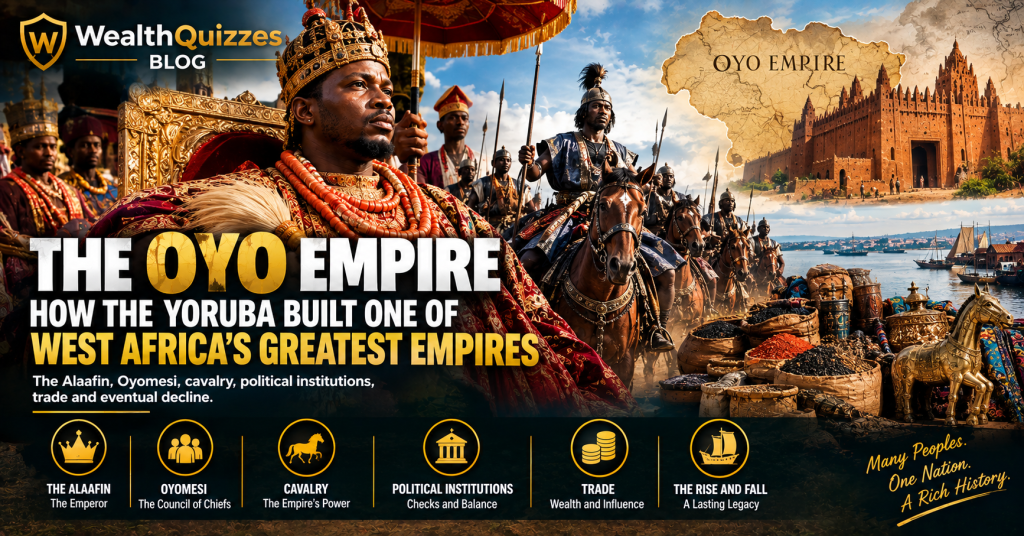
The Oyo Empire: How the Yoruba Built One of West Africa’s Greatest Empires
The Alaafin, Oyomesi, cavalry, political institutions, trade and eventual decline
Long before the emergence of Nigeria as a modern political entity, the Yoruba-speaking peoples of West Africa had developed sophisticated urban centres, kingdoms and systems of government. Among these states, the Oyo Empire emerged as one of the most powerful and influential.
At its height, Oyo controlled an extensive territory across much of present-day southwestern Nigeria and beyond. Its influence reached into neighbouring regions, including parts of present-day Benin Republic. It derived its power from an unusual combination of political institutions, commercial wealth, military organisation and especially cavalry warfare.
Historian B.A. Agiri describes Old Oyo as the largest and best-known of the Yoruba kingdoms, noting that it reached prominence particularly during the seventeenth and eighteenth centuries before collapsing and disintegrating in the early nineteenth century. (B.A. Agiri, “Early Oyo History Reconsidered,” History in Africa.)
The history of Oyo is consequently much more than the story of a powerful king. It is the story of a political system in which royal authority was deliberately balanced against the power of important chiefs, an economy sustained by agriculture and long-distance commerce, and a military machine whose cavalry enabled Oyo to project power over an enormous territory.
The Origins of Oyo
The origins of Oyo are intertwined with Yoruba traditions concerning Ile-Ife, the spiritual and cultural centre of the Yoruba world.
Yoruba traditions associate the foundation of Oyo with Oranmiyan, a legendary prince connected with Ife. The precise historical chronology remains debated because early traditions combine historical memories with mythology and dynastic traditions. Agiri cautions that the early history of Oyo is difficult to reconstruct precisely because the traditions concerning its origins are deeply intertwined with myth and legend.
What is clearer is that Oyo developed into a major Yoruba political centre and eventually surpassed many other Yoruba kingdoms in political and military influence.
The geography of Oyo was critical to its development.
Unlike the forest environment surrounding many southern Yoruba states, Old Oyo was located in the savannah zone north of the forest belt, in the region south of the Niger River. This environment was particularly suitable for horse-based warfare and also positioned Oyo close to important commercial routes.
According to Oxford Research Encyclopedia’s account of precolonial Yoruba states, changes in trade routes helped Oyo eclipse Ile-Ife in political prestige and power, eventually allowing Oyo to establish the largest empire in the region and dominate political affairs across much of Yorubaland. (Ayodeji Ogunnaike, “Precolonial Yoruba States,” Oxford Research Encyclopedia of African History.)
The Alaafin: The Emperor at the Centre of the State
At the centre of the Oyo political system stood the Alaafin, the supreme ruler of the empire.
The Alaafin exercised substantial political, military, judicial and religious authority. He represented the continuity of the Oyo dynasty and was the symbolic centre of imperial unity.
But the Alaafin was not an absolute monarch in the European sense.
This distinction is fundamental to understanding Oyo’s political sophistication.
The political system incorporated powerful councils and chiefs whose authority could constrain the Alaafin. The most important of these institutions was the Oyo Mesi.
The Oyomesi: A Constitutional Check on Royal Power
The Oyo Mesi was a council of leading non-royal chiefs who played a crucial role in the administration of the empire.
The council was headed by the Bashorun, one of the most powerful political figures in the kingdom.
Historian R.C.C. Law’s detailed study of Oyo’s constitutional troubles demonstrates that the relationship between the Alaafin and the Oyo Mesi was a central feature of the kingdom’s political system. During the eighteenth century, serious struggles developed between the king and the chiefs over political authority and control of the wealth generated by imperial expansion. These conflicts culminated in major political upheavals, including the seizure of power by the Bashorun in 1754 and another decisive crisis around 1796. (R.C.C. Law, “The Constitutional Troubles of Ọyọ in the Eighteenth Century,” The Journal of African History.)
The Oyo Mesi therefore functioned as a significant institutional counterweight to the Alaafin.
Traditional accounts hold that the council could compel an Alaafin to abdicate. The constitutional relationship was therefore based not simply on obedience to the king but on an institutional distribution of authority.
The African Histories project at Wake Forest University, drawing particularly on the scholarship of Robin Law, describes Oyo’s political structure as one in which policy was jointly formulated by the Alaafin and the Oyo Mesi. The Alaafin was the ultimate arbiter in principle, but was expected to take account of the views of the council.
This arrangement demonstrates that sophisticated governance did not necessarily require modern constitutional documents or Western parliamentary institutions.
Oyo had its own system of checks, balances, offices and political accountability.
The Provincial System
The political structure of Oyo extended beyond the capital.
The empire consisted of the metropolitan core and a network of provincial and tributary territories. Local rulers retained varying degrees of authority but were required to recognise Oyo’s supremacy and fulfil obligations to the imperial centre.
The Alaafin appointed or recognised officials who helped administer imperial territories. Tribute, military service and political allegiance connected the provinces to the centre.
This arrangement enabled Oyo to exercise influence over a large geographical area without requiring the complete replacement of every local political institution.
The system was therefore both centralised and flexible.
Oyo could incorporate neighbouring political communities while allowing local structures to survive under imperial supervision.
The Cavalry: The Military Engine of Oyo
If political organisation gave Oyo its institutional strength, cavalry gave it much of its imperial reach.
Robin Law’s landmark study, A West African Cavalry State: The Kingdom of Oyo, is particularly important for understanding this dimension of Oyo’s history.
Law argues that Oyo’s use of cavalry may have been adopted as early as the sixteenth century. Oyo was never self-sufficient in horses and depended upon imports from the Central Sudan. Horse mortality caused by diseases such as trypanosomiasis was a serious limitation, making the maintenance of cavalry an expensive undertaking. Nevertheless, Oyo cavalry possessed substantial military value. (Robin Law, “A West African Cavalry State: The Kingdom of Oyo,” The Journal of African History.)
The importance of cavalry was directly connected to Oyo’s geography.
Mounted troops were particularly effective in the open savannah environment. They provided mobility, shock power and the ability to conduct rapid campaigns over considerable distances.
The empire could therefore use cavalry to suppress rebellion, expand territory, enforce tribute arrangements and intimidate rival states.
The position of the Are-Ona-Kakanfo, traditionally associated with the military leadership of the empire, illustrates the institutional importance of warfare.
Military power, however, came at a price.
Horses had to be imported, maintained and replaced. Cavalrymen required specialised equipment, training and logistical support. Law therefore argues that the economic burden of cavalry may itself have contributed to the peculiar political structure of Oyo by limiting the extent to which the Alaafin could establish an entirely autonomous royal military machine.
In other words, the very military institution that made Oyo powerful also imposed economic and political constraints upon the empire.
Trade and the Wealth of Oyo
Oyo’s imperial power was closely connected with commerce.
Its location between the northern savannah and the southern forest placed it at an important crossroads of regional trade.
Agricultural production provided the economic foundation of the society, while long-distance commerce generated additional wealth. Oyo became deeply involved in the movement of goods between the interior and the Atlantic coast.
Trade included livestock, agricultural products, textiles and other commodities. Over time, Oyo also became deeply involved in the Atlantic slave trade.
Robin Law’s scholarship demonstrates that Oyo’s imperial expansion and Atlantic commercial connections were closely intertwined. During its period of greatest power, the empire supplied enslaved people to European merchants operating along the coast.
This aspect of Oyo’s history must be addressed honestly.
The Atlantic slave trade was not simply an external European phenomenon imposed upon passive African societies. African states, including powerful ones such as Oyo, participated in systems of warfare, enslavement, tribute and commercial exchange that fed into the Atlantic market.
At the same time, European demand dramatically expanded the scale and economic significance of the trade.
The resulting wealth contributed to the political power of Oyo but also intensified warfare and political competition.
Oyo’s Imperial Reach
At its height, Oyo was not merely one Yoruba kingdom among many.
It had become an imperial power.
Robin Law estimates that during its period of greatest expansion, Oyo controlled much of northern Yorubaland and extended southwestward into the Egbado region, with its influence approaching the Atlantic coast. The Alaafin also received tribute from neighbouring states, including territories associated with Dahomey.
Oyo’s power therefore rested upon a combination of:
- political authority;
- military superiority;
- cavalry;
- tribute;
- agriculture;
- long-distance trade;
- control of commercial routes; and
- diplomatic relationships with neighbouring states.
The empire’s success demonstrates how African states could build imperial systems without adopting European political models.
The Contradictions of Imperial Power
Yet the Oyo political system contained internal contradictions.
The Alaafin needed the Oyo Mesi.
The provincial rulers needed the imperial centre.
The imperial centre needed tribute from the provinces.
The military needed horses.
The horses depended upon external trade.
The economy benefited from expansion but expansion increased competition over wealth and political office.
These tensions became increasingly dangerous in the eighteenth century.
R.C.C. Law’s analysis of the constitutional crisis shows that the struggle between the Alaafin and the Oyo Mesi was not simply a personal dispute. It was connected to competition over the enormous new sources of wealth created by imperial expansion.
As Oyo became richer, the question of who controlled that wealth became increasingly consequential.
The Beginning of Decline
Oyo’s decline was not caused by one isolated event.
It resulted from a combination of internal political conflict, weakening central authority, military difficulties, provincial rebellions and changing regional conditions.
The eighteenth century witnessed serious struggles between the Alaafin and the Oyo Mesi. By the end of the century, the political balance that had previously helped stabilise the empire had become increasingly dysfunctional.
Robin Law’s study of Oyo’s political disintegration argues that the kingdom had already been weakened by prolonged internal conflict before the decisive events of the early nineteenth century.
This is an important distinction.
The eventual collapse of Oyo should not be explained simply as the result of an external Muslim revolution or a single rebellion.
The empire was already experiencing profound internal instability.
The Ilorin Crisis and the Final Collapse
One of the most consequential developments occurred in the northern part of the empire at Ilorin.
Afonja, the Are-Ona-Kakanfo and ruler of Ilorin, had been in rebellion against the Alaafin. In 1817, he formed an alliance with a militant Muslim faction led by the Fulani cleric Alim al-Salih.
The development was influenced by the wider political transformation occurring in Hausaland following the Fulani jihad led by Usman dan Fodio, which had produced the Sokoto Caliphate.
The alliance eventually resulted in Muslim control of Ilorin and the incorporation of the city into the Sokoto sphere.
Robin Law argues that the decisive point is that the Ilorin crisis emerged from Oyo’s pre-existing political disintegration. The internal civil conflict had already weakened the empire’s capacity to respond effectively.
The result was catastrophic.
Oyo’s central authority collapsed.
The old capital was abandoned.
The empire fragmented.
The political vacuum contributed to decades of warfare across Yorubaland, during which new powers—including Ibadan, Abeokuta and other states—emerged.
The Collapse of Old Oyo
By approximately 1830–1836, the old imperial system had effectively collapsed.
The once-powerful Old Oyo capital was abandoned.
The Alaafin dynasty survived, however, and a new Oyo polity was eventually established farther south.
The distinction between the collapse of the Oyo Empire and the disappearance of Oyo kingship is therefore essential.
The empire fell, but the institution of the Alaafin did not disappear.
The Yoruba political world subsequently entered a new era characterised by competing states, warfare, migration, diplomacy and commercial transformation.
Oxford Research Encyclopedia describes the collapse of Oyo as a development whose consequences extended far beyond the empire itself, contributing to a prolonged period of warfare and political reorganisation throughout the Yoruba region.
Why Did Oyo Fall?
Historians have debated the relative importance of the various causes.
A simplistic explanation would identify one factor—such as the Fulani jihad—and declare it responsible for the collapse.
The historical evidence suggests something more complicated.
1. Internal Political Conflict
The struggle between the Alaafin and the Oyo Mesi weakened the central government.
2. Provincial Rebellion
Provincial leaders increasingly challenged the authority of the imperial centre.
3. Military Weakening
The cavalry system was expensive and dependent upon imported horses. Robin Law links the decline in cavalry strength partly to economic difficulties.
4. Economic Disruption
Changes in regional trade affected the resources available to the imperial state.
5. External Pressure
Oyo faced challenges from neighbouring states and emerging powers.
6. Ilorin and the Sokoto Expansion
The loss of Ilorin created a major strategic and political crisis.
The collapse was therefore systemic rather than instantaneous.
The Legacy of the Oyo Empire
The Oyo Empire’s political collapse did not erase its historical influence.
Its political institutions left a deep imprint on Yoruba political thought.
Its military traditions demonstrated the effectiveness of cavalry in West African statecraft.
Its commercial networks helped connect the interior with Atlantic markets.
Its imperial expansion shaped the political geography of Yorubaland.
And its constitutional arrangements remain one of the most striking examples of institutional checks on royal authority in pre-colonial Africa.
Historian Toyin Falola has emphasised the importance of nineteenth-century Yoruba historical writing, particularly the work of figures such as Samuel Johnson, whose The History of the Yorubas became one of the most influential written accounts of Yoruba history.
Such works are important not merely because they preserve memories of Oyo but because they demonstrate that Yoruba historical consciousness continued to interpret, debate and reconstruct the empire long after its political collapse.
Conclusion: An Empire Built on Institutions
The Oyo Empire deserves its place among the great political formations of pre-colonial West Africa.
Its greatness did not rest upon the Alaafin alone.
It rested upon a system.
The Alaafin provided dynastic authority and political legitimacy.
The Oyo Mesi provided institutional restraint.
Provincial authorities extended imperial administration.
The cavalry projected military power.
Trade generated wealth.
Tribute connected the provinces to the imperial centre.
And the wider Yoruba political culture supplied the social and institutional foundations upon which the empire was built.
Oyo’s eventual collapse is equally instructive.
It demonstrates that powerful empires do not necessarily fall because they encounter a stronger external enemy. They can also decline when the institutions that once made them successful become sources of internal conflict.
The story of Oyo is therefore both a story of Yoruba achievement and a lesson in political resilience.
It reveals a society capable of building one of West Africa’s most extensive empires while simultaneously demonstrating the dangers of institutional rivalry, military dependence, economic disruption and provincial fragmentation.
Most importantly, the Oyo experience challenges the outdated notion that sophisticated constitutional thinking, organised military systems and complex imperial administration were foreign to pre-colonial Africa.
They were not.
The Yoruba built them themselves.
Selected Renowned Authorities
- Robin Law, The Oyo Empire, c.1600–c.1836: A West African Imperialism in the Era of the Atlantic Slave Trade (Oxford University Press, 1977).
- Robin Law, “A West African Cavalry State: The Kingdom of Oyo,” The Journal of African History — a foundational study of Oyo’s cavalry system, horse imports and military economy.
- Robin Law, “The Constitutional Troubles of Ọyọ in the Eighteenth Century,” The Journal of African History — important scholarship on the Alaafin–Oyo Mesi struggle.
- B.A. Agiri, “Early Oyo History Reconsidered,” History in Africa — a critical examination of Oyo’s early history and the difficulties of reconstructing it from oral traditions.
- R.C.C. Law, scholarship on the political disintegration and fall of Oyo.
- Toyin Falola, scholarship on Yoruba history and nineteenth-century Yoruba historiography.
- Robert Smith, “The Alafin in Exile: A Study of the Igboho Period in Oyo History,” The Journal of African History.
- Ayodeji Ogunnaike, “Precolonial Yoruba States,” Oxford Research Encyclopedia of African History.
WealthQuizzes Blog takeaway: The Oyo Empire was not built by military force alone. Its enduring significance lies in the institutions that connected kingship, councils, provincial administration, cavalry and commerce into one of West Africa’s most formidable pre-colonial states.