
The Personal Finance Operating System: How to Run Your Money Like a Business
Why Financial Success Requires Systems—Not Good Intentions
Introduction: The Illusion of Financial Control
Most people believe they are “managing” their money.
They:
- Earn income
- Pay bills
- Spend what’s left
- Occasionally save
And yet, despite these efforts, many still feel:
- Disorganized
- Financially stagnant
- Uncertain about progress
This reveals a critical flaw:
They don’t have a system—they have habits.
And habits, without structure, are unreliable.
The Core Truth
Core Idea: Money needs systems, not intentions
Mindset Shift: Random handling → Structured control
If your finances depend on:
- Memory
- Mood
- Willpower
Then your outcomes will always be:
Inconsistent
What Is a Personal Finance Operating System?
A Personal Finance Operating System (PFOS) is:
A structured framework that controls how money flows, is allocated, and grows
It is not:
- A budget alone
- A savings plan alone
It is:
A complete system governing your financial life
Why You Must Treat Money Like a Business
Every successful business has:
- Revenue streams
- Expense management
- Profit allocation
- Financial reporting
- Growth strategy
Your personal finances are no different.
As Peter Drucker famously said:
“What gets measured gets managed.”
Yet most individuals:
- Do not track properly
- Do not allocate intentionally
- Do not review performance
The Problem with Habit-Based Money Management
When you rely on habits:
- Spending becomes reactive
- Saving becomes inconsistent
- Investing becomes optional
This creates:
Financial randomness
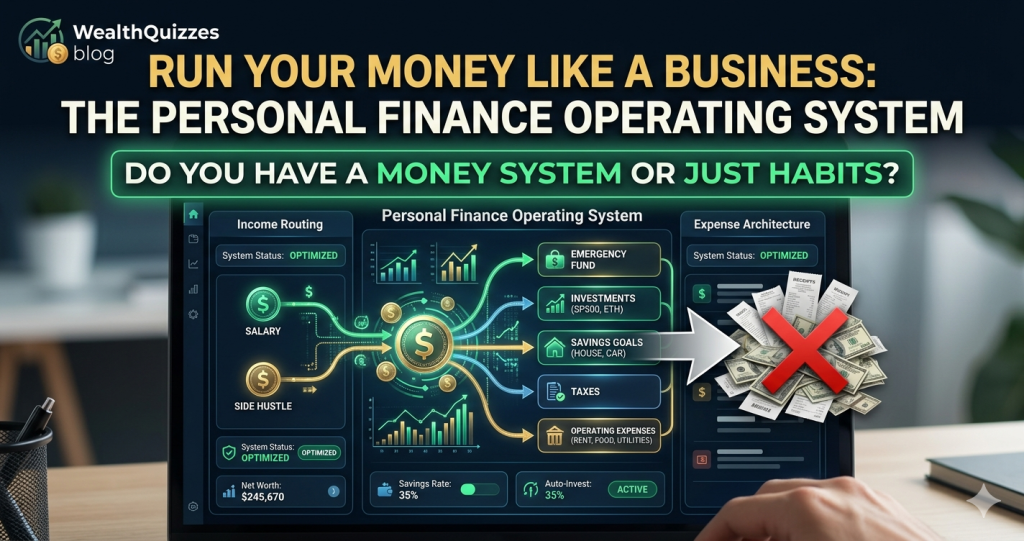
The Structure of a Personal Finance Operating System
A functional PFOS has four core layers:
🧱 1. Income Routing System
The Principle:
Money should not land randomly and be spent randomly.
It should:
Be directed immediately into predefined channels
How It Works:
When income comes in, it is automatically divided into:
- Essentials (living costs)
- Savings
- Investments
- Discretionary spending
Why This Matters
As George Clason advised:
“Pay yourself first.”
But most people:
- Spend first
- Save what’s left (if anything)
System Thinking:
Income → Allocation → Spending
Not: Income → Spending → Regret
⚙️ 2. Expense Architecture
The Principle:
Not all expenses are equal.
Categories:
Fixed Expenses
- Rent
- Utilities
- Transport
Variable Expenses
- Food
- Entertainment
- Lifestyle spending
Growth Expenses
- Skills
- Investments
- Business inputs
The Mistake Most People Make
They treat:
- Lifestyle spending
- Investment spending
As equal.
The System Approach
Design your expenses so that:
Growth is funded before comfort
🔁 3. Financial Control Loop
The Principle:
A system without feedback will fail.
Monthly Financial Cycle:
- Track income and expenses
- Compare with plan
- Identify leaks
- Adjust allocations
Why This Matters
As W. Edwards Deming emphasized:
“You can’t improve what you don’t measure.”
Without This Loop:
- Mistakes repeat
- Waste continues
- Growth stalls
📈 4. Growth Engine
The Principle:
Money must move beyond maintenance into multiplication.
Growth Channels:
- Investments
- Business
- Skill monetization
The Key Shift
From:
- Managing money
To:
Growing money
Insight from Authority
As Warren Buffett explains:
“Do not save what is left after spending, but spend what is left after saving.”
The Difference Between People With and Without Systems
| Without System | With System |
|---|---|
| Reactive | Proactive |
| Inconsistent | Predictable |
| Emotional | Structured |
| Short-term | Long-term |
The Nigerian Context: Why Systems Are Critical
In Nigeria:
- Income can be unstable
- Costs are rising
- Social pressure affects spending
Without a system:
Money disappears faster than expected
Example of No System
- Salary comes in
- Bills are paid randomly
- Spending fills the gaps
- No tracking
- No clear growth
Example of a System
- Income is allocated instantly
- Expenses are predefined
- Savings and investments are automatic
- Monthly review ensures improvement
The Psychological Advantage of Systems
Systems remove:
- Decision fatigue
- Emotional spending
- Inconsistency
As James Clear explains:
“You do not rise to the level of your goals. You fall to the level of your systems.”
The Real Reason People Fail Financially
It is not:
- Lack of income
- Lack of knowledge
It is:
Lack of structure
Building Your Personal Finance Operating System
Step 1: Define Allocation Percentages
Example:
- 50% Essentials
- 20% Savings
- 20% Investments
- 10% Lifestyle
Step 2: Automate Money Flow
- Separate accounts
- Scheduled transfers
Step 3: Track Monthly
- Know your inflow
- Know your outflow
Step 4: Optimize Continuously
- Reduce waste
- Increase efficiency
The Identity Shift
You must move from:
- “I manage money casually”
To:
“I operate a financial system.”
The Real Transformation
When you build a PFOS:
You move from:
- Chaos → Control
- Guessing → Clarity
- Earning → Building
The Hard Truth
Most people are not financially stuck because:
- They don’t earn enough
They are stuck because:
They don’t have a system.
Conclusion: Systems Create Wealth
Money flows naturally toward:
- Structure
- Discipline
- Control
Without systems:
- Income disappears
- Opportunities are missed
With systems:
Wealth becomes predictable
Final Thought
Before chasing more income, ask yourself:
“Do I have a money system—or just habits?”
Because the difference between financial stress and financial control is not how much you earn—
It is how your money is structured.
👉 Do you have a money system or just habits? Find out on WealthQuizzes