

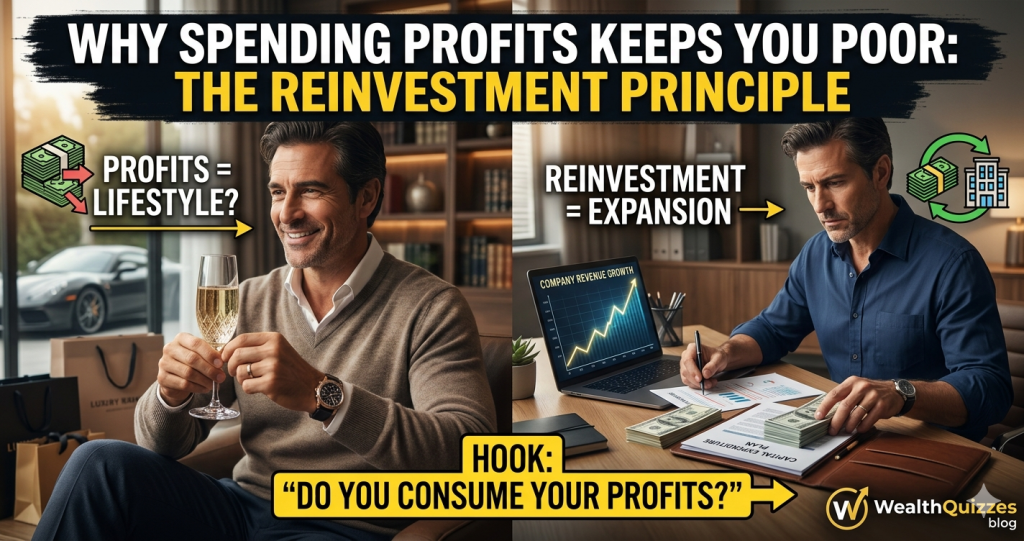
The Reinvestment Principle: Why Spending Profits Keeps You Poor
How Consuming Gains Undermines Growth—and Why Reinvestment Is the Engine of Wealth
Introduction: Profit Without Progress
Earning a profit—whether from a business, side hustle, or investment—is often seen as the ultimate financial milestone. It signals progress, validation, and success.
Yet a recurring pattern undermines this progress:
- Profits are withdrawn and spent
- Lifestyle expands
- Growth stalls
Months or years later, despite repeated “profits,” there is little to show in terms of scalable wealth.
This contradiction reveals a critical principle:
Profit alone does not build wealth—reinvestment does.
The Core Truth
Core Idea: Growth requires reinvestment
Mindset Shift: Profit → Lifestyle → Profit → Growth
If profits are consistently consumed, growth is capped.
If profits are strategically reinvested, growth compounds.
What Is the Reinvestment Principle?
The Reinvestment Principle states:
A significant portion of profits must be redirected back into productive use to generate future income and expansion.
This applies across:
- Businesses
- Investments
- Personal finance systems
The Two Paths of Profit
When profit is earned, there are only two broad choices:
1. Consumption Path
- Spending on lifestyle
- Immediate gratification
- No long-term growth
2. Reinvestment Path
- Expanding business capacity
- Increasing investment capital
- Building income-generating systems
The Long-Term Difference
| Approach | Outcome |
|---|---|
| Consume profits | Stagnation |
| Reinvest profits | Compounding growth |
Insight from Authority
As Warren Buffett built his fortune, a defining strategy was:
Reinvesting earnings to generate further returns
This disciplined approach allowed small gains to grow into vast wealth over time.
Why People Spend Profits
Despite knowing the benefits of reinvestment, many individuals still consume their gains.
1. Reward Psychology
After effort and success, people feel entitled to:
- Celebrate
- Upgrade lifestyle
2. Lack of Financial Structure
Without a reinvestment plan:
- Profits are treated as disposable income
3. Short-Term Thinking
Immediate satisfaction is prioritized over:
- Long-term wealth
Insight from Authority
As Daniel Kahneman explains, humans tend to:
Overvalue immediate rewards and undervalue long-term benefits.
The Hidden Cost of Consuming Profits
Every naira spent from profit has:
An opportunity cost—the growth it could have generated
Example:
- ₦200,000 profit spent → zero future return
- ₦200,000 reinvested → potential compounding income
Over Time:
This difference becomes exponential.
The Compounding Effect
Reinvestment activates compounding:
- Profits generate more profits
- Those profits are reinvested
- Growth accelerates
Insight from Authority
As Albert Einstein is widely credited with noting:
“Compound interest is the eighth wonder of the world.”
Business Perspective: Reinvestment Drives Expansion
In business:
- Reinvestment funds growth
- Growth increases revenue
- Increased revenue generates larger profits
Areas for Reinvestment:
- Marketing and customer acquisition
- Product improvement
- Operational efficiency
- Talent and systems
Without Reinvestment:
- Growth stagnates
- Competitors advance
- Market position weakens
Investment Perspective: Capital Growth
For investors:
- Reinvesting dividends or returns increases capital base
- Larger capital generates larger returns
The Snowball Effect:
- Small capital → modest returns
- Reinvested returns → larger capital
- Larger capital → accelerated growth
The Nigerian Context: Why Reinvestment Is Critical
In Nigeria:
- Inflation reduces purchasing power
- Business environments are competitive
- Income volatility is common
Without Reinvestment:
- Profits are eroded by inflation
- Growth remains limited
With Reinvestment:
- Capital grows
- Financial resilience improves
- Opportunities expand
The Discipline Gap
The challenge is not knowledge—it is execution.
Many people:
- Understand reinvestment
- But fail to apply it consistently
Why?
Because:
- There is no system
- Decisions are emotional
- Spending is habitual
The Identity Shift
To apply the Reinvestment Principle, you must move from:
- “Profit is mine to spend”
To:
“Profit is fuel for growth.”
Practical Reinvestment Framework
Step 1: Define a Reinvestment Ratio
Decide in advance:
- What percentage of profits will be reinvested
Example:
- 60% reinvested
- 40% available for use
Step 2: Separate Profit Accounts
- Keep reinvestment funds distinct
- Avoid mixing with personal spending
Step 3: Automate Reinvestment
- Set up automatic transfers or reinvestment plans
Step 4: Reinvest Strategically
Focus on:
- High-impact opportunities
- Scalable systems
Step 5: Delay Lifestyle Expansion
Upgrade lifestyle only after:
- Growth is secured
- Systems are stable
The Long-Term Impact
Consistent reinvestment leads to:
- Larger capital base
- Increased income streams
- Financial independence potential
The Real Transformation
You move from:
- Earning profits → Spending profits
To:
- Earning profits → Multiplying profits
The Hard Truth
Most people are not financially stuck because:
- They don’t make profits
They are stuck because:
They consume the profits they make.
Conclusion: Growth Is a Decision
Profit is not the destination.
It is:
The starting point of growth
Money spent ends.
Money reinvested:
- Grows
- Multiplies
- Transforms your financial future
Final Thought
Right now, reflect on your last financial gain:
“Did I grow my capital—or just upgrade my lifestyle?”
Because the difference between financial stagnation and wealth is not profit—
It is what you do with it.
👉 Do you consume your profits? Find out on WealthQuizzes