
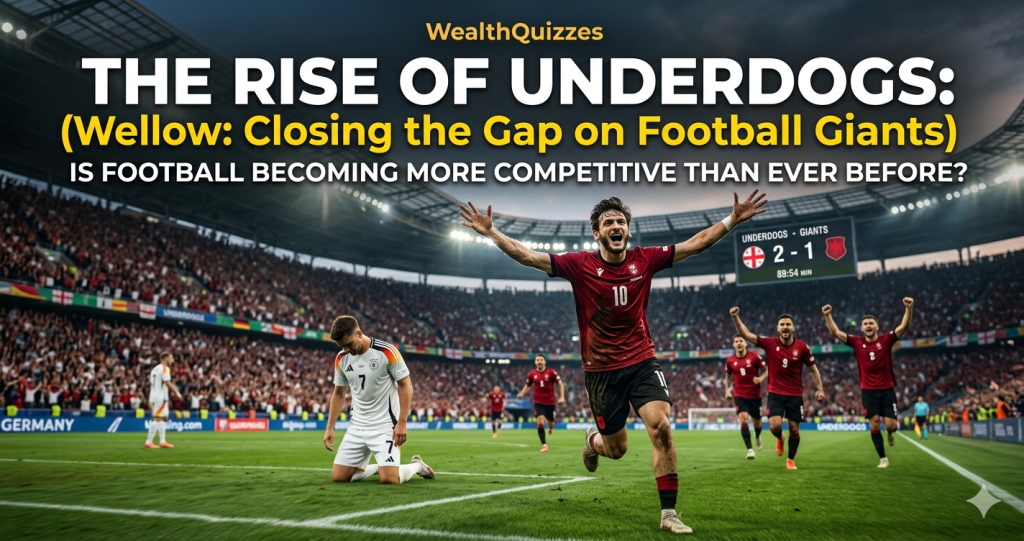
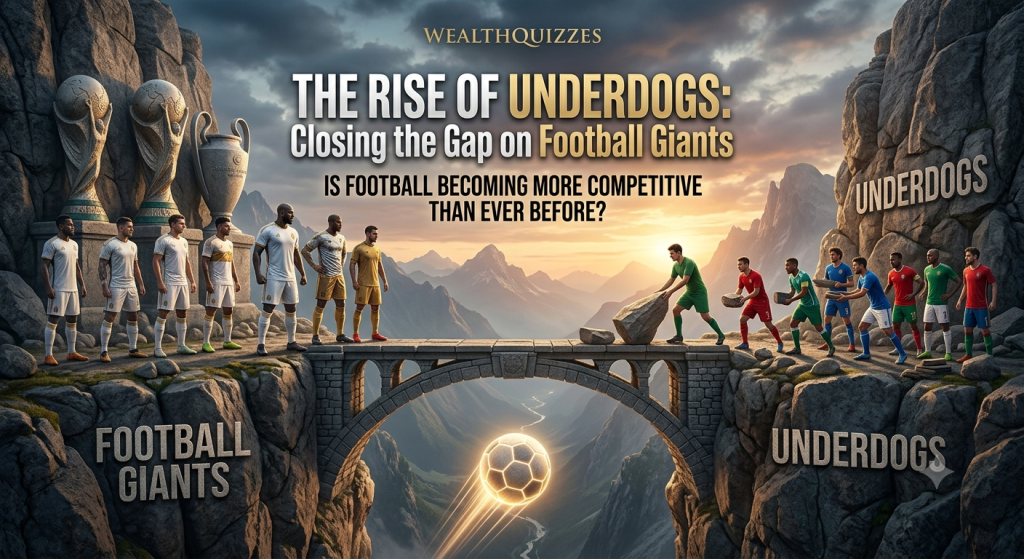
The Rise of Underdogs: Why Smaller Nations Are Closing the Gap on Football Giants
Is Football Becoming More Competitive Than Ever Before?
For much of football history, the FIFA World Cup was dominated by a select group of traditional powers. Nations such as Brazil, Germany, Italy, Argentina, and France built legacies through decades of consistent excellence, producing generations of world-class players and collecting multiple World Cup trophies. Facing these football giants was once viewed as an almost impossible challenge for smaller or emerging football nations.
Today, that narrative is rapidly changing.
The FIFA World Cup 2026 has already produced compelling evidence that the gap between football’s traditional superpowers and emerging nations is narrowing. Smaller countries are no longer content merely to participate—they are arriving with sophisticated tactical systems, highly trained players, world-class coaching staffs, advanced sports science programs, and genuine ambitions of competing with the very best.
The modern World Cup has become increasingly unpredictable, and that unpredictability may be the clearest sign that international football is entering a new era.
The question is no longer whether underdogs can compete.
It is whether football has become more competitive than at any other point in its history.
The Traditional World Order
Historically, international football revolved around a relatively small group of dominant nations.
Between the inaugural FIFA World Cup in 1930 and the early twenty-first century, the overwhelming majority of World Cup titles were won by a handful of countries with long-established football cultures.
These nations possessed advantages that were difficult for others to match:
- Extensive youth development systems.
- Strong domestic leagues.
- Superior coaching infrastructure.
- Greater financial investment.
- Rich football traditions.
- Larger pools of elite players.
Football historian David Goldblatt explains in The Ball Is Round that football dominance historically reflected broader economic, institutional, and cultural advantages rather than talent alone.
Those structural advantages helped establish the global hierarchy that defined much of twentieth-century football.
The Rise of the Modern Underdog
Over the past two decades, however, significant changes have reshaped international football.
Countries once considered outsiders have become increasingly capable of challenging established powers.
Remarkable examples include:
- Croatia reaching the 2018 World Cup final.
- Morocco becoming the first African nation to reach a World Cup semifinal in 2022.
- Japan repeatedly defeating traditional European and South American powers.
- South Korea consistently demonstrating tactical sophistication on football’s biggest stage.
These achievements are no longer viewed as isolated surprises.
They increasingly represent the new competitive reality.
Better Coaching Has Changed Everything
One of the most significant reasons for the rise of smaller nations is the global improvement in coaching.
Elite coaching knowledge is no longer confined to traditional football powers.
Modern coaches study identical tactical concepts through international licensing programs, coaching exchanges, and digital education platforms.
Former Arsenal manager and FIFA Chief of Global Football Development Arsène Wenger has repeatedly emphasized that coaching standards have improved dramatically across every continent.
As tactical education has spread, smaller nations have become increasingly capable of organizing defensively, pressing collectively, and executing sophisticated attacking systems.
The difference between elite and emerging teams is therefore becoming smaller.
Global Player Development
Another major factor is globalization.
Talented young footballers from emerging nations increasingly develop their skills within Europe’s strongest professional leagues.
Players representing countries in Africa, Asia, North America, and Oceania now compete regularly in:
- Premier League
- La Liga
- Bundesliga
- Serie A
- Ligue 1
Exposure to elite competition accelerates player development.
Football journalist Jonathan Wilson argues that tactical understanding now spreads internationally at unprecedented speed because players regularly train alongside the world’s best coaches and teammates.
When they return to represent their national teams, they bring that experience with them.
Sports Science Levels the Playing Field
Modern football depends increasingly upon sports science.
Areas such as:
- Nutrition.
- Performance analysis.
- Injury prevention.
- Recovery management.
- GPS tracking.
- Physical conditioning.
have become essential components of elite performance.
Sports scientist Tim Gabbett has demonstrated that marginal gains accumulated across numerous performance areas can significantly influence competitive outcomes.
Previously, only football’s richest nations could access these resources.
Today, sports science expertise is far more widely available.
Smaller nations now prepare their athletes with methods approaching those used by traditional powers.
Technology Has Democratized Knowledge
Technology has dramatically accelerated football’s globalization.
Video analysis software, tactical databases, artificial intelligence, and digital coaching platforms have made elite football knowledge accessible worldwide.
National teams can now analyze opponents with extraordinary precision.
Coaches can review:
- Pressing structures.
- Passing patterns.
- Defensive weaknesses.
- Set-piece routines.
- Transition moments.
Sports economist Stefan Szymanski has argued that information increasingly represents one of football’s most valuable competitive resources.
Technology has reduced informational inequality between large and small football nations.
Team Cohesion Often Beats Individual Stardom
International football differs fundamentally from club football.
National teams have relatively little preparation time.
Consequently, collective organization frequently outweighs individual brilliance.
Legendary Italian coach Arrigo Sacchi famously argued:
“Football is the most important of the least important things.”
More importantly, Sacchi consistently emphasized that organized teams defeat collections of talented individuals.
Many emerging nations now demonstrate exceptional tactical discipline.
Compact defensive structures, coordinated pressing, and rapid transitions frequently neutralize technically superior opponents.
The World Cup increasingly rewards organization.
The Psychological Barrier Has Disappeared
Perhaps the greatest transformation has occurred mentally.
Previous generations often approached matches against football giants with caution or even intimidation.
Today’s players exhibit far greater confidence.
Sports psychologist Bob Rotella explains that belief significantly influences elite performance.
Once athletes genuinely believe victory is possible, they compete differently.
Recent World Cups have repeatedly demonstrated that emerging nations now enter matches expecting to compete—not merely survive.
That psychological shift has altered tournament dynamics.
The Expanded 48-Team World Cup
The FIFA World Cup 2026 has introduced another important development.
Expansion from 32 to 48 teams provides more nations with opportunities to compete against elite opposition.
Critics initially feared that expansion would weaken tournament quality.
Instead, many analysts argue it may accelerate football development worldwide.
Former FIFA President Gianni Infantino has consistently defended expansion by arguing that greater participation stimulates investment, infrastructure development, and competitive growth across all confederations.
More exposure creates more experience.
More experience produces stronger teams.
Morocco Changed Football History
Perhaps no recent example better illustrates football’s changing landscape than Morocco’s extraordinary performance at the 2022 FIFA World Cup.
Morocco defeated several European powers before becoming the first African nation ever to reach a World Cup semifinal.
The achievement was not based on luck.
It reflected:
- Outstanding coaching.
- Tactical discipline.
- Elite goalkeeping.
- Defensive organization.
- Mental resilience.
Morocco demonstrated that emerging nations could consistently compete with football’s traditional elite.
Their success inspired countless other countries.
Youth Development Is Expanding Globally
Youth academies are no longer concentrated solely in Europe and South America.
Investment in player development has expanded significantly across:
- Africa.
- Asia.
- North America.
- The Middle East.
Former Dutch legend Johan Cruyff believed that sustained success begins with youth education rather than expensive transfers.
Many emerging football nations have embraced precisely that philosophy.
The results are increasingly visible at World Cups.
Football’s Growing Competitive Balance
Economists often describe competitive balance as essential to sporting entertainment.
When outcomes become less predictable, competitions become more exciting.
The World Cup increasingly reflects this principle.
Traditional giants remain exceptionally strong.
However, victories are no longer guaranteed.
Every match demands complete concentration.
Every opponent deserves respect.
This growing balance enhances the tournament’s global appeal.
Lessons for Football Giants
The rise of underdogs carries important lessons for established powers.
Historical reputation no longer guarantees success.
Elite nations must continuously innovate.
Former Manchester United manager Sir Alex Ferguson frequently warned against complacency.
Football evolves constantly.
Teams failing to adapt inevitably lose their competitive advantage.
The modern World Cup rewards preparation rather than reputation.
Conclusion: A Stronger World Cup for Everyone
Is football becoming more competitive than ever before?
The evidence strongly suggests that it is.
Improved coaching, globalization, sports science, advanced technology, expanded youth development, and greater tactical sophistication have dramatically reduced the gap between football’s traditional powers and emerging nations.
While countries such as Brazil, Argentina, Germany, France, and Italy remain among the sport’s elite, they now face increasingly capable challengers from every continent.
The FIFA World Cup 2026 reflects this transformation.
Underdogs are no longer simply hoping to produce occasional upsets.
They are arriving with the genuine belief that they belong among football’s best.
As Johan Cruyff wisely observed, football is ultimately played with both the head and the feet.
Today’s emerging nations have developed both.
That evolution is making the FIFA World Cup more competitive, more unpredictable, and more captivating than ever before.