
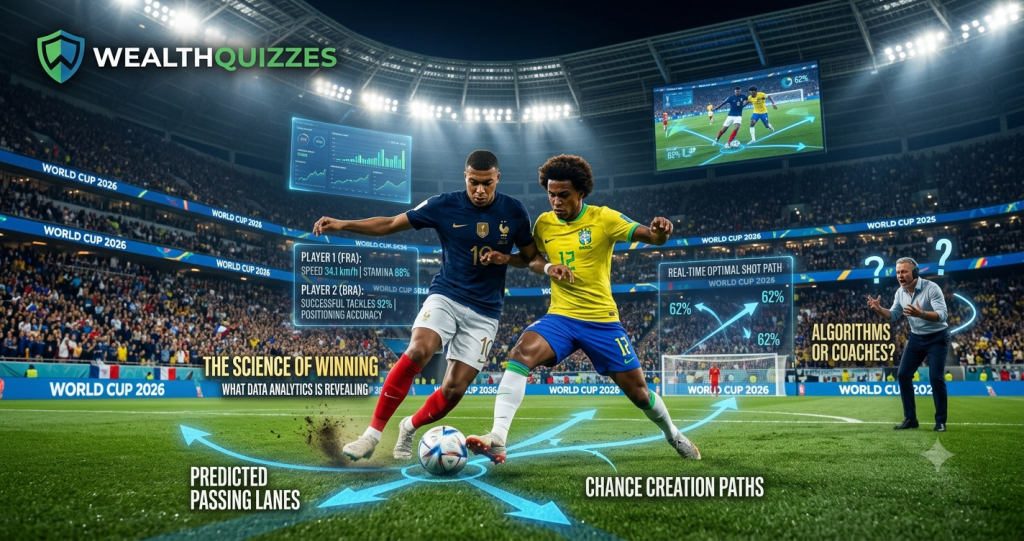
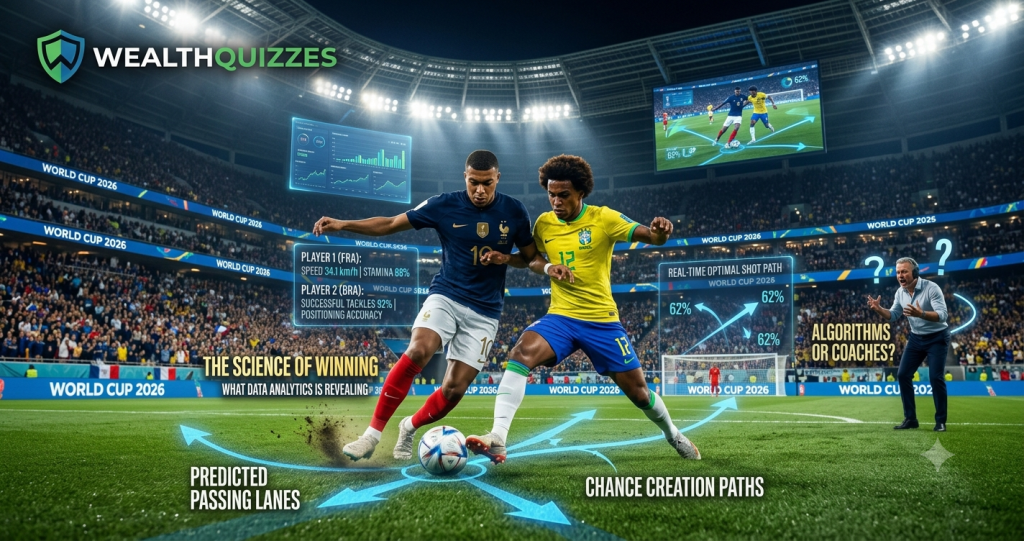
The Science of Winning: What Data Analytics Is Revealing at FIFA World Cup 2026
Are Algorithms Becoming as Important as Coaches?
Football has often been described as the beautiful game because of its unpredictability. A single moment of brilliance, an unexpected tactical adjustment, or an inspired save can alter the destiny of a nation. Yet beneath the emotion, passion and drama that define the FIFA World Cup lies an increasingly scientific discipline. In modern football, every sprint, pass, tackle, shot and positional movement generates data. Teams no longer rely solely on instinct or experience—they increasingly rely on analytics.
The FIFA World Cup 2026, jointly hosted by the United States, Canada and Mexico, showcased this evolution more clearly than any previous tournament. As the first World Cup featuring 48 nations and 104 matches, it became not only the largest football competition in history but also one of the most data-intensive sporting events ever staged.
Elite national teams employed sophisticated analytics departments alongside traditional coaching staffs. Artificial intelligence-assisted scouting, GPS performance tracking, predictive modelling, biomechanical monitoring and video analytics all played crucial roles in match preparation and player management.
This raises an intriguing question:
Are algorithms becoming as important as coaches?
The answer is both fascinating and nuanced.
While football remains a game played by human beings, the science behind winning has never been more advanced.
Football’s Data Revolution
Only two decades ago, football analysis consisted largely of coaches reviewing match recordings and compiling handwritten notes.
Today, every movement on the pitch can be measured.
According to FIFA’s Football Technology & Innovation Department, modern tournaments utilize optical tracking systems, wearable technologies during training, event data, positional tracking and advanced video analysis to provide coaches with detailed performance information.
Companies such as Stats Perform, Opta Analyst, Hudl, Catapult Sports, and Second Spectrum have transformed football analysis by collecting millions of data points throughout a tournament.
These systems answer questions that previously depended entirely upon subjective judgment:
- Which midfielder covers the most dangerous passing lanes?
- Which full-back recovers quickest after losing possession?
- Which pressing system creates the highest probability of forcing turnovers?
- Which striker consistently finds high-value shooting positions?
- How does fatigue influence passing accuracy after the 75th minute?
World Cup 2026 demonstrated that these questions are no longer theoretical.
They influence real coaching decisions.
Spain: Champions Built on Intelligence
Spain’s triumph at FIFA World Cup 2026 illustrated the marriage between traditional football philosophy and modern analytics.
Manager Luis de la Fuente inherited technically gifted footballers but combined their natural ability with meticulous tactical preparation.
Throughout the tournament Spain consistently demonstrated:
- Superior positional discipline.
- Efficient pressing triggers.
- Excellent ball progression.
- Controlled possession under pressure.
- Defensive compactness.
These qualities reflected careful analysis rather than coincidence.
According to FIFA’s Technical Study Group (TSG), chaired by legendary former Arsenal manager Arsène Wenger, elite teams increasingly rely upon detailed positional data to optimize defensive shape and attacking transitions.
Spain embodied these principles throughout the tournament.
Their success demonstrated that data enhances—not replaces—football intelligence.
Expected Goals (xG): Measuring Chance Quality
Perhaps no analytical metric has transformed football discussion more than Expected Goals (xG).
Popularized by analysts working with companies such as Opta and StatsBomb, xG estimates the probability that a particular shot will result in a goal based on historical data.
Factors considered include:
- Shooting distance.
- Angle to goal.
- Type of assist.
- Body part used.
- Defensive pressure.
- Goalkeeper positioning.
Former Liverpool manager Jürgen Klopp has acknowledged that expected-goals models provide useful insights when interpreted correctly, although he cautions against treating them as absolute predictors of outcomes.
World Cup 2026 provided several examples where teams generated high xG values but failed to convert opportunities, reinforcing football’s enduring unpredictability.
Analytics reveal probabilities.
Players determine realities.
GPS Technology Is Transforming Physical Performance
Modern footballers are monitored almost continuously during training.
Companies such as Catapult Sports provide wearable GPS devices capable of measuring:
- Total distance covered.
- High-speed running.
- Sprint frequency.
- Acceleration.
- Deceleration.
- Heart-rate responses.
- Player workload.
According to FIFA’s Medical Network, workload management has become essential in reducing injury risk during condensed international tournaments.
Teams competing deep into World Cup 2026 increasingly rotated players based upon physiological data rather than intuition alone.
Sports science now influences squad selection as much as tactical considerations.
Artificial Intelligence Is Enhancing Opposition Analysis
Preparing for international opponents once required weeks of manual video review.
Artificial intelligence now accelerates that process dramatically.
Machine-learning systems identify recurring tactical patterns including:
- Preferred attacking channels.
- Pressing tendencies.
- Set-piece routines.
- Defensive vulnerabilities.
- Passing networks.
- Transition behaviours.
Former German coach Joachim Löw famously emphasized meticulous opponent preparation during Germany’s successful 2014 World Cup campaign.
Modern AI tools simply make that preparation faster and more comprehensive.
World Cup 2026 demonstrated how coaching staffs increasingly combine human expertise with computational analysis.
Goalkeepers Benefit from Predictive Analytics
Perhaps no position has embraced analytics more enthusiastically than goalkeeping.
Penalty preparation now extends far beyond watching highlight videos.
Goalkeeping coaches analyse:
- Preferred penalty directions.
- Run-up characteristics.
- Body orientation.
- Historical placement tendencies.
- Psychological patterns under pressure.
Former Arsenal and Czech Republic goalkeeper Petr Čech, now widely respected for his analytical approach to goalkeeping, has frequently highlighted the growing importance of data in penalty preparation.
Spain’s Unai Simón, winner of the tournament’s Golden Glove, benefited from one of football’s most sophisticated analytical support systems.
Preparation increasingly begins long before kick-off.
Recruitment Is Becoming More Scientific
Although national teams cannot buy players, domestic clubs increasingly use sophisticated analytics when developing future internationals.
Renowned clubs including Liverpool FC, Brighton & Hove Albion, Brentford FC, and FC Midtjylland have become famous for integrating statistical analysis into recruitment and player development.
Football writer Michael Lewis, author of Moneyball, helped popularize the idea that statistical inefficiencies can create competitive advantages.
While football differs significantly from baseball, the underlying principle remains relevant.
Smarter decisions frequently outperform larger budgets.
World Cup 2026 showcased numerous players whose development benefited from data-driven coaching environments.
The Human Brain Still Matters Most
Despite extraordinary technological advances, no algorithm can fully measure:
- Leadership.
- Courage.
- Confidence.
- Creativity.
- Mental resilience.
- Emotional intelligence.
These remain fundamentally human qualities.
Legendary manager Sir Alex Ferguson consistently argued that football management depends primarily upon understanding people rather than tactics alone.
Similarly, renowned sports psychologist Dr. Steve Peters, author of The Chimp Paradox, emphasizes that emotional regulation frequently determines elite performance under pressure.
World Cup 2026 repeatedly demonstrated this truth.
No algorithm could quantify Lionel Messi’s leadership.
No statistical model fully explained Spain’s composure in the final.
No predictive system could accurately measure the psychological momentum generated by passionate supporters.
Football remains gloriously human.
Data Does Not Replace Coaching
One common misconception suggests that analytics diminish the role of coaches.
The opposite is true.
Data provides information.
Coaches provide interpretation.
Former Manchester City manager Pep Guardiola, widely regarded as one of football’s greatest tactical innovators, has repeatedly emphasized that statistics must always serve football understanding rather than replace it.
The best coaches ask better questions because they possess better information.
Algorithms cannot deliver inspirational halftime speeches.
They cannot substitute exhausted players based upon emotional intuition.
They cannot unite dressing rooms after painful defeats.
Leadership remains irreplaceable.
Ethical Questions Are Emerging
The rapid expansion of football analytics also raises important ethical considerations.
These include:
- Player privacy.
- Ownership of biometric data.
- Artificial intelligence transparency.
- Competitive fairness.
- Data security.
FIFA has increasingly emphasized responsible governance regarding football technologies, ensuring innovation develops alongside ethical safeguards.
As analytics continue evolving, balancing technological progress with player welfare will become increasingly important.
Lessons for Business and Leadership
The analytical revolution occurring in football mirrors transformations across modern business.
Organizations increasingly rely upon:
- Predictive analytics.
- Artificial intelligence.
- Machine learning.
- Performance dashboards.
- Behavioural data.
- Scenario modelling.
Yet successful companies consistently combine these technologies with experienced leadership.
Management expert Peter Drucker famously stated:
“What gets measured gets managed.”
World Cup 2026 demonstrated that principle repeatedly.
However, measurement alone never guarantees success.
Interpretation remains equally important.
The Future of Football Analytics
Looking ahead to future World Cups, several innovations appear increasingly likely:
- Real-time tactical recommendations supported by artificial intelligence.
- Enhanced injury prediction models.
- More sophisticated fatigue monitoring.
- Improved talent identification algorithms.
- Advanced virtual reality training environments.
- Greater integration of biometric performance data.
FIFA’s continued investment in football innovation suggests analytics will become even more influential during future tournaments.
Nevertheless, football’s unpredictability ensures complete automation remains impossible.
That uncertainty remains one of the sport’s greatest attractions.
Conclusion
The FIFA World Cup 2026 demonstrated that football has entered a new scientific era.
Elite teams now prepare with unprecedented precision.
Every movement is measured.
Every opponent is analysed.
Every tactical adjustment is informed by sophisticated data.
Algorithms undoubtedly play a larger role than ever before.
Yet they remain tools—not decision-makers.
Spain’s World Cup triumph reflected the successful integration of modern analytics with exceptional coaching, intelligent leadership and extraordinary teamwork.
As Arsène Wenger has repeatedly argued through FIFA’s Technical Study Group, technology should enhance football rather than redefine it.
Ultimately, data can identify opportunities.
Artificial intelligence can predict probabilities.
Algorithms can optimize preparation.
But they cannot score winning goals.
They cannot inspire teammates.
They cannot lift trophies.
Football’s future belongs not to machines alone, but to those who combine the power of data with the timeless qualities of human judgment, courage and imagination.
That is the true science of winning.