
The Skill Monetization Framework: Turning Ability into Scalable Income
Why Having a Skill Is Not Enough—and How to Structure It Into Real Wealth
Introduction: The Talent Trap
Millions of people possess valuable skills:
- Graphic design
- Writing
- Programming
- Teaching
- Marketing
- Photography
- Sales
- Public speaking
Yet many skilled individuals remain financially stagnant.
Why?
Because:
A skill alone does not automatically produce income.
This is one of the biggest misunderstand truths in modern wealth creation.
Many people focus heavily on:
- Learning skills
But ignore:
- Structuring those skills into scalable income systems
As a result:
- They stay underpaid
- Overworked
- Financially inconsistent
The reality is simple:
Skills only create wealth when they are monetized strategically.
The Core Truth
Core Idea: Skills must be structured to pay
Mindset Shift: Skill → Income system
The market does not reward talent alone.
It rewards:
- Value delivery
- Positioning
- Scalability
- Systems
The Difference Between a Skill and a Monetized Skill
There is a major difference between:
- Having ability
And: - Converting ability into reliable income
Example:
A talented designer may:
- Create excellent work
But still struggle financially because:
- There is no business structure around the skill
Meanwhile:
- A less talented designer with strong systems may earn significantly more.
Why Many Skilled People Stay Broke
1. Skills Without Positioning
People often:
- Learn skills
- But fail to define:
- Who they help
- What problem they solve
- Why they are valuable
Result:
- Weak demand
- Poor pricing power
2. Trading Time Directly for Money
Many skilled individuals rely entirely on:
- Hourly work
Problem:
Income becomes limited by:
- Time
- Energy
- Capacity
3. Lack of Packaging
Raw skill is difficult to sell.
Structured offers are easier to buy.
Example:
Instead of:
- “I do marketing”
A packaged skill becomes:
“I help small businesses increase online sales through targeted social media campaigns.”
Insight from Authority
As Peter Drucker famously emphasized:
“The purpose of business is to create and keep a customer.”
Skills become valuable only when they solve identifiable problems.
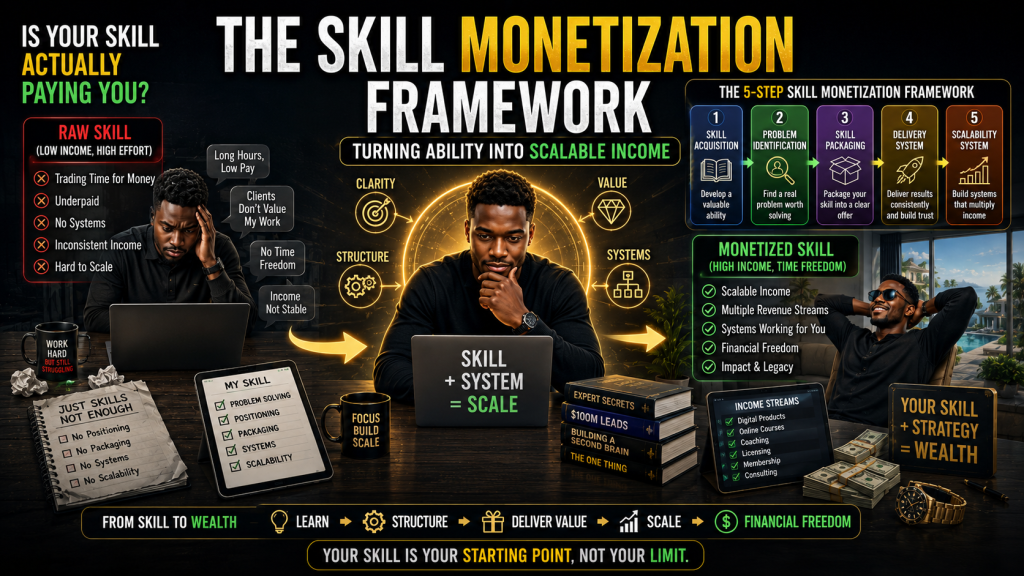
The Skill Monetization Framework
To transform ability into scalable income, skills must move through a structured framework.
Stage 1: Skill Acquisition
This is where:
- Competence is developed
Examples:
- Learning coding
- Learning copywriting
- Learning video editing
Important:
Skill alone is only the beginning.
Stage 2: Problem Identification
Ask:
“What specific problem does this skill solve?”
Wealth follows problem-solving.
The larger and more painful the problem:
- The greater the income potential
Stage 3: Skill Packaging
Packaging transforms:
- Raw ability
Into:
- A clear market offer
Good packaging includes:
- Defined outcome
- Clear target audience
- Specific value proposition
Example:
Instead of:
- “I teach fitness”
Package it as:
“I help busy professionals lose weight in 90 days without extreme dieting.”
Insight from Authority
As Seth Godin explains:
People do not buy products or services; they buy solutions, transformation, and outcomes.
Stage 4: Delivery System
This stage focuses on:
- Consistency
- Professionalism
- Results
Strong delivery creates:
- Reputation
- Referrals
- Trust
Stage 5: Scalability
This is where true income growth happens.
Instead of:
- Repeating manual labor endlessly
You create:
- Systems that multiply income
Examples of Scalable Monetization
- Digital products
- Online courses
- Subscription communities
- Licensing
- Templates
- Automation
- Agencies
- Software tools
The Scalability Difference
Without scalability:
- Income remains linear
With scalability:
- Income can grow exponentially
Insight from Authority
As Naval Ravikant explains:
Modern wealth is built through leverage—especially products and systems that scale without proportional labor.
The Nigerian Context: Why Skill Monetization Matters
Nigeria has:
- A large youth population
- Rising unemployment
- Economic volatility
This makes skill monetization increasingly critical.
Traditional employment alone:
- May not provide sufficient financial growth
Those who successfully monetize skills gain:
- Flexibility
- Independence
- Expanded income opportunities
Common Skill Monetization Mistakes
1. Learning Without Execution
Many people:
- Consume endless tutorials
- But never build offers
Result:
- Knowledge accumulation without income
2. Underpricing
People often:
- Charge too little
- Due to lack of confidence or positioning
Result:
- Burnout with low profitability
3. Lack of Specialization
Generalized skills often struggle in competitive markets.
Specialized solutions attract:
- Higher demand
- Better pricing
The Identity Shift
To monetize skills effectively, you must move from:
- “I have talent”
To:
“I operate a value-producing system.”
Packaging Skills Into Wealth
Skill monetization improves dramatically when skills are converted into:
1. Products
Examples:
- E-books
- Templates
- Digital resources
2. Services
Examples:
- Consulting
- Coaching
- Freelancing
3. Systems
Examples:
- Agencies
- Platforms
- Membership models
The Role of Personal Branding
In today’s digital economy:
- Visibility matters
Strong personal brands increase:
- Trust
- Authority
- Demand
Insight from Authority
As Gary Vaynerchuk repeatedly emphasizes:
Attention is one of the most valuable assets in modern business.
Building a Skill Income System
Step 1: Identify Your Core Skill
Ask:
- What valuable ability do I possess?
Step 2: Define the Market Problem
Clarify:
- Who needs this solution?
Step 3: Create a Structured Offer
Develop:
- A clear transformation promise
Step 4: Build Visibility
Use:
- Social media
- Content
- Networking
- Online platforms
Step 5: Introduce Scalability
Gradually move from:
- One-to-one labor
Toward:
- Systems and leveraged products
The Long-Term Advantage
When skills are monetized properly:
- Income becomes more predictable
- Growth becomes scalable
- Wealth creation accelerates
The Real Transformation
You move from:
- Having useful abilities
To:
Owning income-producing systems built around your expertise
The Hard Truth
Many talented people remain financially limited not because:
- Their skills lack value
But because:
Their skills lack structure.
Conclusion: Skill Alone Is Not Wealth
A skill is:
- Potential
Monetization is:
- Conversion
The marketplace rewards:
- Structure
- Positioning
- Scalability
- Consistent value delivery
In today’s economy, one of the greatest financial advantages is not merely learning skills—
It is:
Building systems that allow those skills to generate scalable income repeatedly.
Final Thought
Ask yourself honestly:
“Is my skill simply an ability—or is it an income system?”
Because the difference between talent and wealth is not knowledge alone—
It is monetization structure.
👉 Is your skill actually paying you? Find out on WealthQuizzes