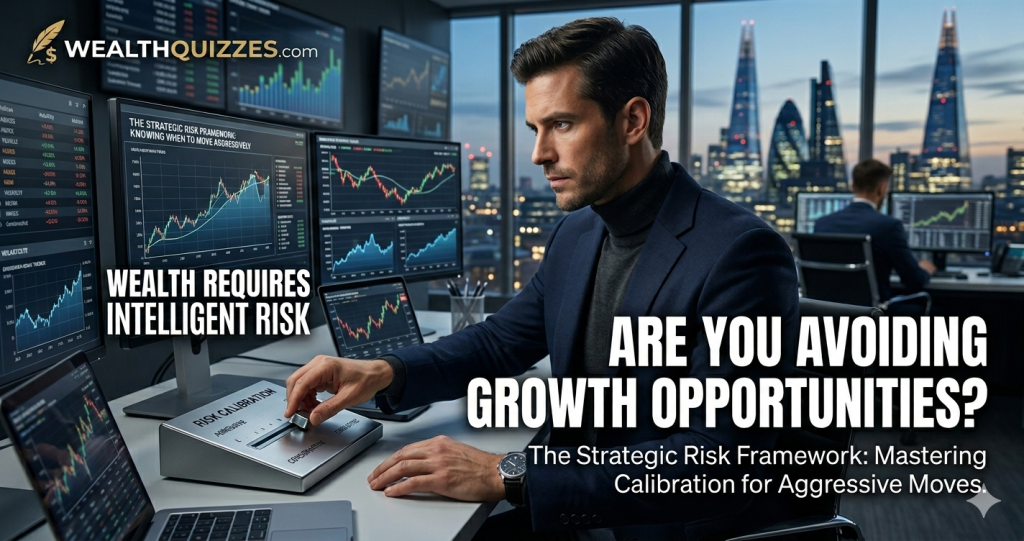
The Strategic Risk Framework: Knowing When to Move Aggressively
Why Intelligent Risk-Taking Separates Wealth Builders from Wealth Watchers
Introduction: The Hidden Cost of Playing Too Safe
Many people believe the path to financial security is avoiding risk.
They are taught:
- Protect what you have
- Stay comfortable
- Avoid uncertainty
- Never take chances
At first glance, this advice appears sensible.
After all, risk can lead to:
- Financial losses
- Business failures
- Investment mistakes
- Career setbacks
However, there is another side to the equation that often goes unnoticed:
Avoiding risk carries its own risks.
A person who never invests may lose purchasing power to inflation.
A professional who never develops new skills may become obsolete.
An entrepreneur who never expands may miss transformational opportunities.
An investor who never takes calculated risks may never build significant wealth.
This creates an important reality:
Wealth requires intelligent risk.
Virtually every major financial success story involves moments where individuals moved beyond certainty and embraced carefully calculated uncertainty.
The challenge is not whether to take risks.
The challenge is:
Knowing which risks are worth taking.
This is the foundation of:
The Strategic Risk Framework.
The Core Truth
Core Idea: Wealth requires intelligent risk
Angle: Risk calibration
Financial success is rarely created by:
- Recklessness
Nor is it created by:
- Excessive caution
Instead, it emerges from:
Intelligent risk management.
Understanding Risk Correctly
Many people misunderstand risk.
They view risk as:
- Danger
- Loss
- Uncertainty
However:
In finance, risk is simply:
The possibility that outcomes may differ from expectations.
Some risks create:
- Losses
Others create:
- Opportunities
Therefore:
The goal is not eliminating risk.
The goal is:
Managing risk intelligently.
Insight from Authority
Investor Howard Marks has repeatedly argued that successful investing is not about avoiding risk entirely.
Instead:
Successful investors understand and price risk better than others.
Why Wealth Requires Risk
Nearly every wealth-building activity involves uncertainty.
Examples include:
- Starting a business
- Investing in stocks
- Buying real estate
- Acquiring new skills
- Expanding operations
- Changing careers
None of these activities guarantee success.
Yet they often create the greatest opportunities for wealth creation.
The Reality:
No meaningful financial growth occurs in a completely risk-free environment.
Insight from Authority
Economist Frank Knight distinguished between certainty and uncertainty.
His work highlighted that profit often emerges because individuals are willing to act under uncertain conditions.
The Cost of Excessive Caution
Many people focus entirely on:
- What they might lose
They rarely consider:
- What they might miss
This creates a hidden problem:
Opportunity cost.
Examples include:
- Delaying investments for decades
- Avoiding entrepreneurship permanently
- Refusing skill development
- Remaining in stagnant careers
- Ignoring emerging opportunities
While these decisions may feel safe:
They often carry long-term financial costs.
Insight from Authority
Economist Thomas Sowell has emphasized that every decision involves trade-offs.
Choosing safety often means sacrificing potential upside.
Risk Versus Recklessness
One of the most important distinctions in wealth-building is:
Risk is not the same as recklessness.
Recklessness involves:
- Gambling
- Emotional decisions
- Poor research
- Excessive leverage
- Blind speculation
Strategic risk involves:
- Analysis
- Preparation
- Probability assessment
- Downside protection
- Long-term thinking
Wealthy individuals rarely gamble blindly.
Instead:
They make calculated bets.
The Nigerian Context
In Nigeria, risk management is particularly important due to:
- Inflation
- Currency volatility
- Business uncertainty
- Economic fluctuations
- Regulatory changes
These conditions create both:
- Challenges
and - Opportunities
Some individuals respond by becoming excessively cautious.
Others become recklessly aggressive.
The most successful often pursue a middle path:
Strategic risk-taking.
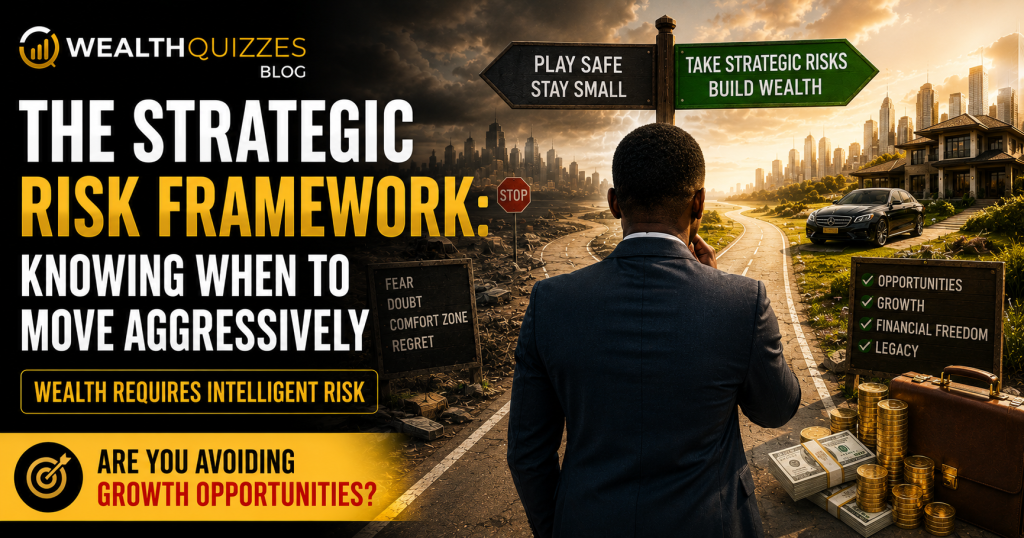
They evaluate opportunities carefully while remaining willing to act.
The Asymmetry Principle
One of the most powerful concepts in risk management is:
Asymmetry.
An asymmetric opportunity exists when:
Potential upside is significantly larger than potential downside.
Example:
Learning a valuable skill may require:
- Time
- Effort
- Modest cost
But the upside may include:
- Higher income
- Better opportunities
- Career growth
Limited downside.
Massive upside.
Insight from Authority
Entrepreneur and investor Naval Ravikant frequently discusses the importance of seeking opportunities with:
- Large upside potential
- Limited downside exposure
The Risk Calibration Framework
Strategic risk-taking requires calibration.
Before making decisions, ask:
1. What Is the Potential Upside?
How much can be gained?
2. What Is the Potential Downside?
What is the maximum loss?
3. Can I Survive the Loss?
Would failure be manageable?
4. Is the Reward Worth the Risk?
Does the opportunity justify exposure?
5. What Is the Probability of Success?
How realistic is the expected outcome?
This framework improves decision quality.
Why Wealthy People Move Aggressively at Certain Times
One common misconception is that wealthy people always take risks.
Not true.
Instead:
They often become aggressive when:
- Information is strong
- Probabilities are favorable
- Downside is manageable
- Opportunity is significant
They are selective.
They do not move aggressively all the time.
They move aggressively when conditions justify action.
Insight from Authority
Investor Warren Buffett famously noted:
Opportunities come infrequently.
When they do appear:
Decisive action often matters.
The Role of Preparation
Confidence in risk-taking usually comes from preparation.
Preparation includes:
- Knowledge
- Research
- Skill acquisition
- Financial reserves
- Strategic planning
Well-prepared individuals often perceive opportunities differently than unprepared individuals.
Why?
Because preparation reduces uncertainty.
The Financial Resilience Connection
Strategic risk-taking becomes easier when resilience exists.
Individuals with:
- Emergency savings
- Diversified income
- Strong skills
- Healthy cash flow
Can often take opportunities others cannot.
Resilience creates:
- Flexibility
- Confidence
- Strategic freedom
Insight from Authority
Investor Ray Dalio emphasizes balancing risk and resilience to create durable financial systems.
The Psychological Side of Risk
Many financial decisions are influenced by:
- Fear
- Anxiety
- Overconfidence
- Emotion
These emotions distort judgment.
Insight from Authority
Psychologist Daniel Kahneman demonstrated that humans frequently make irrational decisions when evaluating uncertainty.
Therefore:
Good risk management requires both:
- Analysis
and - Emotional discipline
The Strategic Risk Framework
To improve risk-taking decisions:
1. Evaluate Upside and Downside
Measure both potential gains and losses.
2. Seek Asymmetric Opportunities
Prioritize opportunities where rewards significantly outweigh risks.
3. Protect Survival
Never take risks capable of causing irreversible damage.
4. Build Resilience First
Create stability before increasing exposure.
5. Act Decisively When Conditions Are Favorable
Avoid paralysis when opportunities are genuinely attractive.
The Identity Shift
To apply the Strategic Risk Framework, you must move from:
“I want certainty.”
To:
“I want intelligently managed uncertainty.”
This mindset recognizes that growth often requires stepping beyond comfort zones.
The Hard Truth
Many people do not remain financially stagnant because:
- They lack talent
They remain stagnant because:
They consistently avoid opportunities that require calculated risk.
Every major wealth-building path involves uncertainty.
The question is not whether risk exists.
The question is whether the potential reward justifies it.
Conclusion: Wealth Favors Intelligent Action
The most successful wealth builders are rarely:
- Reckless gamblers
Nor are they:
- Excessively cautious observers
They understand that wealth creation requires:
- Analysis
- Preparation
- Discipline
- Strategic courage
Because every meaningful financial opportunity carries some degree of uncertainty.
The goal is not avoiding risk.
The goal is taking the right risks.
And when probabilities, preparation, and opportunity align:
Moving aggressively can become one of the most profitable decisions a person ever makes.
Final Thought
Ask yourself honestly:
“Am I protecting my future—or am I hiding from opportunity?”
Because wealth is often built by those who understand a simple truth:
Intelligent risk is not the enemy of financial security.
It is often the path to it.
👉 Are you avoiding growth opportunities? Find out on WealthQuizzes.