The Strategic Spending Model: Spending Like the Wealthy
Why Smart Spending Is Not About Looking Rich—But Building Financial Leverage
Introduction: The Hidden Difference Between Rich-Looking and Wealthy
Many people assume wealthy individuals simply:
- Spend more
- Buy luxury items
- Live extravagantly
- Upgrade constantly
But genuine wealth creation often operates very differently from popular perception.
One of the biggest distinctions between financially struggling individuals and financially intelligent individuals is not merely:
- Income level
It is:
Spending strategy.
Most people spend emotionally.
Wealth builders spend strategically.
This distinction changes everything.
Many financial problems do not come from:
- Low income alone
They come from:
- Poor allocation decisions
- Consumption without leverage
- Spending that produces no future value
The wealthy often evaluate expenses differently.
Instead of asking:
- “Can I afford this?”
They ask:
“What return does this create?”
This mindset shift forms the foundation of:
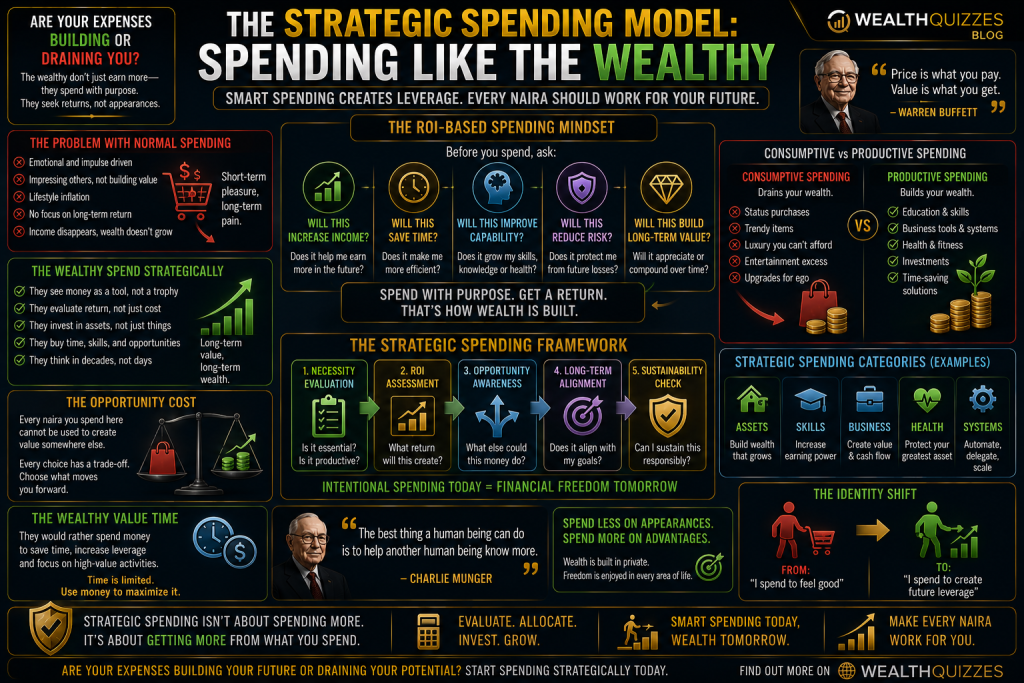
The Strategic Spending Model.
The Core Truth
Core Idea: Smart spending creates leverage
Angle: ROI-based spending
Not all expenses are equal.
Some expenses:
- Drain wealth
Others:
- Increase future earning power
- Improve efficiency
- Expand opportunities
- Produce long-term returns
The Problem With Traditional Spending Habits
Most people spend based on:
- Emotion
- Social pressure
- Impulse
- Temporary gratification
Common examples include:
- Status purchases
- Lifestyle inflation
- Trend-driven spending
- Unplanned consumption
The result:
Income disappears quickly while:
- Wealth growth remains weak.
Insight from Authority
As Morgan Housel explains:
Spending money to show people how much money you have is the fastest way to have less money.
This highlights a critical financial truth:
Consumption and wealth are not the same thing.
What Is Strategic Spending?
Strategic spending means:
Allocating money toward expenses that create measurable long-term value.
Instead of spending randomly, strategic spenders evaluate:
- Utility
- Return potential
- Efficiency gains
- Long-term impact
- Opportunity cost
This creates:
Financial leverage.
Understanding Financial Leverage Through Spending
Leverage occurs when:
- An expense creates disproportionate future benefits.
Example:
Spending money on:
- Education
- Skills
- Business systems
- Productivity tools
- Health optimization
- Strategic networking
May generate:
- Increased earning power
- Time efficiency
- Better opportunities
Meanwhile:
Some expenses provide:
- Temporary satisfaction only.
The wealthy often distinguish between:
- Consumptive spending
And: - Productive spending.
Consumptive Spending vs Productive Spending
Consumptive Spending
This includes expenses primarily designed for:
- Immediate pleasure
- Temporary status
- Short-lived gratification
Examples:
- Excess luxury spending
- Constant gadget upgrades
- Unnecessary lifestyle expansion
- Image-based purchases
Productive Spending
This includes expenses that improve:
- Future capacity
- Income potential
- Financial positioning
- Efficiency
Examples:
- Investments
- Business infrastructure
- Skill acquisition
- Health maintenance
- Automation systems
Insight from Authority
As Warren Buffett consistently demonstrates through his investment philosophy:
Capital allocation determines long-term outcomes.
In both business and personal finance:
Where money goes matters enormously.
The ROI-Based Spending Mindset
ROI means:
Return on Investment.
Wealthy individuals often evaluate spending through an ROI lens.
Questions include:
- Will this increase income potential?
- Will this save time?
- Will this improve productivity?
- Will this appreciate in value?
- Will this reduce future costs?
This changes spending behavior dramatically.
Example: Education as Strategic Spending
Many financially successful individuals spend heavily on:
- Learning
- Skills
- Knowledge systems
Why?
Because knowledge can:
- Compound over time.
Insight from Authority
Investor Charlie Munger repeatedly emphasized:
“The best thing a human being can do is to help another human being know more.”
Knowledge investment often creates:
- Long-term financial leverage.
Time Efficiency Spending
One major characteristic of wealthy individuals is:
- They value time aggressively.
Strategic spending may include:
- Delegation
- Automation
- Productivity tools
- Transportation efficiency
- Operational systems
Why?
Because:
Time is a limited asset.
Wealthy individuals frequently spend money to:
- Save time
Rather than: - Waste time to save small amounts of money.
The Nigerian Context: Spending Under Economic Pressure
Nigeria’s economic realities include:
- Inflation
- Currency instability
- Rising living costs
- Social spending pressure
This creates unique spending challenges.
Many people feel pressured into:
- Social status spending
- Event spending
- Lifestyle signaling
Examples include:
- Excessive wedding expenses
- Image-based purchases
- Financially draining celebrations
- Social comparison spending
Unfortunately:
These often produce:
- Low long-term financial returns.
Strategic spending becomes increasingly important in environments where:
- Resources are limited.
The Lifestyle Inflation Trap
One major financial danger is:
- Lifestyle inflation.
As income increases:
Expenses often rise automatically.
Result:
Despite earning more:
- Financial freedom does not improve.
Strategic spenders often focus instead on:
- Asset accumulation
- Financial flexibility
- Long-term leverage
Insight from Authority
As Thomas Stanley discovered through extensive research:
Many wealthy individuals live far below their means despite substantial net worth.
Why?
Because:
Wealth preservation matters more than appearances.
Opportunity Cost: The Hidden Spending Factor
Every expense has:
Opportunity cost.
Meaning:
Money spent in one area cannot simultaneously be used elsewhere.
Example:
A luxury purchase today may delay:
- Investments
- Business growth
- Asset accumulation
- Emergency reserves
Strategic spenders constantly evaluate:
- Trade-offs.
The Psychology of Smart Spending
Strategic spending requires:
- Emotional discipline.
Humans naturally prefer:
- Immediate rewards
Over:
- Delayed financial benefits.
Behavioral economists refer to this as:
Present bias.
Insight from Authority
Psychologist Daniel Kahneman demonstrated how emotions heavily influence financial decisions.
Without structure:
- Spending often becomes reactive rather than rational.
The Strategic Spending Framework
Effective strategic spending generally includes:
1. Necessity Evaluation
Ask:
- Is this essential?
- Is this productive?
2. ROI Assessment
Will this expense:
- Produce future value?
3. Opportunity Cost Awareness
What alternative financial use exists for this money?
4. Long-Term Alignment
Does this expense align with:
- Financial goals?
5. Sustainability Check
Can this expense be maintained responsibly?
The Wealthy Think in Allocation
One major mindset difference is that wealthy individuals often think in:
- Allocation percentages.
Instead of spending first and saving later, they often:
- Allocate intentionally first.
Categories may include:
- Investments
- Business growth
- Savings
- Lifestyle spending
- Learning
- Protection systems
This creates:
Structured financial control.
The Identity Shift
To spend strategically, you must move from:
- “I spend based on emotion”
To:
“I deploy money where it creates future leverage.”
The Real Transformation
Strategic spending changes:
- Financial growth speed
- Wealth preservation
- Opportunity access
- Long-term stability
Eventually:
Money becomes:
- A tool for expansion
Rather than: - A source of temporary gratification only.
The Hard Truth
Many people are not financially struggling because:
- They earn too little
But because:
Their spending produces little future value.
Conclusion: Smart Spending Creates Wealth Momentum
The wealthy do not merely spend differently because they have more money.
Very often:
They have more money because they spend differently.
Strategic spending transforms:
- Expenses into leverage
- Consumption into investment thinking
- Money into future opportunity
Because in finance:
Allocation determines direction.
Final Thought
Ask yourself honestly:
“Are my expenses building my future—or draining it?”
Because every naira spent is either:
- Moving you toward financial freedom
Or:
- Pulling you further away from it.
👉 Are your expenses building or draining you? Find out on WealthQuizzes