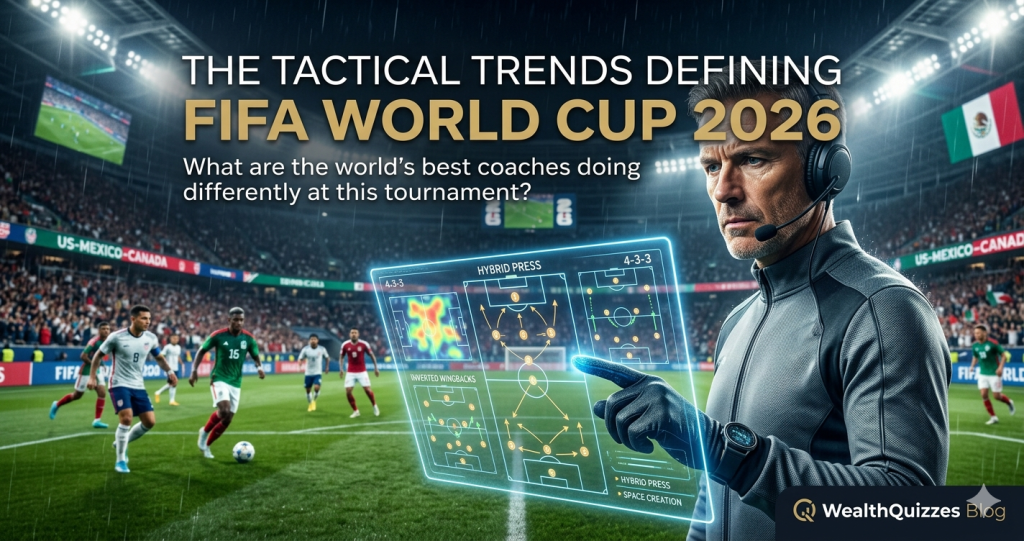
The Tactical Trends Defining FIFA World Cup 2026
What Are the World’s Best Coaches Doing Differently at This Tournament?
Every FIFA World Cup tells two stories. The first is written by the players—the goals, the saves, the moments of brilliance that captivate billions of fans around the world. The second, often less visible but equally important, is crafted by the coaches. Long before the referee blows the opening whistle, elite managers have already begun fighting for victory through tactical planning, data analysis, player positioning, and strategic preparation.
The FIFA World Cup 2026 is proving once again that modern football is as much a game of intelligence as it is of athleticism. With the tournament expanded to 48 teams and hosted across the United States, Canada, and Mexico, coaches are confronting new tactical challenges unlike those faced in previous editions. Longer tournaments, greater squad depth, varied climatic conditions, and more diverse opponents have forced managers to rethink traditional approaches.
The opening stages of the competition have already revealed several tactical trends that are shaping matches and redefining how international football is played. Rather than relying solely on individual brilliance, today’s elite coaches are emphasizing flexibility, collective organization, pressing systems, and intelligent game management.
The question is no longer simply which team possesses the most talented players. Increasingly, it is which coach can best solve football’s most complex tactical puzzles.
Football Has Become a Chess Match
Legendary Dutch football philosopher Johan Cruyff famously observed:
“Playing football is very simple, but playing simple football is the hardest thing there is.”
Cruyff’s words remain remarkably relevant.
Modern football demands constant decision-making. Coaches now spend months analyzing opponents through video footage, performance statistics, and advanced tactical software before tournaments even begin.
According to football writer Jonathan Wilson, author of Inverting the Pyramid, football tactics have evolved from rigid formations into fluid systems where players frequently change positions during matches.
The 2026 World Cup reflects this evolution.
Tactical Flexibility Is Replacing Fixed Formations
One of the defining characteristics of the tournament has been tactical adaptability.
In previous decades, teams were often described simply as playing 4-4-2, 4-3-3, or 3-5-2.
Today, those numbers tell only part of the story.
Elite coaches increasingly instruct players to alter formations depending on possession.
For example:
- A 4-3-3 may become a 3-2-5 during attacking phases.
- A 4-2-3-1 can quickly transform into a compact 4-5-1 when defending.
- Wing-backs often function as midfielders during possession.
Former Arsenal manager and FIFA’s Chief of Global Football Development, Arsène Wenger, has repeatedly argued that positional flexibility is one of modern football’s defining characteristics.
Rather than occupying fixed positions, players increasingly operate within tactical zones.
The opening matches of World Cup 2026 demonstrate this trend repeatedly.
High Pressing Remains a Dominant Weapon
Few tactical concepts have influenced modern football more than high pressing.
Popularized by coaches such as Jürgen Klopp and refined by Pep Guardiola, pressing seeks to recover possession immediately after losing the ball.
Instead of retreating defensively, teams attack opponents’ build-up play.
The benefits are substantial:
- Winning possession closer to goal.
- Creating immediate scoring opportunities.
- Preventing opponents from establishing rhythm.
- Maintaining territorial dominance.
Sports scientist Tim Gabbett notes that successful pressing depends upon physical conditioning, coordinated movement, and intelligent communication rather than simply running harder.
The best teams press collectively.
The opening week of the World Cup has shown several nations employing coordinated pressing systems designed to force mistakes in dangerous areas.
Midfield Control Has Become More Important Than Possession
Possession statistics once dominated football analysis.
Today, coaches increasingly recognize that meaningful possession matters far more than simply controlling the ball.
Former Spain coach Vicente del Bosque frequently emphasized that possession must create opportunities rather than merely maintain control.
Many World Cup teams now prioritize:
- Vertical passing.
- Progressive movement.
- Quick transitions.
- Creating overloads between defensive lines.
The objective is not simply to complete passes.
It is to manipulate defensive structures.
As football analyst Michael Cox explains in Zonal Marking, modern midfielders increasingly function as tactical directors rather than merely ball distributors.
Intelligent Rotation Is Becoming Essential
The expanded World Cup presents unique logistical challenges.
More matches increase physical demands.
Consequently, squad rotation has become an increasingly important tactical consideration.
Elite managers now carefully balance:
- Physical freshness.
- Tactical continuity.
- Injury prevention.
- Match-specific planning.
According to sports medicine researchers, cumulative fatigue reduces decision-making quality and increases injury risk.
Coaches are therefore making substitutions earlier and rotating squads more strategically than in previous tournaments.
Depth has become a competitive advantage.
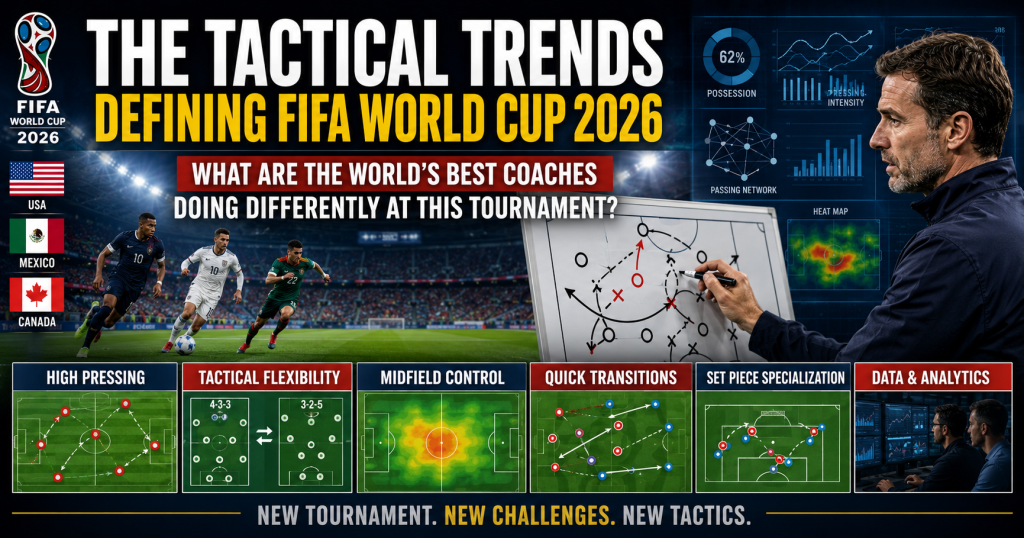
Data Analytics Is Guiding Tactical Decisions
Perhaps no development has transformed football coaching more profoundly than data analytics.
Elite national teams now employ specialists who analyze:
- Passing networks.
- Defensive positioning.
- Running intensity.
- Pressing efficiency.
- Set-piece effectiveness.
- Transition speed.
Sports economist Stefan Szymanski has argued that football increasingly resembles other data-driven industries where information creates competitive advantages.
The best coaches combine traditional football instincts with statistical evidence.
Video analysis now plays an essential role before, during, and after every match.
Set Pieces Have Become Tactical Gold
Former Liverpool analyst Ian Graham has noted that set pieces represent one of football’s most controllable attacking situations.
Corners, indirect free kicks, and throw-ins receive unprecedented attention from coaching staffs.
Specialized routines now involve:
- Blocking movements.
- Decoy runs.
- Screen formations.
- Multiple delivery variations.
According to FIFA Technical Study Group reports from recent tournaments, approximately one-third of World Cup goals originate from set-piece situations.
Consequently, coaches invest enormous preparation into these moments.
The 2026 tournament continues this trend.
Defensive Organization Has Become More Sophisticated
Modern defending extends far beyond individual tackling.
Teams increasingly defend as coordinated units.
Former Italian coach Arrigo Sacchi revolutionized football by arguing that defending depends upon collective positioning rather than isolated defensive actions.
Many World Cup teams now defend using:
- Compact defensive blocks.
- Coordinated pressing triggers.
- Controlled defensive lines.
- Space-oriented marking.
The objective is to deny space rather than merely challenge opponents physically.
This tactical sophistication has made breaking down organized defenses increasingly difficult.
Goalkeepers Are Now Playmakers
One of football’s most significant tactical transformations concerns goalkeepers.
Modern keepers are expected to contribute actively during possession.
Legendary goalkeeper Manuel Neuer helped popularize the “sweeper-keeper” role by functioning almost as an additional defender.
Today’s World Cup goalkeepers routinely:
- Build attacks.
- Break opposition presses.
- Deliver accurate long passes.
- Support defensive circulation.
Goalkeepers have become integral components of tactical systems.
Their distribution frequently determines how successfully teams progress the ball from defense into midfield.
Tactical Preparation Begins Months Before Kickoff
World Cup coaching extends far beyond matchday decisions.
Elite managers prepare extensively through:
- Opponent scouting.
- Scenario planning.
- Training simulations.
- Psychological preparation.
- Recovery management.
Sports psychologist Bob Rotella has repeatedly emphasized that confidence grows from preparation.
The most successful teams enter tournaments with clearly rehearsed tactical responses for multiple match situations.
Preparation reduces uncertainty.
Uncertainty often determines outcomes.
Artificial Intelligence and Technology
Another emerging trend involves technology.
National teams increasingly employ:
- GPS performance tracking.
- AI-assisted video analysis.
- Machine-learning scouting tools.
- Biomechanical monitoring.
These technologies enable coaches to identify weaknesses, optimize workloads, and personalize tactical instruction.
While football remains fundamentally human, technological innovation increasingly supports decision-making.
What World Cup 2026 Reveals About Football’s Future
The opening stages of the tournament suggest several broader conclusions.
Football is becoming:
- More flexible.
- More analytical.
- More physically demanding.
- More tactically sophisticated.
- More collaborative.
Individual brilliance remains essential.
However, collective organization increasingly determines success.
As legendary coach Sir Alex Ferguson once observed:
“Attack wins you games, defence wins you titles.”
Modern football expands that principle further.
Preparation wins tournaments.
Conclusion: Coaching Has Never Been More Important
The FIFA World Cup 2026 is demonstrating that football’s greatest battles often occur long before kickoff.
Today’s elite coaches are not simply selecting lineups.
They are designing adaptable tactical systems, integrating sports science, leveraging data analytics, optimizing player workloads, and preparing teams for an extraordinary range of competitive scenarios.
The tournament’s early matches have highlighted the growing importance of tactical flexibility, coordinated pressing, intelligent squad rotation, structured defending, and technological innovation.
As Jonathan Wilson has argued, football tactics continue evolving because the game itself never stands still.
World Cup 2026 is the latest chapter in that evolution.
Ultimately, while players score the goals and lift the trophy, coaches increasingly determine the conditions under which success becomes possible.
In the modern World Cup, victory belongs not only to the most talented team but also to the most tactically intelligent one.