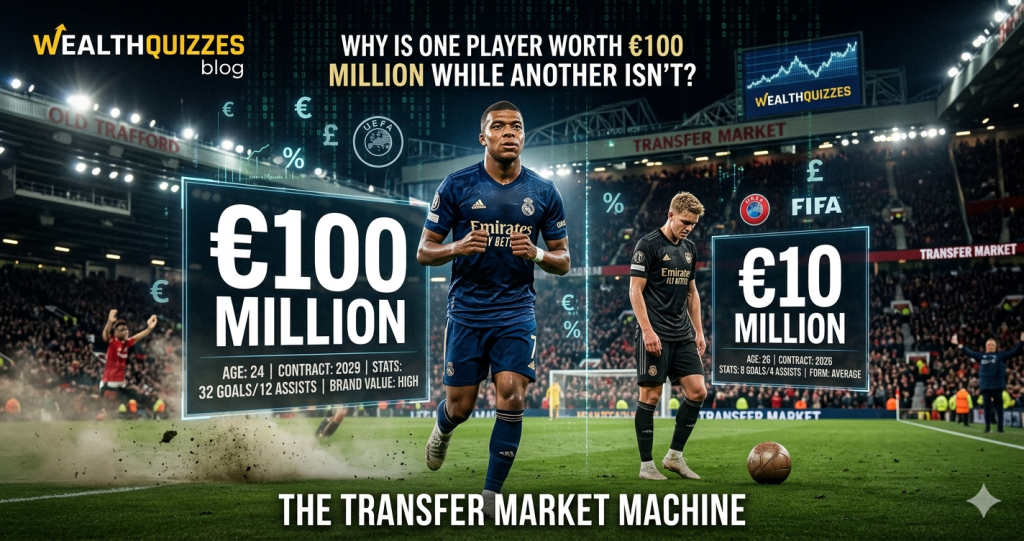
The Transfer Market Machine: Why Players Cost Millions
Why is one player worth €100 million while another isn’t?
Every transfer window brings the same headlines: a teenager sold for tens of millions, a striker valued higher than an entire club, and fans wondering how football arrived at such staggering numbers. At first glance, transfer fees seem irrational. How can one player be worth €100 million while another, equally talented in the eyes of supporters, is available for a fraction of that price?
The answer is that football transfers are not simple talent auctions. A player’s price reflects economics, scarcity, branding, age, contract leverage, club finances, market timing, and strategic risk. In modern football, transfers are less like buying athletes and more like investing in complex financial assets.
Football’s Transfer Market Is an Economic Ecosystem
Football is now a global entertainment industry worth billions of euros annually. Clubs operate as businesses competing for revenue, trophies, and brand dominance. According to Deloitte’s Football Money League, the world’s richest clubs generate enormous annual revenues through broadcasting, sponsorships, merchandising, and matchday income. Those revenues shape what clubs can afford to spend on players.
Economist Stefan Szymanski argues that football clubs often behave differently from ordinary profit-maximizing firms. Many prioritize sporting success because winning increases revenue, prestige, and long-term brand value. This creates intense competition for elite talent, pushing prices upward.
In other words, transfer fees are driven not just by what a player is, but by what clubs believe the player can produce commercially and competitively.
Scarcity: Elite Talent Is Rare
The simplest economic explanation is scarcity.
There are millions of footballers in the world, but only a tiny number can consistently perform at the highest level in elite leagues and competitions. A club trying to win the UEFA Champions League cannot simply replace a world-class forward with an average professional.
This scarcity becomes even more extreme for players who combine multiple elite qualities:
- Technical ability.
- Athleticism.
- Tactical intelligence.
- Mental resilience.
- Consistency under pressure.
A player who scores 25 goals in a top league is not just producing goals; he is offering reliability in the most valuable matches. Reliable elite performance is rare, and rare assets become expensive.
As former Arsenal manager Arsène Wenger once noted, the transfer market behaves like any market with limited supply and high demand: when several wealthy clubs want the same rare asset, the price rises dramatically.
Age and Potential Matter as Much as Current Ability
A 30-year-old star may be better today than a 20-year-old prospect, yet the younger player can cost more. Why? Because clubs are buying future value.
Younger players offer:
- Longer service life — A club may benefit from eight or ten prime years instead of two or three.
- Resale value — The player can later be sold, potentially for profit.
- Development upside — Clubs hope the player will improve significantly.
This is why promising teenagers can command enormous fees despite limited experience. Clubs are paying for projected future performance, not merely current statistics.
Sports analytics expert Michael Lewis popularized the idea that markets value future expected output, not just present reputation. Football clubs increasingly apply similar logic through scouting and data analysis.
Contracts Create Leverage
A player’s contract situation heavily influences price.
If a player has four years remaining on a contract, the selling club has leverage. They are not forced to sell, so buying clubs must pay a premium. If the contract is nearing expiration, the player can soon leave for free, reducing the transfer fee.
This is why clubs often rush to extend contracts for valuable players. The contract itself becomes a financial asset.
Football finance expert Kieran Maguire frequently explains that transfer negotiations are shaped by bargaining power. A club with a long contract and no financial pressure can demand far more than a club facing debt, relegation risk, or an expiring deal.
Club Finances Distort the Market
Not all clubs participate equally in the transfer market. Wealthy clubs backed by huge revenues or powerful owners can spend aggressively, while smaller clubs may need to sell talent to survive.
This imbalance inflates prices. Selling clubs know that elite buyers can pay more, so asking prices rise accordingly.
For example, when a Premier League club with massive television revenue enters negotiations, the selling club often increases its demands. The buyer’s wealth changes the market price.
The growth of broadcasting income, especially in leagues like the Premier League, has intensified this effect. TV deals have given clubs unprecedented spending power, which then cascades through the transfer market.
Brand Value and Commercial Impact
Some players generate revenue beyond football performance. Global stars attract sponsors, sell shirts, increase social media engagement, and expand a club’s international fan base.
A player with a massive global following can therefore justify a higher fee because he contributes commercially as well as athletically.
Consider what a superstar brings:
- Jersey sales.
- New sponsorship opportunities.
- Higher global visibility.
- Increased ticket demand.
- Digital engagement and media attention.
Marketing scholar Philip Kotler has long emphasized that brands derive value from emotional connection and visibility. Football stars function as global brands in their own right, and clubs often price that commercial impact into transfer decisions.
Position and Playing Style Affect Valuation
Not all positions are valued equally.
Goals are the easiest contribution to measure and market, so elite forwards and attacking players often command the highest fees. Defenders and goalkeepers can be world-class yet historically receive lower valuations because their contributions are less glamorous and harder for casual audiences to quantify.
However, tactical trends can change valuations. When ball-playing center-backs became strategically important, prices for elite defenders rose sharply. Similarly, midfielders who can press, progress the ball, and control tempo have become more valuable in modern systems.
In short, the market rewards whatever qualities top clubs currently consider hardest to replace.
Market Timing and Competition Drive Prices Up
A player’s value is not fixed. It fluctuates with market conditions.
Prices rise when:
- Several clubs compete for the same player.
- The buying club is desperate to fill a tactical need.
- The seller can wait.
- The transfer occurs late in the window, increasing urgency.
Prices fall when:
- There are few interested buyers.
- The player wants to leave publicly.
- The selling club needs cash quickly.
- Injuries or poor form reduce demand.
This explains why transfer fees can seem inconsistent. The same player might cost €40 million in one summer and €70 million in another depending on competitive pressure and timing.
Data Analytics Has Changed Valuation
Modern clubs rely heavily on data analysis. They evaluate players using metrics such as expected goals (xG), pressing intensity, progressive passes, defensive actions, and injury risk.
Analytics does not eliminate uncertainty, but it helps clubs estimate future performance more systematically.
However, data can also increase prices. If analytics identifies a player as uniquely effective, multiple clubs may pursue him simultaneously, creating a bidding war.
As analytics pioneer Bill James demonstrated in sports more broadly, better information can uncover undervalued assets—but once the market catches up, bargains disappear.
Psychology and Hype Matter Too
Football is emotional, and transfer markets are influenced by narrative as much as numbers.
A standout World Cup performance, viral highlights, media hype, or comparison to a legend can dramatically raise perceived value. Clubs are run by humans, and humans are influenced by optimism, fear of missing out, and public pressure.
Fans and media also shape the market. A club chasing a famous name may feel pressure to make a statement signing, even at a premium price.
Behavioral economists would describe this as a market influenced by sentiment and perception, not just fundamentals.
Why One Player Costs €100 Million
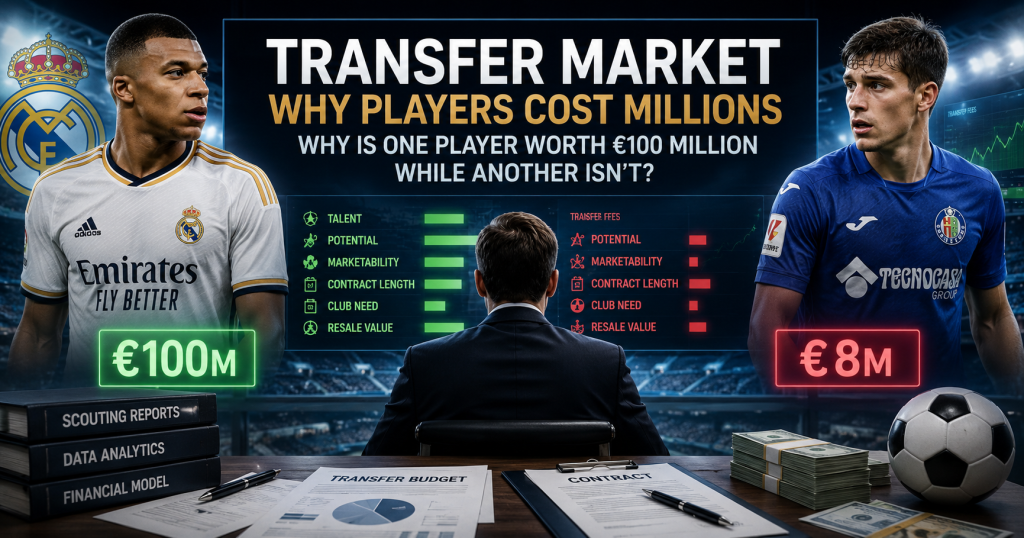
When a player reaches a €100 million valuation, it usually means several factors are converging:
- Elite current performance.
- Young age or long-term potential.
- Long contract length.
- Scarcity at the position.
- Strong commercial appeal.
- Competition among wealthy buyers.
- Strategic importance to the buying club.
A player lacking even a few of these elements may be far cheaper despite similar raw talent.
For example, an older striker with one year left on his contract may score as many goals as a younger star, yet command a much lower fee because resale value and long-term utility are limited.
The Transfer Market Is Part Art, Part Finance
Ultimately, football transfers are imperfect predictions about the future. Clubs are trying to estimate how much value a player will create over several years—on the pitch and off it.
Sometimes they are right.
Sometimes a €100 million signing transforms a team and generates huge revenue.
Sometimes the investment fails spectacularly.
That uncertainty is why the transfer market remains fascinating. It is not a simple scoreboard of talent. It is a collision of economics, strategy, branding, psychology, and sporting ambition.
The next time a headline announces another nine-figure transfer, the better question is not Is this player that talented? It is What combination of scarcity, leverage, potential, commercial value, and competitive pressure made clubs believe he is worth that price?