

The Wealth Compounding Curve: When Growth Finally Becomes Visible
Why Financial Progress Feels Slow at First—and Then Accelerates Rapidly
Introduction: The Frustration of “No Results”
One of the most common frustrations in personal finance is this:
- You save consistently
- You invest cautiously
- You try to be disciplined
Yet months—or even years—pass with little visible change.
It feels like nothing is working.
This perception leads many people to:
- Lose motivation
- Abandon discipline
- Return to old habits
But this reaction is based on a misunderstanding of how wealth actually grows.
Wealth does not grow in a straight line—it grows in a curve.
The Core Truth
Core Idea: Wealth is invisible before it’s obvious
Mindset Shift: Slow growth → Exponential patience
In the early stages, progress is subtle and often unnoticeable.
Later, that same progress becomes:
Rapid, visible, and powerful
Understanding the Compounding Curve
At the heart of wealth creation lies a fundamental principle:
Compounding
Compounding occurs when:
- Your returns generate additional returns
- Growth builds upon itself
The Nature of the Curve
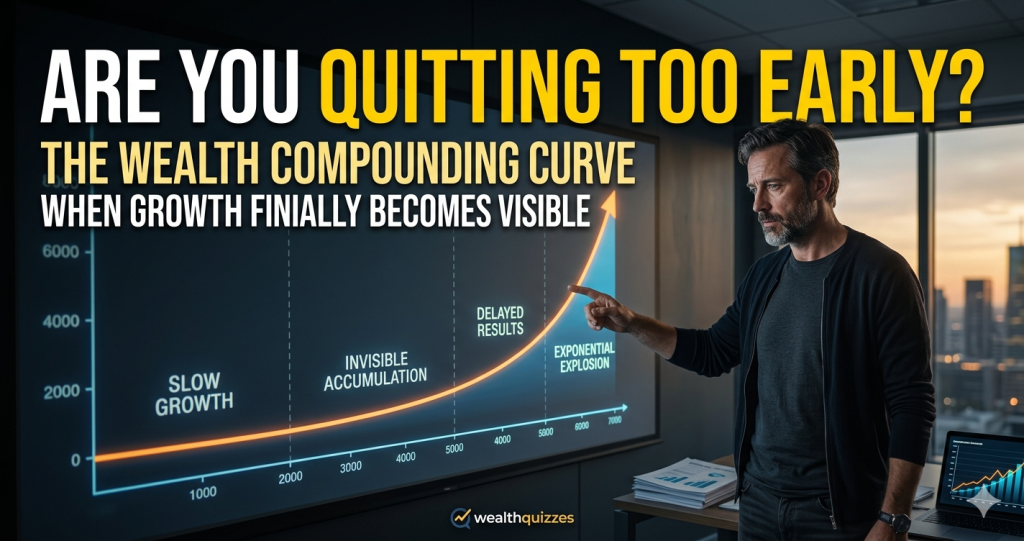
The compounding curve has three distinct phases:
1. The Invisible Phase
- Growth is slow
- Progress appears insignificant
- Motivation is hardest to sustain
2. The Acceleration Phase
- Returns begin to build
- Growth becomes noticeable
3. The Visible Phase
- Wealth increases rapidly
- Results become obvious
- Momentum strengthens
Why the Early Phase Feels So Slow
1. Small Base Effect
At the beginning:
- Capital is limited
- Returns are small
Example:
- 10% of ₦100,000 = ₦10,000
- 10% of ₦1,000,000 = ₦100,000
Same effort—very different outcomes.
2. Time Lag
Compounding requires:
- Time
- Consistency
Without sufficient time:
- Growth remains minimal
Insight from Authority
As Albert Einstein is widely credited with saying:
“Compound interest is the eighth wonder of the world.”
But There Is a Catch
The “wonder” only becomes visible:
After sustained patience
The Psychological Challenge
The early phase creates:
- Doubt
- Impatience
- Frustration
Why?
Because humans are wired to:
- Seek immediate results
- Value visible progress
Insight from Authority
As Daniel Kahneman explains:
People struggle to appreciate delayed rewards, often abandoning long-term strategies prematurely.
The Danger: Quitting Too Early
Many people exit the compounding process during:
The invisible phase
What Happens Next?
- They stop saving
- They withdraw investments
- They return to consumption
Result:
They never experience:
The exponential phase
The Wealth Compounding Curve When Growth Finally Becomes Visible
Insight from Authority
As Morgan Housel notes:
Wealth is often built quietly, without visible signs for long periods.
The Turning Point: When Growth Becomes Visible
At a certain stage:
- Capital base increases
- Returns become significant
- Growth accelerates
This is the “Curve Break”
Where:
- Effort begins to pay off visibly
- Motivation strengthens
- Wealth becomes tangible
Why This Phase Feels Different
Because:
- Returns are now meaningful
- Compounding is working at scale
Example:
- Early stage: ₦10,000 growth → unnoticed
- Later stage: ₦500,000 growth → impactful
The Key Insight
The same principles that produced small results earlier are now producing large outcomes.
The Nigerian Context: Why Patience Is Harder
In Nigeria:
- Economic pressure is high
- Inflation erodes savings
- Immediate needs compete with long-term goals
This makes:
- Long-term discipline more difficult
- Short-term decisions more tempting
But the Principle Still Holds
Those who remain consistent:
Eventually benefit from compounding
The Identity Shift
To benefit from the compounding curve, you must move from:
- “I need quick results”
To:
“I am building long-term growth systems.”
Practical Strategies to Stay on the Curve
Step 1: Focus on Process, Not Results
- Track consistency
- Not just outcomes
Step 2: Automate Contributions
- Remove emotional decisions
- Ensure regular investment
Step 3: Avoid Interruptions
- Do not withdraw prematurely
- Stay committed
Step 4: Increase Contributions Over Time
- As income grows
- Scale your inputs
Step 5: Educate Yourself Continuously
- Improve decision-making
- Strengthen confidence
The Compounding Advantage
Those who stay consistent gain:
- Time advantage
- Growth advantage
- Psychological advantage
Over Time:
They move ahead rapidly.
The Hard Truth
Most people fail not because:
- They chose the wrong strategy
But because:
They did not stay long enough to see results.
The Real Transformation
When you understand the compounding curve:
You move from:
- Doubt → Confidence
- Impatience → Discipline
- Short-term thinking → Long-term strategy
Conclusion: Trust the Curve
Wealth is not:
- Instant
- Linear
- Obvious at the beginning
It is:
Gradual, invisible, and then exponential
The early phase tests:
- Your patience
- Your discipline
- Your belief
But those who persist reach a point where:
Growth becomes undeniable.
Final Thought
Right now, ask yourself:
“Am I failing—or am I just too early in the process?”
Because the difference between those who build wealth and those who don’t is not knowledge—
It is how long they stay on the curve.
👉 Are you quitting too early? Find out on WealthQuizzes