
The Wealth Flywheel: How to Build Self-Sustaining Financial Growth
Why True Wealth Is Built Through Momentum, Not Constant Struggle
Introduction: The Problem With Starting Over Financially
Many people experience the same frustrating cycle repeatedly:
- Earn money
- Make progress
- Encounter expenses
- Lose momentum
- Start over again
This financial “reset loop” prevents long-term wealth accumulation.
Even hardworking individuals often feel trapped because their finances depend entirely on:
- Continuous effort
- Constant labor
- Active decision-making
The moment effort slows:
- Progress slows
- Income drops
- Financial pressure returns
But wealthy individuals and financially resilient systems operate differently.
At some point, wealth creation stops relying solely on raw effort and begins operating through:
Momentum
This is where the concept of the:
Wealth Flywheel
becomes critical.
The Core Truth
Core Idea: Wealth becomes automatic with systems
Mindset Shift: Effort → Momentum
True wealth is not built merely by working harder.
It is built by creating:
- Self-reinforcing financial systems
- Compounding processes
- Automated growth mechanisms
What Is a Wealth Flywheel?
A wealth flywheel is:
A self-sustaining financial system where consistent actions create increasing momentum over time.
The concept originates from business strategist Jim Collins, who described the “flywheel effect” as the process where small consistent pushes eventually create unstoppable momentum.
In personal finance and wealth building:
The flywheel works similarly.
At first:
- Progress feels slow
- Results appear minimal
But over time:
- Systems compound
- Momentum accelerates
- Growth becomes easier and more automatic
The Difference Between Effort and Momentum
Many people live in:
Effort-based financial systems
Characteristics of Effort-Based Finances
- Income depends entirely on labor
- Spending is reactive
- No automation exists
- Financial growth resets frequently
Result:
- Constant financial exhaustion
Momentum-based financial systems operate differently.
Characteristics of Momentum-Based Wealth
- Savings are automated
- Investments compound
- Systems reduce decision fatigue
- Assets generate recurring value
Result:
Wealth continues growing even when effort fluctuates.
The Wealth Flywheel Structure
The wealth flywheel operates through interconnected stages.
Stage 1: Income Generation
Every flywheel begins with:
- Active income
- Business revenue
- Professional earnings
This is the starting force.
However:
- Income alone does not create wealth
Stage 2: Controlled Allocation
Money must be directed intentionally.
This includes:
- Savings
- Investments
- Asset acquisition
- Emergency reserves
Insight from Authority
As Warren Buffett famously emphasized:
“Do not save what is left after spending, but spend what is left after saving.”
Allocation creates structure.
Without allocation:
- Income disappears into consumption.
Stage 3: Asset Accumulation
This is where money begins working independently.
Examples include:
- Investments
- Businesses
- Dividend assets
- Digital products
- Real estate
- Intellectual property
Assets are critical because:
Assets create recurring value beyond direct labor.
Stage 4: Compounding Growth
Once assets begin producing returns:
- Growth accelerates
This is where:
- Reinvestment becomes powerful
Example:
Investment returns generate:
- Additional capital
Which generates: - Additional returns
This creates:
Exponential momentum.
Insight from Authority
As Albert Einstein is widely credited with describing compound interest as:
“The eighth wonder of the world.”
Whether or not the exact wording is historically verified, the principle remains powerful:
Compounding transforms small beginnings into significant outcomes.
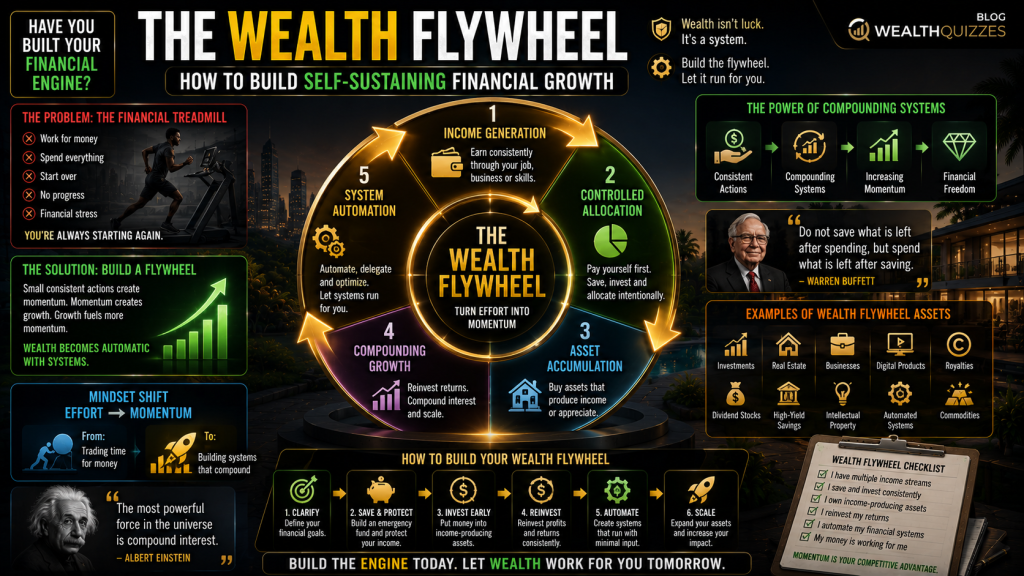
Stage 5: System Automation
At advanced stages:
- Wealth systems become increasingly automated
Examples:
- Automatic investing
- Automated savings
- Recurring business systems
- Delegated operations
Result:
Financial growth becomes:
- More predictable
- Less emotionally dependent
The Power of Momentum
Momentum changes everything.
At the beginning:
Progress feels:
- Slow
- Invisible
- Frustrating
But eventually:
The flywheel gains speed.
Small consistent actions begin producing:
- Larger outcomes
- Faster growth
- Greater stability
The Nigerian Context: Why Financial Momentum Matters
In Nigeria:
- Inflation pressures purchasing power
- Economic uncertainty is common
- Many households depend heavily on active income
This creates vulnerability.
Without systems:
- Financial setbacks repeatedly erase progress
However, individuals who build wealth flywheels gradually create:
- Financial resilience
- Reduced dependency on labor
- Greater long-term stability
Why Most People Never Build Momentum
1. Inconsistency
People:
- Start financial systems
- Then abandon them
Result:
The flywheel never gains speed.
2. Consumption Dominance
Income is consumed immediately rather than:
- Allocated strategically
Result:
No compounding engine forms.
3. Lack of Patience
Many expect:
- Immediate results
But flywheels require:
- Repetition
- Time
- Discipline
Insight from Authority
As Morgan Housel explains:
Wealth is often invisible because it is built slowly before it becomes obvious.
The Psychology of the Wealth Flywheel
One major advantage of systems is:
Reduced emotional dependence.
Why this matters:
People often make poor financial decisions when:
- Emotional
- Tired
- Stressed
Systems reduce:
- Impulsive spending
- Inconsistent investing
- Reactive financial behavior
Systems create:
Financial discipline through structure.
The Role of Compounding Systems
The wealth flywheel depends heavily on:
- Compounding systems
Examples include:
- Automated investing
- Recurring business revenue
- Asset reinvestment
- Skill monetization systems
- Delegated operations
Over time:
These systems interact and strengthen one another.
Example:
- Increased income funds investments
- Investments generate returns
- Returns fund new assets
- Assets increase cash flow
The flywheel accelerates continuously.
Building Your Personal Wealth Flywheel
Step 1: Stabilize Income
Focus first on:
- Reliable cash flow
Step 2: Create Allocation Systems
Automate:
- Saving
- Investing
- Emergency funding
Step 3: Build Income-Producing Assets
Acquire:
- Investments
- Scalable skills
- Businesses
- Digital assets
Step 4: Reinvest Consistently
Avoid consuming all profits.
Reinvestment fuels:
Momentum.
Step 5: Automate and Optimize
Reduce manual dependency wherever possible.
The Identity Shift
To build a wealth flywheel, you must move from:
- “I work for money”
To:
“I build systems that generate and compound value.”
The Real Transformation
The wealth flywheel transforms:
- Financial stress into stability
- Effort into momentum
- Labor into scalable growth
Eventually:
The system becomes:
- Self-sustaining
- Compounding
- Resilient
The Hard Truth
Most people remain financially stuck not because:
- They lack effort
But because:
They never build systems strong enough to create momentum.
Conclusion: Wealth Is Built Through Systems
Wealth creation is not merely about:
- Earning more
It is about:
- Building structures that sustain and multiply growth over time.
The people who achieve lasting financial success are rarely those making random big moves.
They are:
The people who consistently build compounding systems.
Final Thought
Ask yourself honestly:
“Am I constantly pushing my finances manually—or have I built a system that creates momentum?”
Because true wealth begins when:
Your financial systems start working harder than you do.
👉 Have you built your financial engine? Find out on WealthQuizzes