

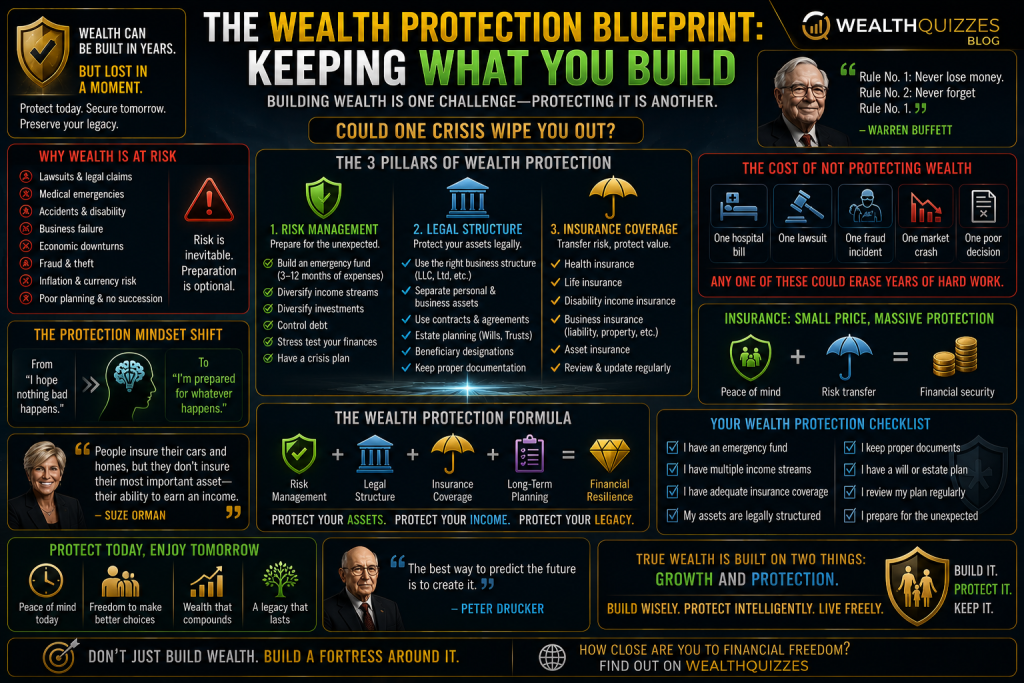
The Wealth Protection Blueprint: Keeping What You Build
Why Building Wealth Is Only Half the Battle—and Protecting It Is the Other Half
Introduction: The Wealth Most People Lose Too Easily
Many people spend years trying to:
- Earn more money
- Build businesses
- Acquire assets
- Increase investments
- Improve financial stability
Yet surprisingly, many financially successful individuals still experience devastating setbacks that erase years of progress.
Why?
Because:
Building wealth and protecting wealth are two completely different disciplines.
A person may successfully:
- Increase income
- Grow investments
- Build businesses
But without proper protection systems, one crisis can trigger:
- Financial collapse
- Legal exposure
- Asset loss
- Debt spirals
- Business destruction
This is one of the most overlooked truths in personal finance:
Wealth creation without wealth protection creates vulnerability.
True financial intelligence is not merely about:
- Accumulating wealth
It is also about:
- Preserving wealth against predictable risks.
This is where:
The Wealth Protection Blueprint
becomes essential.
The Core Truth
Core Idea: Building wealth is one challenge—protecting it is another
Angle: Risk management, legal structure, insurance
Financial success becomes fragile when:
- Protection systems are weak.
Why Wealth Protection Matters
Every person building wealth faces:
- Risk.
The question is not:
- Whether crises can happen
The real question is:
Whether your financial structure can survive them.
Risks may include:
- Medical emergencies
- Business lawsuits
- Economic downturns
- Job loss
- Accidents
- Fraud
- Inflation
- Currency instability
- Unexpected family obligations
The problem is that:
Many people focus almost entirely on:
- Growth
While ignoring:
- Protection.
Insight from Authority
As Warren Buffett famously stated:
“Rule No. 1: Never lose money. Rule No. 2: Never forget Rule No. 1.”
Buffett’s statement emphasizes an important principle:
Preservation matters.
Because large financial losses can take years to recover from.
The Difference Between Wealth Builders and Wealth Preservers
Many people know how to:
- Make money
Fewer people know how to:
- Keep money.
Wealth builders focus on:
- Expansion
- Opportunities
- Investments
- Income growth
Wealth preservers focus on:
- Risk management
- Stability
- Legal protection
- Long-term sustainability
The most financially resilient people understand:
Growth and protection must operate together.
The Three Pillars of Wealth Protection
A strong wealth protection blueprint generally includes:
- Risk management
- Legal structure
- Insurance systems
1. Risk Management: Preparing for Financial Shocks
Risk management means:
Identifying potential threats before they become disasters.
Wealth is vulnerable when people assume:
- “Nothing bad will happen.”
Financial history repeatedly shows otherwise.
Economic downturns, emergencies, and unexpected disruptions are normal parts of life.
Effective risk management includes:
- Emergency funds
- Diversified income
- Asset allocation
- Controlled debt
- Crisis planning
Why Emergency Funds Matter
Emergency reserves create:
- Financial breathing room.
Without emergency savings:
- Small problems become major financial crises.
Example:
A sudden medical emergency without savings may lead to:
- Debt
- Forced asset sales
- Financial instability
Insight from Authority
As Dave Ramsey consistently teaches:
Emergency funds create financial peace and stability.
While investment growth matters, liquidity and preparedness matter too.
Diversification as Protection
One major risk is:
- Dependence on a single financial source.
Examples:
- One salary
- One business
- One customer
- One investment category
Diversification reduces vulnerability.
This may include:
- Multiple income streams
- Different asset classes
- Geographic diversification
- Business redundancy systems
2. Legal Structure: Protecting Assets Intelligently
Legal structure is one of the most underestimated aspects of wealth protection.
Many people build assets personally without understanding:
- Legal exposure
- Liability risks
- Ownership vulnerabilities
Proper legal structures may help protect:
- Businesses
- Investments
- Intellectual property
- Real estate assets
Legal protection may involve:
- Registered businesses
- Contracts
- Trust structures
- Corporate entities
- Estate planning
- Proper documentation
Why Legal Structure Matters
Without proper legal systems:
- Personal assets may become exposed to business liabilities.
Insight from Authority
Business strategist Robert Kiyosaki has repeatedly emphasized:
The rich often use legal structures strategically to protect assets and reduce vulnerability.
The Nigerian Context
In Nigeria, many businesses operate informally without:
- Proper registration
- Documentation
- Compliance systems
This creates risks involving:
- Ownership disputes
- Legal uncertainty
- Tax complications
- Inheritance conflicts
Strong legal structure creates:
- Clarity
- Protection
- Continuity
Estate Planning: Protecting Wealth Beyond Your Lifetime
Many people build assets but fail to prepare:
- Succession systems.
This can create:
- Family disputes
- Asset fragmentation
- Wealth destruction after death
Estate planning may include:
- Wills
- Trust arrangements
- Succession plans
- Beneficiary structures
Wealth protection includes:
Intergenerational continuity.
3. Insurance: Transferring Financial Risk
Insurance is one of the most practical forms of wealth protection.
Yet many people misunderstand it completely.
Insurance is not primarily:
- An investment.
It is:
A risk transfer mechanism.
Insurance protects against losses that could otherwise:
- Destroy years of financial progress.
Important forms may include:
- Health insurance
- Life insurance
- Business insurance
- Property insurance
- Disability coverage
Why Insurance Matters
A single major event can create:
- Massive financial pressure.
Example:
Without health coverage:
- Serious medical expenses may wipe out savings or force debt accumulation.
Insurance protects:
- Stability.
Insight from Authority
Financial advisor Suze Orman frequently emphasizes:
People insure cars and phones while failing to protect income and long-term financial security.
The Wealth Erosion Problem
Many people believe wealth loss happens only through:
- Poor investments.
But wealth is often destroyed through:
- Unprotected risks.
Examples include:
- Lawsuits
- Medical emergencies
- Poor documentation
- Inflation exposure
- Business collapse
- Lack of succession planning
The Psychology of Wealth Protection
Many people avoid protection systems because:
- Risks feel distant or unlikely.
Behavioral economists call this:
Optimism bias.
People naturally assume:
- Negative events are less likely to happen to them.
However:
Financial resilience requires:
- Preparation before crisis.
Insight from Authority
Psychologist Daniel Kahneman demonstrated how humans consistently underestimate risk probabilities in decision-making.
The Wealth Protection Formula
Strong wealth protection systems generally include:
1. Liquidity
Cash reserves create:
- Flexibility during emergencies.
2. Diversification
Avoid excessive dependence on:
- One financial source.
3. Legal Structure
Ensure:
- Proper ownership systems
- Documentation
- Asset separation
4. Insurance Coverage
Transfer catastrophic risks strategically.
5. Long-Term Planning
Think beyond:
- Immediate income generation.
The Identity Shift
To protect wealth effectively, you must move from:
- “How do I make more money?”
To:
“How do I preserve and protect what I build?”
The Real Transformation
Wealth protection changes:
- Financial stability
- Risk exposure
- Long-term resilience
- Family security
Eventually:
Financial growth becomes:
- More sustainable
And: - Less vulnerable to disruption.
The Hard Truth
Many people spend years building wealth structures that:
One major crisis could destroy completely.
Conclusion: Wealth Without Protection Is Fragile
Building wealth is important.
But keeping wealth requires:
- Systems
- Structure
- Risk awareness
- Protection strategies
The financially resilient are usually not merely the people who:
- Earn the most.
They are:
The people who prepare intelligently for uncertainty.
Because in finance:
Survival is not accidental.
It is structured.
Final Thought
Ask yourself honestly:
“Could one crisis wipe out everything I’ve built financially?”
Because true wealth is not merely about:
- Growth.
It is about:
Protecting what you build long enough for it to compound.
👉 Could one crisis wipe you out? Find out on WealthQuizzes