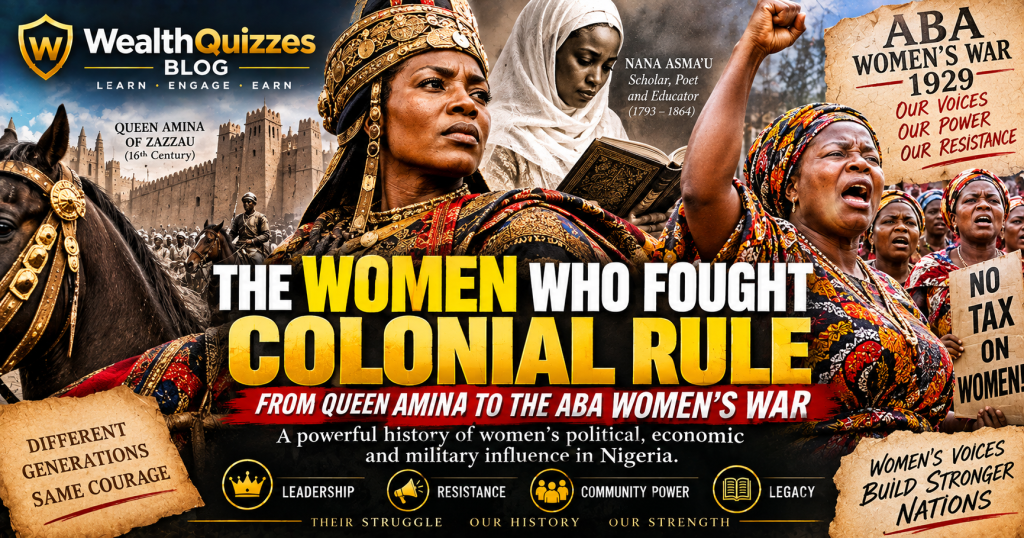
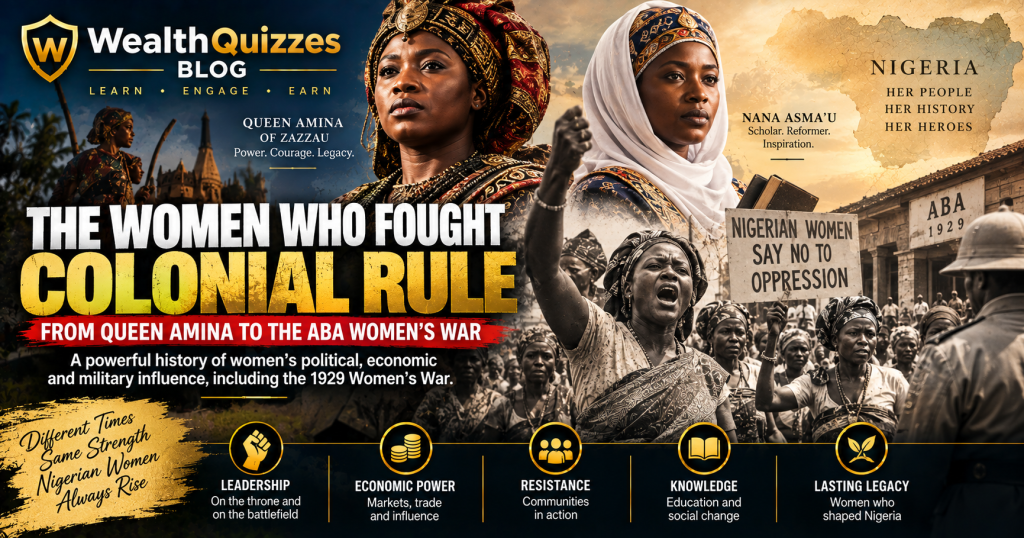
THE WOMEN WHO FOUGHT COLONIAL RULE: FROM QUEEN AMINA TO THE ABA WOMEN’S WAR
How Nigerian Women Exercised Political, Economic and Military Power—and Challenged Colonial Authority
The history of Nigeria’s formation is often narrated through the exploits of kings, emirs, military commanders, colonial officials and nationalist politicians. Yet this male-centred narrative can obscure a crucial historical reality: women were never merely spectators in the political, economic and military development of the societies that became Nigeria.
Long before British colonial rule, women occupied positions of authority, controlled commercial networks, influenced succession and diplomacy, participated in warfare, organised community institutions and exercised forms of political power that could constrain male rulers.
From Queen Amina of Zazzau to the market women who confronted British officials during the Women’s War of 1929, Nigerian women’s history is therefore not simply a story of victimhood. It is also a history of leadership, organisation, economic power, resistance and political agency.
Queen Amina: The Warrior Queen of Zazzau
Queen Amina of Zazzau occupies one of the most enduring places in the historical memory of northern Nigeria.
Associated with the Hausa city-state of Zazzau, later known as Zaria, Amina is traditionally placed in the sixteenth century. Historical traditions surrounding her are preserved in Hausa chronicles and later accounts, although scholars caution that parts of her biography are intertwined with oral tradition and legendary material.
What makes Amina historically significant is the persistence of the tradition that portrays her as a ruler who personally directed military expansion.
Recent scholarship on women in precolonial Nigerian warfare identifies Amina among the most prominent examples of women exercising military authority in the Nigerian region. Her reputation rests particularly on campaigns associated with the expansion of Zazzau’s influence across parts of Hausaland.
The importance of Amina, therefore, extends beyond the question of precisely which territories she conquered. Her memory demonstrates that the political imagination of precolonial northern Nigeria could accommodate a woman as a warrior, ruler and commander.
Her story challenges the assumption that political and military leadership were exclusively male domains.
Women and Political Power in Precolonial Nigeria
Amina was not an isolated historical curiosity.
Across precolonial Nigerian societies, women exercised power through a variety of institutions. The forms differed considerably from one society to another, and it would be misleading to suggest that Nigerian women enjoyed identical rights everywhere.
Among the Yoruba, for example, institutions such as the Iyalode gave prominent women an acknowledged position within political and commercial affairs. The Iyalode was associated particularly with women’s interests and commercial communities and could become an important intermediary between women and political authorities.
In southeastern Nigeria, women participated through organised associations and councils that could mobilise large numbers of people. Women’s collective authority did not necessarily resemble the office of a modern government minister or legislator. Instead, it operated through kinship, markets, age associations, ritual institutions, public assemblies and collective action.
Historian Cheryl P. Johnson’s research on women’s anticolonial activity in southwestern Nigeria notes the importance of institutions such as queen mothers, Iyalodes and women’s councils across West African societies. Her work reinforces the broader scholarly conclusion that African women were active participants in shaping the political histories of their societies.
This distinction is important because colonial officials often interpreted African political authority through European institutional categories. Where women exercised influence through associations, markets, kinship structures or customary institutions rather than through a European-style office, colonial administrators could underestimate or deliberately disregard that authority.
Nana Asma’u: The Power of Knowledge
The history of women’s influence was not confined to warfare.
In the nineteenth-century Sokoto Caliphate, Nana Asma’u (1793–1864) became an extraordinary example of female intellectual, educational and religious influence.
Daughter of Usman dan Fodio, Nana Asma’u was a scholar and prolific writer who produced works in Arabic and Ajami. Cambridge scholarship identifies her as an important figure in the consolidation and continuation of the Sokoto intellectual tradition.
Her influence illustrates another form of power: knowledge as political infrastructure.
Nana Asma’u was associated with the education of women and the transmission of Islamic learning. Scholarship on the Sokoto intellectual tradition has gone so far as to suggest that her importance makes the conventional description of the founders of the Sokoto state as a triumvirate incomplete; her contribution warrants recognition alongside the major male intellectuals of the movement.
Her life demonstrates that women’s power could operate through education, scholarship, religion and intellectual networks just as effectively as through the battlefield.
Women, Trade and Economic Power
Economic history provides another powerful correction to male-centred narratives.
Across precolonial Nigeria, women were deeply involved in agriculture, food processing, manufacturing and especially commerce. In many communities, markets were not merely places where women bought and sold goods; they were institutions through which women accumulated wealth, developed networks and exercised collective influence.
This became particularly significant in southeastern Nigeria.
Women were active in local and regional markets and participated in networks involving agricultural produce, palm products, textiles, foodstuffs and other commodities. Their economic position gave them a degree of independence and created organisational structures that could later be transformed into instruments of political resistance.
The connection between economic power and political power became unmistakable under colonial rule.
When colonial policies disrupted women’s markets, imposed taxation, empowered warrant chiefs or threatened women’s control over economic activity, women did not necessarily see these issues as separate political questions.
Economic interference could become political oppression.
That reality would become decisive in 1929.
Colonialism and the Erosion of Women’s Authority
British colonial rule did not simply introduce a new flag and a new bureaucracy. It transformed existing political relationships.
Cambridge’s Understanding Colonial Nigeria observes that women in precolonial Nigeria could exercise significant official and unofficial power, although their experiences differed considerably by region. With colonialism, however, women were increasingly relegated to the private sphere, while colonial political structures created barriers to their participation in formal governance.
This was particularly consequential in southeastern Nigeria.
British indirect rule relied heavily on institutions such as warrant chiefs and native courts. But the political systems of many southeastern communities had traditionally distributed authority across multiple institutions, including lineage groups, assemblies and women’s organisations.
The colonial system therefore did not merely add another layer of government. It rearranged the balance of power.
Men appointed or recognised by colonial officials could acquire authority that they had not previously possessed in the same form. Women who had traditionally exercised collective political influence could find themselves excluded from the new colonial structure.
The consequences were explosive.
The Aba Women’s War of 1929
The event remembered today as the Aba Women’s War, or Ogu Umunwanyi among Igbo women and Ekong Iban in Ibibio, represented one of the most important episodes of anticolonial resistance in Nigeria.
Oxford Research Encyclopedia describes the Women’s War as a resistance movement involving predominantly Igbo and Ibibio women, alongside women from other communities including Ogoni and Andoni.
The immediate crisis began in Oloko in November 1929.
A colonial warrant chief, Okezie Okugo, attempted to have women counted. The women feared that the exercise was connected with the introduction of taxation on women.
But the crisis cannot be reduced to taxation alone.
Women were responding to a much broader transformation of political and economic life under colonialism. The warrant-chief system, native courts, taxation, economic pressures and restrictions on traditional political participation had combined to create deep resentment.
The spark became a regional fire.
Thousands of women mobilised.
A Sophisticated System of Resistance
One of the most remarkable aspects of the Women’s War was the sophistication of its organisation.
The women did not simply gather spontaneously and riot.
They employed established cultural and social mechanisms of mobilisation. Women’s networks, market associations, dance groups, kinship connections and community structures helped spread the movement.
Their methods included public demonstrations, singing, dancing, collective shaming, surrounding officials, blocking transport routes and occupying government spaces.
Oxford Research Encyclopedia records that women removed the symbols of authority from warrant chiefs, destroyed or looted colonial property, burned native court buildings, blocked railway lines, cut telegraph wires and released prisoners.
These actions reveal an important strategic understanding.
The women attacked the infrastructure of colonial authority.
They understood that colonial power did not exist only in the person of the British administrator. It operated through warrant chiefs, courts, tax systems, communication networks, prisons, treasuries and commercial installations.
Consequently, these institutions became targets.
“Sitting on a Man”: Collective Political Pressure
One of the most famous methods associated with southeastern women’s protest was the practice commonly described in English as “sitting on a man.”
This did not simply mean physical violence.
It represented a culturally recognised form of collective condemnation in which women could surround the home or office of an offending man, sing, dance, ridicule him, demand compliance and refuse to leave until their grievances were addressed.
It was a powerful political weapon because it transformed women’s collective social authority into public pressure.
The colonial administration initially struggled to understand the movement.
The women were not behaving according to the political categories through which British officials understood protest. Their mobilisation crossed communities and operated through institutions that colonial officials had not created and could not easily control.
The British Response
The colonial government eventually resorted to armed force.
Women were shot by colonial security forces at locations including Abak, Utu Etim Ekpo and Opobo. The violence produced fatalities and injuries and eventually brought the uprising to an end.
The human cost was significant, but the movement nevertheless produced political consequences.
According to Adam Paddock’s Oxford Research Encyclopedia account, the British administration eventually abandoned the warrant-chief system in the affected areas and moved toward village councils.
Yet there was an important contradiction.
Although the women had demonstrated their political power, colonial governance did not suddenly embrace women’s equal political representation.
The system remained overwhelmingly male-dominated.
The Women’s War had forced colonial authorities to reconsider aspects of their administration without eliminating the structural exclusion of women from formal political authority.
From Resistance to Nationalism
The significance of the Women’s War extended beyond the immediate dispute.
Toyin Falola and Matthew Heaton, in A History of Nigeria, place anticolonial resistance within the wider transformation of Nigerian society during the first half of the twentieth century.
Colonial rule generated resistance from its earliest stages, although that resistance was initially shaped largely by local circumstances rather than a unified Nigerian nationalism.
The Women’s War illustrates precisely this transition.
The women were not necessarily fighting for the modern Nigerian nation-state as it would later be imagined.
They were defending their communities, economic independence, political institutions and social rights.
But their resistance contributed to the broader historical process through which Nigerians increasingly challenged colonial authority.
Later generations of Nigerian women continued this tradition.
Women such as Funmilayo Ransome-Kuti, Alimotu Pelewura and others became prominent political organisers and nationalists. Historian Judith Byfield’s work on women and nation in postwar Nigeria places figures such as Ransome-Kuti, Efunroye Tinubu and Alimotu Pelewura within a longer history of women’s political activism.
The continuity is striking.
The methods changed—from customary protest and market mobilisation to petitions, newspapers, political organisations and nationalist campaigns—but the underlying principle remained: women could organise collectively to challenge institutions that threatened their economic, social and political interests.
A History Far Larger Than the Aba Women’s War
It would therefore be misleading to treat the Aba Women’s War as the beginning of Nigerian women’s political activism.
The evidence points to a much longer history.
Queen Amina represents the tradition of female military and political leadership.
Yoruba Iyalodes demonstrate the importance of women within political and commercial institutions.
Nana Asma’u demonstrates the power of female scholarship and education.
Women traders demonstrate the connection between economic independence and political influence.
Southeastern women’s councils and associations demonstrate the capacity for collective political mobilisation.
And the women of 1929 demonstrated that these traditions could be converted into a formidable anticolonial movement.
The most important lesson is that colonialism did not introduce Nigerian women to politics.
Nigerian women were already political actors.
What colonialism did was restructure the institutions through which their authority operated—and, in many cases, attempt to narrow the space in which that authority could be exercised.
The Women’s War was therefore not simply a reaction to a proposed tax.
It was a defence of political voice, economic autonomy, community institutions and social dignity.
Conclusion: The Women Colonial History Tried to Understate
The history of Nigeria cannot be fully understood through the stories of male rulers and colonial officials alone.
From the warrior traditions associated with Queen Amina to the intellectual legacy of Nana Asma’u, from the commercial influence of Yoruba women to the organised resistance of Igbo, Ibibio, Annang, Ogoni, Andoni and other southeastern women, women repeatedly shaped the political history of the Nigerian region.
The Aba Women’s War of 1929 stands as one of the clearest demonstrations of that power.
Thousands of women confronted a colonial state that possessed soldiers, courts, prisons, taxation machinery and administrative authority. They responded with something the colonial government could not easily command: mass organisation rooted in indigenous institutions and collective economic power.
Their struggle reminds us that resistance is not always carried by armies.
Sometimes it is carried through markets.
Sometimes through songs and dance.
Sometimes through petitions, associations and community networks.
And sometimes, when ordinary channels fail, thousands of women can walk into the political arena together and make an empire reconsider how it governs.
The history of Nigerian women is therefore not a footnote to the history of colonialism.
It is part of the history of how colonialism was challenged, negotiated and ultimately transformed.