

The World Cup’s Biggest Upsets: Why Giants Sometimes Fall
What Makes Football the Most Unpredictable Sport on Earth?
Few sporting events capture the imagination of the world quite like the FIFA World Cup. Every four years, the finest footballing nations gather to compete for the most coveted trophy in international sport. Fans expect the traditional giants—Brazil, Germany, Argentina, France, Italy, England, and Spain—to dominate the tournament. Their rich histories, elite players, world-class coaches, and enormous football infrastructures often make them overwhelming favorites.
Yet, despite these apparent advantages, the World Cup has repeatedly reminded the world that football obeys no script. Throughout the tournament’s history, heavily favored nations have been stunned by opponents considered vastly inferior on paper. Unknown players have become national heroes overnight, while established superstars have experienced heartbreaking defeats that continue to define football history.
The FIFA World Cup 2026 has continued this remarkable tradition, producing dramatic surprises that once again demonstrate why football remains the world’s most unpredictable sport. Every tournament reinforces a simple truth: in football, reputation earns respect, but it guarantees nothing.
This enduring unpredictability raises an intriguing question: Why do football giants sometimes fall, and why does the FIFA World Cup produce more memorable upsets than almost any other sporting competition?
The answer lies in a fascinating combination of psychology, tactics, probability, preparation, and the unique nature of football itself.
Football Is a Low-Scoring Sport
Perhaps the single greatest reason football produces frequent upsets is its scoring structure.
Unlike basketball, where teams may score over one hundred points, or tennis, where superiority becomes evident over numerous sets, football often produces only one or two decisive moments.
A single goal can determine an entire match.
Football statistician and author David Sumpter explains in Soccermatics that because football contains relatively few scoring opportunities, chance inevitably plays a larger role than in higher-scoring sports.
Even the strongest team may dominate possession, create numerous chances, and still lose because of one defensive mistake or one exceptional counterattack.
The mathematics of football naturally creates uncertainty.
The Pressure of the World Cup
Pressure transforms football.
League competitions reward consistency across many matches.
The FIFA World Cup often requires perfection in a single game.
Sports psychologist Bob Rotella has argued that elite athletes frequently struggle not because of insufficient ability but because pressure alters decision-making and emotional control.
World Cup matches involve extraordinary psychological burdens.
Players carry:
- National expectations.
- Media scrutiny.
- Historical legacy.
- Personal ambition.
- Global attention.
For favored teams, the fear of losing can become more powerful than the desire to win.
Underdogs, by contrast, frequently compete with freedom because expectations remain lower.
Motivation Levels Differ
One of football’s greatest psychological advantages belongs to the underdog.
Smaller nations often approach matches against football giants with extraordinary motivation.
Victory would represent:
- National history.
- International recognition.
- Personal achievement.
- Career advancement.
Meanwhile, traditional powers may unconsciously underestimate opponents.
Former Manchester United manager Sir Alex Ferguson repeatedly warned against complacency, emphasizing that football punishes any reduction in concentration.
The World Cup has repeatedly validated his observation.
Tactical Discipline Can Neutralize Superior Talent
Football remains one of the few sports where exceptional organization can significantly reduce differences in individual quality.
Smaller nations frequently compensate for limited star power through:
- Compact defending.
- Structured pressing.
- Rapid counterattacks.
- Set-piece specialization.
- Tactical discipline.
Legendary Italian coach Arrigo Sacchi consistently argued that organization often defeats individual brilliance.
His philosophy continues influencing international football.
Modern underdogs rarely attempt to outplay superior opponents technically.
Instead, they maximize tactical efficiency.
Sports Science Has Closed the Gap
Historically, elite nations enjoyed significant physical advantages.
Today, sports science has become globally accessible.
Countries across Africa, Asia, North America, and the Middle East increasingly benefit from:
- Professional conditioning.
- Nutrition.
- Performance analysis.
- Recovery science.
- Injury prevention.
Sports scientist Tim Gabbett has demonstrated that optimized preparation can significantly improve competitive performance.
The physical gap separating football’s elite from emerging nations continues narrowing.
Better Coaching Worldwide
Coaching knowledge has become increasingly international.
Modern coaches study identical tactical concepts through UEFA licensing, FIFA coaching programs, digital education, and international collaboration.
Former Arsenal manager and FIFA Chief of Global Football Development Arsène Wenger has repeatedly emphasized that coaching standards have improved dramatically across every continent.
As tactical understanding spreads, smaller nations become increasingly capable of competing with traditional powers.
Knowledge is no longer concentrated in a handful of countries.
Global Player Development
Many footballers representing emerging nations now compete regularly for Europe’s strongest clubs.
They gain experience in competitions such as:
- Premier League
- La Liga
- Bundesliga
- Serie A
- Ligue 1
Football journalist Jonathan Wilson argues that globalization has accelerated tactical development because players acquire elite experience before returning to represent their national teams.
The difference in quality between nations has consequently diminished.
Goalkeepers Can Change Everything
Few positions influence football more dramatically than the goalkeeper.
An exceptional goalkeeper may transform an entire match.
Repeated saves frustrate attacking teams.
Confidence shifts.
Pressure increases.
Underdogs frequently rely upon outstanding goalkeeping performances to remain competitive.
Once matches remain close, belief grows.
Football history contains countless examples of goalkeepers becoming the decisive figures behind major World Cup upsets.
Set Pieces Create Opportunity
Modern football places enormous emphasis on dead-ball situations.
Corners, free kicks, and throw-ins increasingly determine major matches.
Football analytics demonstrate that carefully rehearsed set-piece routines generate significant scoring opportunities.
Emerging nations often invest heavily in these moments because they reduce differences in open-play quality.
One expertly delivered corner may defeat technically superior opponents.
The Crowd Influences Momentum
The emotional atmosphere surrounding the World Cup creates powerful psychological effects.
Supporters inspire players.
Momentum changes rapidly.
One unexpected goal can transform an entire stadium.
Sports psychologists recognize that emotional momentum frequently influences confidence, decision-making, and intensity.
Football therefore becomes increasingly unpredictable once emotions dominate rational expectations.
History’s Greatest World Cup Upsets
The FIFA World Cup has produced unforgettable surprises.
Among the most famous are:
- North Korea defeating Italy in 1966.
- Cameroon defeating Argentina in 1990.
- Senegal defeating France in 2002.
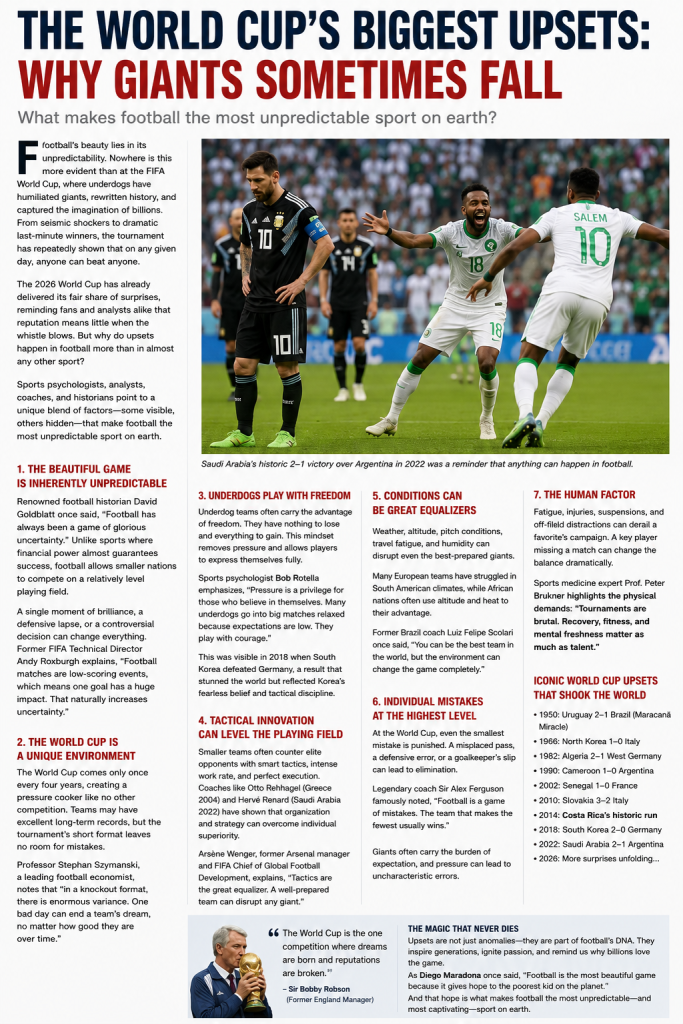
- Saudi Arabia defeating Argentina in 2022.
- Morocco reaching the semifinals in 2022 after defeating several European powers.
These matches remind supporters that football history continually rewards belief over reputation.
Probability Does Not Equal Certainty
Statistical models estimate probabilities.
They never guarantee outcomes.
Mathematician David Sumpter explains that even teams with significantly higher winning probabilities still lose occasionally because football contains inherent randomness.
One deflection.
One mistake.
One moment of brilliance.
Any of these can rewrite history.
The World Cup celebrates precisely that uncertainty.
Lessons for Football Giants
Traditional powers increasingly recognize that preparation matters more than reputation.
Modern football requires:
- Tactical flexibility.
- Mental resilience.
- Physical conditioning.
- Respect for every opponent.
- Continuous innovation.
Former Dutch legend Johan Cruyff famously observed that football is played with the brain.
World Cup history repeatedly confirms his wisdom.
The smartest team often defeats the most famous one.
Why Fans Love the Unexpected
Perhaps football’s greatest strength lies in its unpredictability.
Supporters watch because anything remains possible.
Every underdog carries hope.
Every favorite faces risk.
Sports economist Stefan Szymanski has argued that competitive uncertainty enhances spectator interest because audiences remain emotionally invested when outcomes cannot be predicted confidently.
The World Cup embodies that principle perfectly.
Conclusion: Why Giants Continue to Fall
Why do football giants sometimes fall?
Because football remains beautifully unpredictable.
Its low-scoring nature, psychological intensity, tactical complexity, physical evolution, and global development combine to create a competition where no nation can rely solely on history or reputation.
The FIFA World Cup 2026 continues to demonstrate that preparation, belief, organization, and resilience frequently overcome superior resources and star power. Improvements in coaching, sports science, youth development, and international experience have narrowed the gap between football’s traditional powers and emerging nations.
As David Sumpter’s research illustrates, probability influences football—but it never dictates the final result.
That uncertainty explains why billions of supporters continue to watch every World Cup with anticipation.
Because somewhere, on some unforgettable day, another giant will fall.
And another underdog will remind the world why football remains the most unpredictable sport on earth.