VAR at World Cup 2026: Improving Fairness or Killing the Drama?
Has Technology Made Football Better or More Controversial?
Few innovations in modern football have generated as much debate as the Video Assistant Referee, better known as VAR. Introduced with the promise of eliminating clear officiating errors, VAR has fundamentally transformed the way football is played, officiated, watched, and discussed. Yet, years after its introduction and now firmly established at the FIFA World Cup 2026, the debate remains as intense as ever.
Supporters argue that VAR has made football fairer by correcting obvious mistakes that once decided the fate of nations. Critics counter that it has interrupted the rhythm of the game, diminished spontaneous celebrations, and introduced fresh controversies rather than eliminating them.
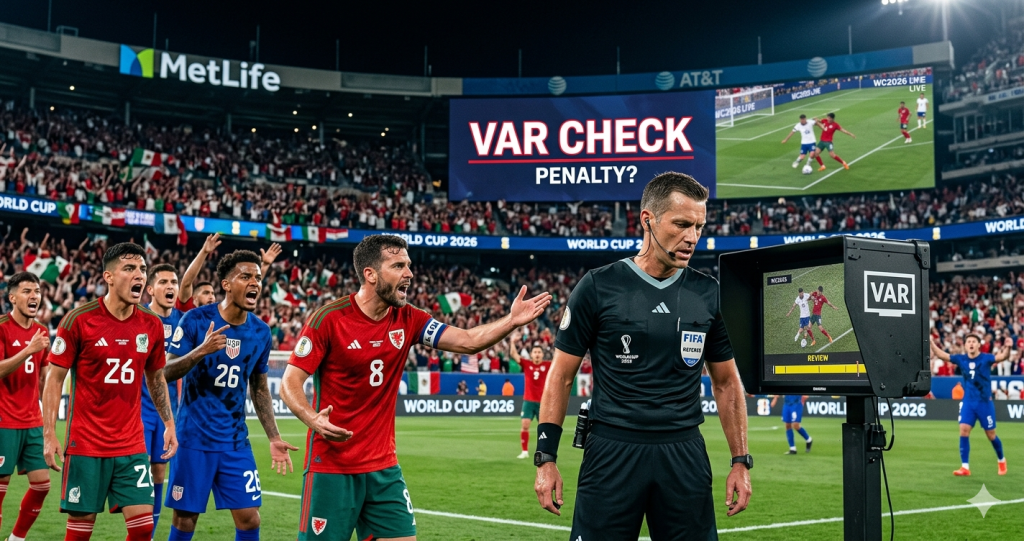
The FIFA World Cup 2026, jointly hosted by the United States, Canada, and Mexico, has once again placed VAR under the global spotlight. Several key decisions during the opening matches have reinforced both its value and its limitations. Every offside call measured by millimeters, every penalty reviewed from multiple camera angles, and every prolonged pause has reignited a fundamental question:
Has technology truly improved football, or has it taken away part of what makes the game beautiful?
The answer lies somewhere between innovation and tradition.
The Birth of VAR
For decades, football relied solely on the judgment of the referee and assistant referees. While most decisions were accurate, mistakes were inevitable.
Several controversial incidents accelerated calls for technological assistance. Among the most famous was the disallowed goal by Frank Lampard against Germany during the 2010 FIFA World Cup. Television replays clearly showed the ball had crossed the goal line, yet the goal was not awarded.
Such incidents intensified demands for reform.
Following extensive testing, FIFA officially introduced VAR at the 2018 FIFA World Cup in Russia, making football one of the last major global sports to embrace video review technology.
Former FIFA referee Pierluigi Collina, one of football’s most respected officials, has consistently explained that VAR was never intended to eliminate every error but rather to correct “clear and obvious mistakes.”
That principle remains central to its application today.
How VAR Works
VAR is designed to assist referees in four specific situations:
- Goals and potential infringements leading to goals.
- Penalty decisions.
- Direct red card incidents.
- Mistaken identity involving disciplinary sanctions.
A team of video officials reviews footage from multiple camera angles while maintaining constant communication with the referee.
When necessary, the referee may review the incident personally using the Referee Review Area (RRA) before making the final decision.
Importantly, VAR does not replace the referee.
It supports the referee.
The final decision always remains with the on-field official.
World Cup 2026 and Enhanced Technology
The FIFA World Cup 2026 has introduced further technological improvements.
Building upon the semi-automated offside technology first used during the 2022 World Cup, FIFA has integrated faster ball-tracking systems, advanced limb-position detection, and artificial intelligence-assisted processing to speed up decision-making.
According to FIFA’s Technical Department, these technologies significantly reduce the time required to determine offside decisions while improving consistency.
The objective is simple: deliver quicker and more accurate decisions without excessively disrupting the flow of matches.
Early matches in the tournament suggest noticeable improvements in review speed compared to previous editions.
Nevertheless, debates continue.
The Case for VAR: Fairness Above All
The strongest argument supporting VAR is fairness.
Football matches often determine careers, national pride, and enormous financial rewards.
Incorrect decisions can alter tournament outcomes.
VAR seeks to minimize those errors.
Former Arsenal manager and FIFA Chief of Global Football Development Arsène Wenger has repeatedly defended technological assistance, arguing that football should embrace innovation if it improves the accuracy of officiating.
According to Wenger, justice must always take precedence over tradition.
This view is shared by many coaches and players who believe that championships should be decided by football rather than officiating mistakes.
Several World Cup matches have already demonstrated VAR’s value by correctly overturning incorrect penalty decisions, identifying offside goals, and preventing cases of mistaken identity.
Without video assistance, those errors would likely have remained uncorrected.

Increased Accuracy in Decision-Making
Independent studies have consistently shown that VAR improves officiating accuracy.
Research published in the Journal of Sports Sciences found that video review systems significantly increase correct decision-making during elite football competitions.
Similarly, FIFA’s Technical Study Group has reported that officiating accuracy at major tournaments has improved substantially since VAR’s introduction.
In elite competition, even a single incorrect decision can define an entire tournament.
From that perspective, improved accuracy represents a significant achievement.
The Human Element Remains
Despite technological advances, football remains a sport officiated by human beings.
VAR provides additional information.
It does not eliminate interpretation.
Questions involving:
- Serious foul play.
- Handball.
- Simulation.
- Excessive force.
still require subjective judgment.
Former referee Pierluigi Collina has frequently reminded observers that technology cannot remove every controversy because football’s Laws often require interpretation rather than simple measurement.
Consequently, disagreements continue even after video reviews.
The Case Against VAR: Losing Football’s Emotion
Critics argue that VAR has changed more than officiating.
They believe it has altered the emotional experience of football itself.
Legendary manager Jürgen Klopp has publicly expressed frustration with lengthy reviews, observing that immediate celebrations have become increasingly cautious.
Supporters often hesitate before celebrating goals.
Players glance toward referees.
Crowds wait.
Only after several seconds—or sometimes minutes—can genuine celebration begin.
Football has always thrived on spontaneous emotion.
Many fear VAR interrupts that unique characteristic.
Does VAR Slow the Game?
Another common criticism concerns interruptions.
Football traditionally flows continuously, distinguishing it from many other sports.
Repeated reviews can interrupt momentum, reduce intensity, and affect tactical rhythm.
Football journalist Jonathan Wilson has argued that while accuracy is desirable, excessive interruptions risk changing football’s essential identity.
The challenge lies in balancing fairness with entertainment.
World Cup 2026 has attempted to address this concern through faster technological processing, but occasional delays remain unavoidable.
Millimeter Offside Decisions
Few aspects of VAR generate more controversy than offside decisions measured by extremely small margins.
Semi-automated technology can detect offside positions involving only centimeters.
While technically correct, many supporters question whether such marginal advantages truly violate the spirit of the game.
Former FIFA President Sepp Blatter has previously suggested that football must ensure technology enhances rather than overwhelms the sport.
The debate illustrates a broader philosophical question:
Should absolute precision always outweigh football’s traditional acceptance of human imperfection?
The Psychological Impact on Players
VAR has also changed player behavior.
Defenders increasingly avoid unnecessary risks inside the penalty area because every incident can be reviewed.
Attackers know that simulation may be exposed.
Sports psychologist Bob Rotella has noted that athletes adapt their decision-making when they know every action is subject to detailed scrutiny.
In this sense, VAR has subtly altered football tactics as well as officiating.
What the Statistics Suggest
Although controversies dominate headlines, statistics indicate that VAR has substantially reduced major officiating errors.
According to FIFA’s post-tournament technical reports from recent international competitions, the percentage of correct match-changing decisions has increased considerably since video review was introduced.
Incorrect goals are rarer.
Mistaken red cards have declined.
Penalty decisions are more accurate.
These improvements demonstrate that VAR has largely achieved its primary objective.
The remaining challenge concerns perception rather than effectiveness.
Football’s Ongoing Evolution
Football has continuously evolved throughout its history.
The sport has adopted:
- Goal-line technology.
- Professional refereeing.
- Performance analytics.
- Semi-automated offside systems.
- Advanced sports science.
VAR represents another stage in that evolution.
Like previous innovations, acceptance has required time.
Many technologies initially criticized eventually became indispensable.
VAR may follow a similar path.
Conclusion: Better, Fairer—but Still Imperfect
Has technology made football better or more controversial?
The evidence suggests both.
VAR has undoubtedly improved the accuracy of officiating, corrected significant mistakes, and strengthened competitive fairness at the FIFA World Cup 2026. Few would wish to return to an era when obvious errors could determine the fate of nations without any possibility of correction.
At the same time, football’s emotional spontaneity has changed. Celebrations are more cautious, reviews occasionally disrupt momentum, and some decisions remain controversial despite technological assistance.
As Pierluigi Collina has wisely observed, the objective of VAR is not perfection but improvement.
Football has always balanced passion with rules, emotion with fairness, and tradition with innovation.
The challenge for FIFA is not whether VAR should exist, but how it can continue evolving to preserve both justice and the unforgettable drama that has made the FIFA World Cup the greatest sporting spectacle on earth.