World Cup 2026’s Most Valuable Teams: The Business Behind the Beautiful Game
Which National Teams Are Worth the Most Financially?
The FIFA World Cup has always been the pinnacle of international football, where nations compete for glory, prestige, and the right to call themselves world champions. Yet behind every spectacular goal, tactical masterclass, and dramatic victory lies another contest that receives far less attention—the financial strength of national teams.
Modern football is no longer defined solely by skill and trophies. It is also driven by economics. Today’s elite national teams represent billions of dollars in player market value, commercial partnerships, broadcasting appeal, merchandising opportunities, and global brand recognition. While national teams themselves are not bought or sold like football clubs, the collective market value of their players and the commercial power they generate have become important indicators of their influence in the global football economy.
As the FIFA World Cup 2026 unfolds across the United States, Canada, and Mexico, questions about football’s financial landscape have become increasingly relevant. Which countries possess the most valuable squads? Why are certain national teams worth significantly more than others? And does financial value actually translate into success on the pitch?
Understanding the economics behind football’s biggest tournament reveals that the World Cup is not only the world’s largest sporting event—it is also one of its most valuable commercial enterprises.
What Makes a National Team Valuable?
Unlike club football, national teams do not have transfer budgets or ownership structures.
Instead, financial value is generally assessed through several interconnected factors:
- The combined transfer market value of players.
- Commercial attractiveness.
- Sponsorship potential.
- Global fan base.
- Broadcasting appeal.
- Merchandising opportunities.
- International brand strength.
Among these, player market valuation remains the most widely accepted benchmark.
According to football finance experts, the collective transfer values of a nation’s players provide a useful measure of the footballing assets available to that country.
Sports economist Stefan Szymanski, co-author of Soccernomics, argues that player valuation increasingly reflects a combination of age, performance, commercial appeal, potential, and scarcity rather than talent alone.
The World’s Most Valuable Squads
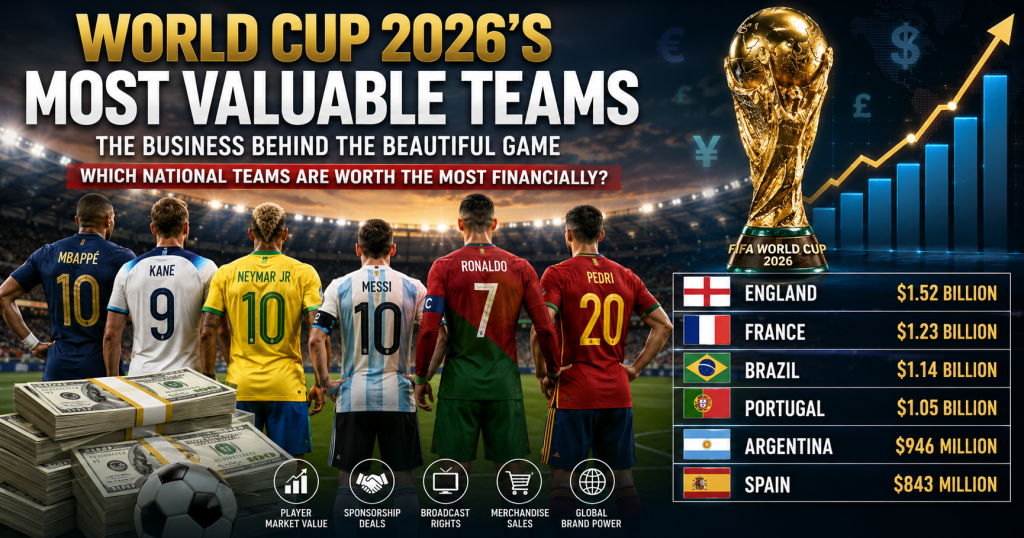
In recent years, several national teams have consistently ranked among the world’s most valuable based on the combined market values of their players.
These include:
- England
- France
- Spain
- Brazil
- Portugal
- Argentina
These nations possess extraordinary depth, with numerous players competing for the world’s richest clubs in the Premier League, La Liga, Bundesliga, Serie A, and Ligue 1.
Football finance platforms such as Transfermarkt and analyses published by leading consultancies consistently place these countries near the top of international squad valuations because they combine elite talent with youth, commercial appeal, and sustained performance.
England: Football’s Billion-Euro Squad
England has frequently entered major tournaments with one of the world’s most valuable national squads.
Its players benefit from:
- The financial strength of the Premier League.
- Elite youth academies.
- High commercial visibility.
- Significant international media exposure.
Stars such as Jude Bellingham, Bukayo Saka, Phil Foden, and Harry Kane contribute not only through performances but also through substantial commercial influence.
According to football finance experts, young elite players command exceptional valuations because clubs are investing in many years of future performance.
France: A Factory of Elite Talent
France remains one of football’s most productive talent-producing nations.
Legendary football historian David Goldblatt has highlighted France’s youth development infrastructure as one of the strongest in world football.
Academies such as those operated by the French Football Federation have consistently produced elite footballers capable of succeeding across Europe’s biggest leagues.
Players including Kylian Mbappé continue to drive France’s enormous collective squad valuation.
Youth, versatility, and international recognition combine to make France one of football’s most commercially valuable national teams.
Brazil: Global Football’s Most Powerful Brand
No country possesses a richer footballing identity than Brazil.
Five World Cup titles, legendary players, and an unmatched football culture have transformed Brazil into one of the sport’s most recognizable global brands.
Icons such as Pelé, Ronaldo Nazário, Ronaldinho, and Neymar have contributed to decades of worldwide commercial appeal.
Although player valuations fluctuate from tournament to tournament, Brazil’s commercial value extends far beyond transfer fees.
Its football brand attracts sponsors, broadcasters, apparel manufacturers, and supporters across every continent.
Argentina’s Financial Renaissance
Following its triumph at the 2022 FIFA World Cup, Argentina experienced renewed commercial momentum.
The influence of Lionel Messi dramatically expanded the team’s global visibility.
Commercial partnerships increased.
Merchandise sales rose.
International fan engagement reached unprecedented levels.
Economists often note that sporting success directly influences commercial performance.
Winning creates visibility.
Visibility attracts investment.
Investment strengthens football infrastructure.
Argentina provides an excellent example of that cycle.
Why Player Market Values Matter
Player valuations influence football in numerous ways.
High-value players typically generate:
- Greater sponsorship opportunities.
- Increased media attention.
- Stronger merchandising sales.
- Higher television audiences.
- Greater ticket demand.
Sports economist Stefan Szymanski argues that football increasingly functions as an entertainment industry in which elite players operate as valuable global assets.
Their influence extends beyond sporting performance into marketing, broadcasting, and international business.
The Commercial Ecosystem Around National Teams
National teams generate revenue through multiple channels.
These include:
Sponsorship Agreements
Major global companies invest heavily in partnerships with successful football nations.
Sportswear manufacturers, airlines, financial institutions, and technology companies compete for association with internationally recognized teams.
For sponsors, visibility during the FIFA World Cup provides extraordinary global exposure.
Broadcasting Rights
The World Cup remains one of the most watched sporting events in history.
Broadcasters invest billions of dollars to secure television and streaming rights because of enormous global audiences.
Popular national teams often attract especially high viewing figures.
Merchandise
Replica jerseys, scarves, hats, and memorabilia generate substantial revenue.
Successful tournaments frequently trigger dramatic increases in merchandise sales.
Football supporters around the world purchase national team apparel as expressions of identity and loyalty.
Does Financial Value Guarantee Success?
Perhaps surprisingly, the answer is no.
Football repeatedly demonstrates that expensive squads do not always win tournaments.
The FIFA World Cup rewards preparation, tactical organization, teamwork, and resilience.
Sports psychologist Bob Rotella has long emphasized that confidence, discipline, and collective belief frequently determine elite performance more than reputation alone.
Recent World Cups have produced remarkable performances from nations whose collective market values were significantly lower than those of traditional powers.
Examples include:
- Croatia reaching the 2018 final.
- Morocco reaching the 2022 semifinals.
These achievements illustrate that financial resources provide advantages but not guarantees.
Youth Development Creates Long-Term Value
Former Arsenal manager and FIFA Chief of Global Football Development Arsène Wenger has repeatedly argued that sustained success depends upon developing young players rather than relying solely on established stars.
Nations investing consistently in youth academies tend to generate higher-value squads over time.
Successful development systems improve:
- Player quality.
- Transfer value.
- National competitiveness.
- Commercial attractiveness.
The world’s most valuable national teams almost always possess outstanding youth development structures.
The Economic Impact of World Cup Success
A successful World Cup campaign extends far beyond football.
Economic studies have shown that international success can stimulate:
- Tourism.
- Consumer spending.
- Sports participation.
- Sponsorship investment.
- Global brand recognition.
While economists caution against overstating the long-term macroeconomic effects of sporting success, they generally agree that major tournaments significantly enhance international visibility.
For emerging football nations, a successful World Cup can permanently alter global perception.
The Future of Football Finance
The FIFA World Cup 2026 reflects broader trends transforming football economics.
Artificial intelligence, data analytics, global scouting networks, digital broadcasting, and social media have expanded football’s commercial reach.
Today’s most valuable national teams combine:
- Elite talent.
- Strong football institutions.
- Commercial appeal.
- Global fan engagement.
- Sustainable player development.
These factors increasingly determine financial strength alongside sporting performance.
Conclusion: Value Beyond the Price Tag
Which national teams are worth the most financially?
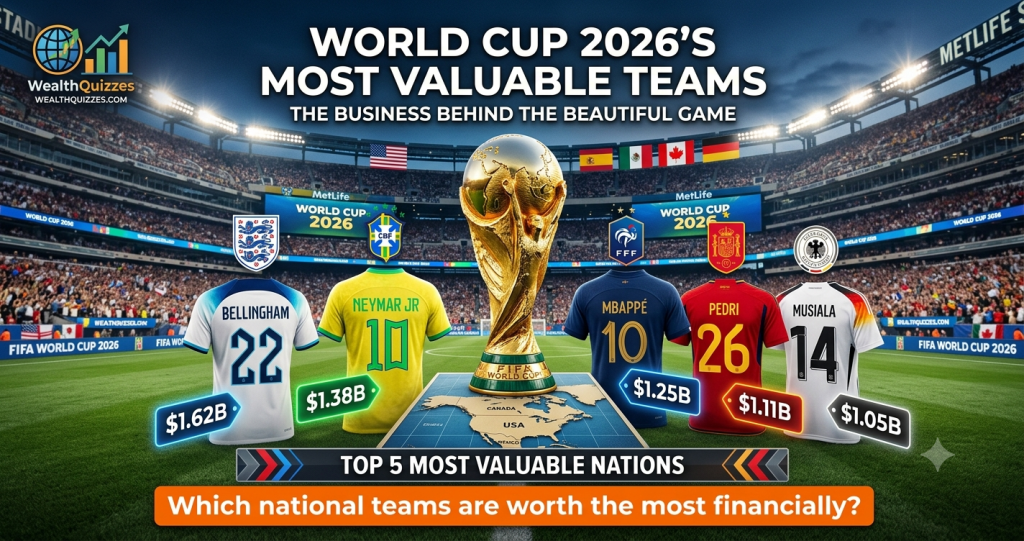
Measured by collective player valuations and commercial influence, countries such as England, France, Brazil, Spain, Portugal, and Argentina continue to dominate football’s financial landscape.
Yet the true value of a national team extends beyond transfer fees.
It includes its history, culture, global appeal, youth development, commercial partnerships, and ability to inspire millions of supporters around the world.
As David Goldblatt has argued, football is simultaneously a sport, a business, and a cultural force.
The FIFA World Cup 2026 illustrates that reality perfectly.
Behind every match lies a sophisticated economic ecosystem involving billions of dollars, worldwide audiences, and some of the most valuable sporting assets on earth.
Ultimately, while trophies determine champions, financial strength helps shape the future of the beautiful game.